Battery or Alternator? A Quick Flow to Tell Which Is Causing Multiple Lights
Jan 30, 2026 • 9 min
Few things are more stomach-dropping than your dash lighting up like a Christmas tree while you're trying to get somewhere. When multiple warning lights appear — battery, ABS, check engine — it's usually the electrical system throwing a tantrum. The two most common culprits are the battery and the alternator. The trick is knowing which one, fast.
This is a practical,0-no-fluff decision flow: what to watch for, a handful of quick tests (yes, including what to read on a multimeter), safe temporary fixes, what to do with hybrids/EVs, and ballpark repair costs so you don't get caught off guard.
The short version (read in 30 seconds)
- Car won't crank at all, or just clicks → 99% battery.
- Car cranks but dies after a few minutes → likely alternator.
- Engine running, battery voltage below ~13V → alternator or regulator problem.
- Engine off, battery below ~12.4V → battery weak or dead.
- Jump-start that works but the car dies again within 10–15 minutes → alternator.
Now let’s walk through it like I would in the passenger seat, calm and practical.
How these two parts actually behave
Quick refresher so the rest makes sense:
- Battery: provides the surge to start the car and powers accessories when the engine is off.
- Alternator: generates electricity once the engine is running and recharges the battery.
They’re a team. One can hide the other’s problem for a little while, but symptoms and simple voltage checks will point you to the guilty party.
The decision flow — step by step
Step 1 — What happened when you turned the key?
This is the single fastest clue.
- Engine doesn't crank or just clicks: battery is the likely suspect. A dead or heavily discharged battery can't spin the starter.
- Engine cranks slowly: battery is weak, or connections are poor. Could also be a mostly-dead battery that the alternator hasn’t been charging.
- Engine starts, then dies after a minute or two: alternator. The battery had enough juice to start, but the alternator isn’t keeping things running.
- Engine starts fine and runs, but battery light stays on: alternator or voltage regulator is suspect.
I’ve seen this enough times to trust starting behavior more than any smell or loose wire guess.
Micro-moment (a tiny detail I remember)
When a coworker’s coupe quit at a stoplight, the dash lights dimmed then popped back bright when she revved it. That bright-when-revving moment is almost always the alternator saying “I’ll work if you make me.” It stuck with me because revving fixed nothing long-term, but it was a clean diagnostic clue.
Step 2 — Look at the lights and accessories while driving
Multiple lights are useful signals, not just annoyances.
- If everything is consistently dim (headlights, interior lights, windows slow), especially before you start the car: battery.
- If lights flicker, brighten when you rev, or dim when you turn on AC or blower: alternator or voltage regulation problem.
- If one accessory fails while others are fine: possibly a specific circuit issue, not the whole charging system.
Pay attention to whether the brightness changes with engine speed. That’s the alternator’s signature.
Step 3 — Visual checks (30 seconds)
- Battery: check terminals for white/green/blue corrosion, look for a swollen or cracked case, smell for rotten-egg odor (rare but real), note age — batteries over 3–5 years are suspect.
- Alternator area: inspect the serpentine belt for cracks or looseness, smell for burning rubber, look for oil or coolant on the alternator (contamination shortens life).
- Warning lights: if the battery/ALT light is on, that’s your lead.
Don’t pry things open under the hood unless you know what you’re doing. Visual clues narrow the problem but don’t replace a voltage check.
Step 4 — The multimeter check (the definitive quick test)
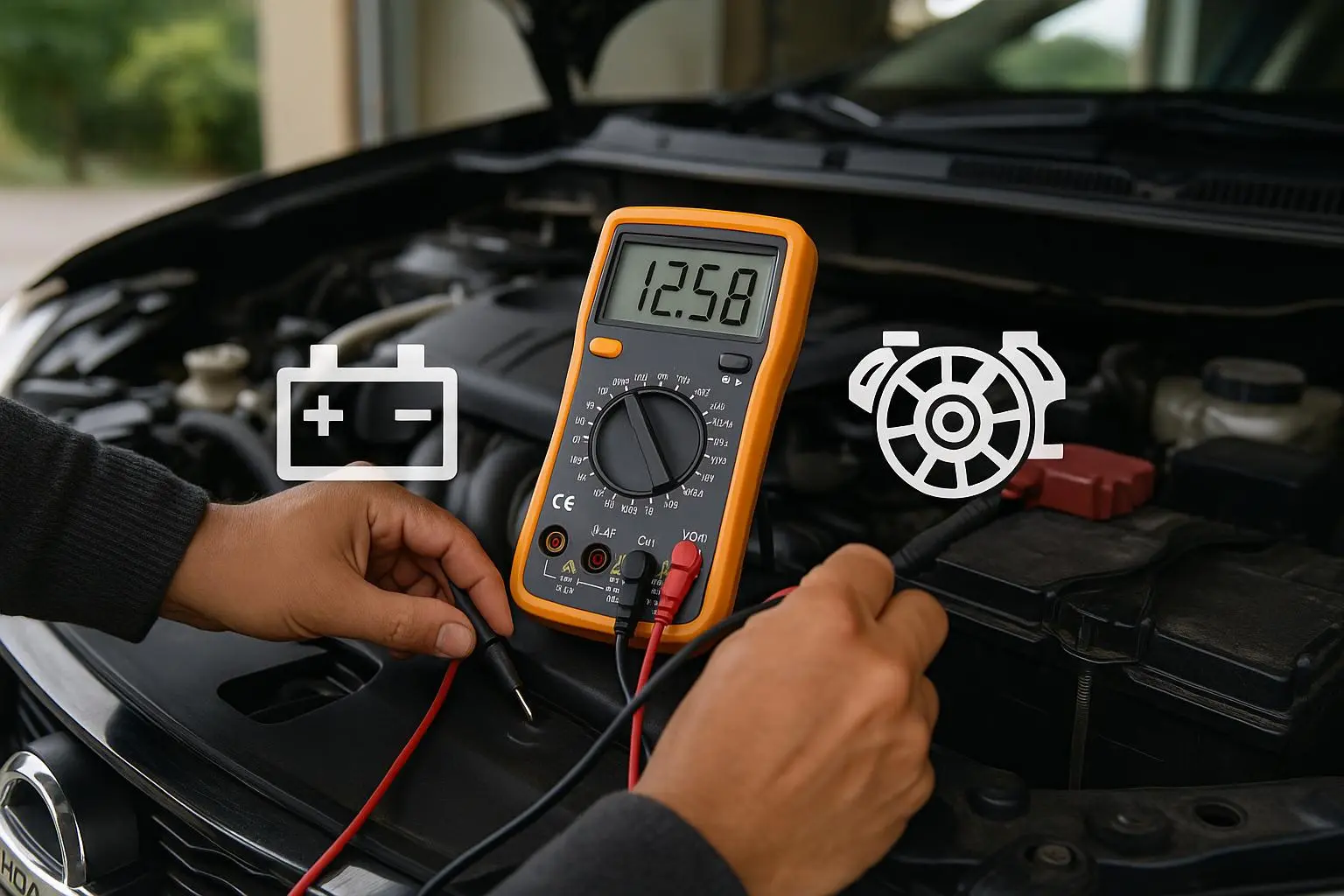
If you have a basic multimeter (under $20), this will save you a tow more often than not. If you don’t, consider asking for a quick voltage check at a nearby shop or AAA.
- With engine off: measure battery voltage between the positive and negative terminals.
- ~12.6V = fully charged.
- 12.4V = about 75% charge.
- 12.0V or lower = discharged; below ~10V is very low/dead.
- With engine running: measure again.
- 13.8–14.7V = alternator charging normally.
- Below ~13.0V = alternator not charging properly.
- Above ~15.0V = voltage regulator overcharging; can damage electronics and the battery.
If the engine-off reading is low and the engine-on reading jumps into the 13.8–14.7 range, the alternator is charging; the battery likely needs replacement. If both readings are low, the alternator might not be charging.
Real test-case story (100–200 words)
One rainy night my own hatchback refused to start after a long grocery run. It clicked, no crank. I used jumper cables from a stranger — got it started, drove home, and it died again the next morning. I kept a cheap multimeter in the glove box (because of past trouble) and checked: 11.8V engine-off, and 12.1V engine-on. That told me two things: battery was weak and the alternator barely registered. The mechanic confirmed: a tired battery and a slipping belt had left the alternator underperforming. Total cost was $420 — new battery $140, belt and labor the rest. I learned two things: carry a multimeter and don't ignore a weak crank. That afternoon could’ve been a tow.
Jump-starting: how to use it as a diagnostic (and what not to do)
A jump-start gets you going, but treat it as a test.
- If jump-starting gets the car running and it stays running afterward: probably a dead battery that will hold charge (but still test it).
- If it dies within 10–15 minutes after being jumped: alternator likely the problem.
- If it runs but electrical gremlins persist (flickering, battery light stays on): alternator or voltage regulator.
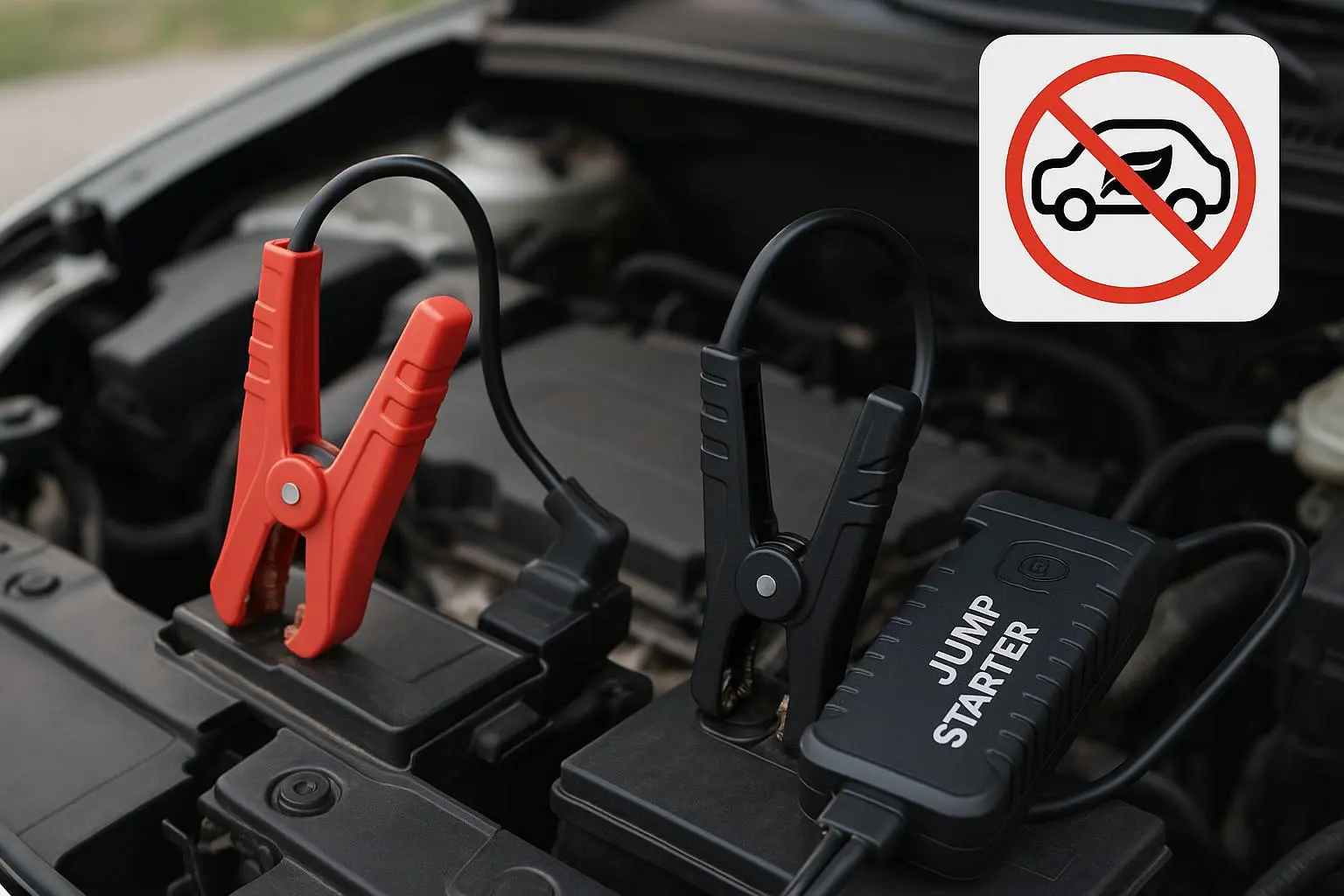
Important: Do not attempt DIY jumps on hybrids/EVs except where the owner's manual explicitly provides safe 12V jump points. Those cars have sensitive high-voltage systems; a mistake can be expensive or dangerous. Call roadside assistance.
Temporary driving tips while you get help
If you suspect the alternator but the car is running:
- Turn off non-essential electronics (radio, seat heaters, extra lights).
- Keep speed moderate; avoid stop-and-go where accessories are used more.
- Drive straight to a repair shop — don’t run errands. If the battery is weak but it starts:
- Drive for at least 20–30 minutes to give the alternator a chance to recharge (if alternator is healthy).
- Have the battery load-tested soon.
These are stopgaps, not fixes.
Urgency ranking — how worried should you be?
- Car won’t start at all → Critical. Don’t leave it. Replace battery or arrange tow.
- Car starts then dies in minutes → Critical. Alternator likely; don’t drive. Tow to shop.
- Consistent dimming or slow crank → High. Get it tested within 24 hours.
- Occasional single light with otherwise normal driving → Medium. Schedule a check within a week.
- Terminal corrosion only → Low. Clean terminals, monitor performance.
Estimated repair costs (ballpark)
- Battery replacement (standard): $100–$200.
- Battery (premium/AGM or specialty): $200–$400.
- Alternator replacement (parts + labor): $600–$1,500 typical. Cheaper with remanufactured parts; labor varies wildly by vehicle.
- Serpentine belt replacement: $225–$575.
- Diagnostic fee (shop): $50–$150 (often waived if you get repair done there).
If a shop replaces a battery and the problem persists, insist on a charging-system test — you might otherwise pay for the same mistake twice.
When to stop DIY and call a pro
- If you smell burning or see smoke.
- If jump-starting doesn’t help or the car dies again soon after.
- If you’re dealing with hybrids/EVs.
- If the battery light stays on even when tests show normal voltage (that can be wiring, regulator, or sensor issues).
- If you’re unsure how to safely perform tests.
Professionals have load testers and scope tools that find intermittent faults you can’t easily catch on the roadside.
Can a bad alternator ruin a new battery?
Short answer: yes. If an alternator is overcharging or undercharging, it can reduce battery life dramatically. Overcharging cooks the battery; undercharging leaves it sulfated and weak. So if you replace a battery without fixing the alternator issue, you might be back in a month.
Hybrid and EV specifics (don’t wing it)
- Hybrids/EVs have a 12V system that operates accessories and certain control systems. A dead 12V can prevent the car from starting or engaging the main system.
- Never jump the high-voltage system. Follow the owner’s manual for 12V jump points.
- For any high-voltage system warnings, contact a dealer or certified EV technician. Towing needs to be EV-aware (flatbed recommended).
Preventive maintenance (what actually saves money)
- Test your battery annually, or before winter.
- Replace batteries every 3–5 years as a rule of thumb.
- Inspect the serpentine belt every 6 months.
- Clean terminals when you see corrosion.
- Install a quality battery and, if you have many accessories, consider an AGM battery if the vehicle calls for it.
- If you notice flicker or dimming, get a charging system test before replacing parts.
Small, regular checks cost pennies compared to a tow plus unexpected alternator replacement.
Final practical checklist (what to do right now)
- Note exactly what happened when you turned the key (click, slow crank, starts then dies).
- Do a quick visual check (corrosion, belt condition).
- If safe and you have a multimeter: check battery with engine off, then with engine running.
- If you don’t have a multimeter, jump-start only if you’re confident; otherwise call for roadside help.
- If the car dies after a jump, it’s almost certainly the alternator — call a tow.
- For hybrids/EVs, call roadside assistance immediately.
A little methodical observation and a 60-second voltage check will save you guessing and replacing the wrong part.