How Much Oil Is Too Much? Precise Thresholds, Real Risks and Repair Costs
Jan 16, 2026 • 9 min
You topped the oil a little aggressively and the dipstick reads over "full." Panic mode: on. But how bad is it, exactly?
Here's the short answer: up to about 0.5 quart over full is usually a safe buffer. Beyond that, the risk curve climbs fast. At 1 quart you're in trouble territory; at 2+ quarts you're flirting with catastrophic damage. Below I walk through thresholds, what to look for, how to test, a decision flow for driving now vs. draining now, and realistic repair costs if things go wrong.
I keep this practical—no fluff, no fear-mongering. Just what mechanics and data-backed sources tell us, and the real outcomes I've seen.
Why a little too much oil matters
Engines are designed for a specific oil volume. The oil pan, pickup, and crank clearance assume that amount so the crank spins without churning oil into foam.
Add too much oil and the crank can hit the surface, whipping oil into froth. Aerated oil doesn't lubricate well. That raises friction, heat, and wear.
Excess oil also raises crankcase pressure. That pressure finds the weakest paths: seals, gaskets, and the PCV system. Oil ends up where it shouldn't—intake, combustion chamber, and exhaust—creating smoke, fouled plugs, and a poisoned catalytic converter.
Think of the engine like a precise recipe: a cup too much liquid changes the outcome. Sometimes the dish survives; sometimes the oven explodes.
The thresholds that matter (and what they actually mean)
These are practical cutoffs based on industry guidance, mechanic consensus, and reported cases.
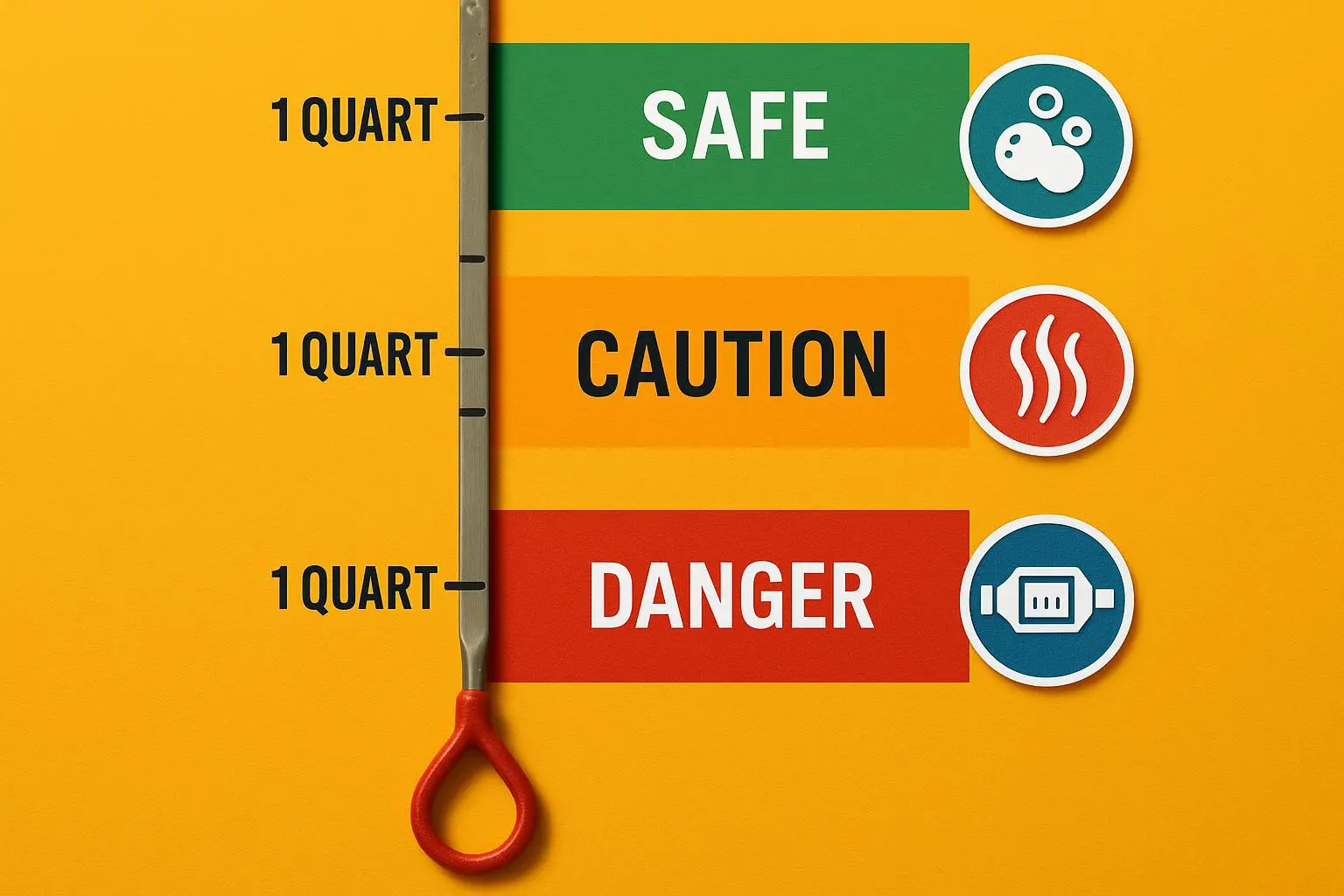
- Up to 0.5 quart over "full": generally safe. Low risk.
- 0.5–1.0 quart over: risky. Foaming and pressure issues likely.
- 1.0–2.0 quarts over: high risk. Oil can get into combustion, PCV, and cat.
- 2.0+ quarts over: emergency. Potential for internal damage, hydrostatic lock, and catastrophic failures.
Now for the why and the symptoms.
Up to 0.5 quart over full
Risk level: Low to moderate.
Most modern engines have a small buffer. If the dipstick is a fraction over the mark (think 1/4 inch or about 0.25–0.5 qt depending on pan size), you're usually OK to drive but keep an eye on it. Drain a little if you can—but it's not a mechanical emergency.
What to watch for: faint burning smell after the engine heats up, and recheck the level after a few drives.
0.5–1.0 quart over full
Risk level: Moderate to high.
This is where the crankshaft may start to contact the oil surface. Foaming and aeration increase. Lubrication efficiency drops and crankcase pressure rises. Seals and gaskets take more stress.
Symptoms that commonly appear:
- Burning oil smell
- Slight blue/white smoke at startup or under load
- Slight drop in performance or rough idle
- Possible oil leaks around valve covers or seals
Action: Drain the excess. Don’t let this sit for long.
1.0–2.0 quarts over full
Risk level: High.
Now oil can be sucked into the PCV system, the intake, and into combustion chambers. Spark plugs foul. The catalytic converter begins to clog with oil-derived deposits. Aeration seriously compromises oil pressure and lubrication.
Symptoms:
- Noticeable blue or white smoke from the tailpipe
- Check Engine Light (often from converter efficiency or misfires)
- Strong burning oil smell
- High or erratic oil pressure on vehicles with a gauge
- Visible oil leaks
Action: Do not drive more than necessary. Drain immediately and get a professional inspection (PCV, plugs, cat).
2.0+ quarts over full
Risk level: Extremely high — stop everything.
You're in danger of hydrostatic lock (oil filling cylinders), bent rods, or severe bearing damage from lack of proper lubrication. The catalytic converter will likely be damaged beyond cleaning.
Symptoms:
- Thick, continuous blue smoke
- Engine knocking or loud noises
- Stalling or failure to start
- Heavy oil puddles
Action: Do not start the engine. Have it drained and inspected immediately.
Symptoms to watch for — quick checklist
- Blue or white-tinged smoke from the exhaust
- Strong burning-oil smell after driving
- Foamy or frothy oil on the dipstick
- Visible oil leaks under the car
- Rough idle, misfires, or loss of power
- Check Engine Light related to emissions or misfires
- Unusually high oil pressure readings
Micro-moment: the first time I smelled burning oil after a quick highway run, I chalked it up to a spill. Two days later it was blue smoke at idle. The dipstick looked frothy—instant "I should’ve checked that first" regret.
How to measure the overfill correctly
Accuracy matters. A sloppy check gives false alarms or false comfort.
- Park on level ground.
- Check with the engine cold for the cleanest reading (or follow your manual—some manufacturers prefer warm checks).
- Pull the dipstick, wipe it clean, reinsert, wait, then read.
- Repeat the wipe-and-read process 2–3 times to confirm.
- Measure how far above the "full" mark the oil reaches. On many dipsticks, 1/4 inch over the mark is small; 1/2 inch is notable. The actual quart equivalent depends on pan capacity, but the general thresholds above hold.
If you must estimate: on most passenger cars, 1/4–1/2 inch over is roughly 0.25–0.5 qt; 1 inch can be close to 1 qt. Your owner's manual may list exact pan capacity.
Simple tests: how to tell if overfill has already done damage
- Dipstick look: foamy, milky, or frothy oil = aeration.
- Spark plugs: remove one plug and check for oil fouling (black, oily deposits).
- PCV check: if PCV valve is oily or stuck, that's a sign oil is getting into ventilation.
- Tailpipe inspection: oil droplets or heavy blue smoke indicates oil consumption.
- OBD scan: pending codes for misfires or catalytic efficiency loss suggest combustion/exhaust contamination.
Tools that help: a fluid extractor pump to remove measured amounts safely, and an OBD2 reader to check for CEL codes tied to emissions or misfires.
Decision flow: drive, monitor, or stop
Here’s a practical decision tree.
- Less than 0.5 qt over and no symptoms: monitor. Drive gently, recheck after a few trips. Drain when convenient.
- 0.5–1.0 qt over or any symptoms present: drain excess ASAP. Don’t put off.
- 1.0+ qt over or obvious smoke/leaks/CEL: stop driving except to move to a safe spot. Drain and get a professional inspection.
- 2.0+ qt over: do not start. Tow to a shop for inspection and drain.
Your mechanic’s mantra I like: "When in doubt, drain it out."
How to remove excess oil safely (DIY options)
- Use a fluid extractor pump to pull oil from the dipstick tube. It’s clean and controlled.
- Loosen the drain plug slightly and let a small amount trickle out into a pan—only if you’re comfortable doing so and know how much is needed.
- Many quick-lube shops will remove a bit for free if you ask.
If you’ve driven and suspect contamination (smoke, plugs fouled), don’t just drain—ask for PCV check, plug inspection, and possibly an oil and filter change.
Real repair-cost scenarios (what people actually paid)
These are realistic ranges, not scare tactics. Prices vary by vehicle and region.
- PCV valve and small hose replacement: $100–$400
- Valve cover gasket or minor seal repairs: $300–$1,500 (rear main seals on some cars are expensive)
- Catalytic converter replacement: $1,000–$3,000+ (some cars cost much more)
- Major engine repair or replacement (rod bearings, hydrostatic lock damage): $3,000–$8,000+
Example: a forum user who ran a car for a week with ~1.5 qt over replaced their catalytic converter and paid about $2,500. Another who caught a 0.75 qt overfill drained it, replaced a PCV valve and cleaned the intake: cost under $300.
The takeaway: a small, prompt correction costs a few dollars or the price of an extractor pump. Ignoring it can cost thousands.
Special notes for turbocharged and diesel engines
Turbo engines and diesels often have different clearances and tighter tolerances. Turbos can fling oil into intake and intercooler systems, making contamination worse. Diesel engines can produce heavier residues. Lean toward caution: if you’re over by 0.5 qt or more in these engines, drain immediately and inspect.
Prevention habits that actually work
- Add oil slowly: half-quart increments, then recheck.
- Keep a funnel and a measured bottle—don’t pour from a jerrycan and guess.
- Mark the last oil change volume in a service log or app.
- Use a fluid extractor in your garage—$30–$100 and it pays for itself the first time.
- Park level and check oil the same way every time.
I learned this the hard way: one winter night I added oil under glare from a shop light and guessed. The dipstick read a hair over. I drove the next day, noticed sluggish revs, then blue smoke. I drained about a quart and replaced a PCV valve—$220 and ten minutes of worry that could have been avoided by adding slowly. Lesson: slow is fast.
Final checklist before you drive
- Dipstick: how far over full?
- Any smoke or burning smell?
- Any leaks under the car?
- Any CEL codes?
- Engine noises unusual?
If two or more answers are "yes," drain and inspect before driving.