Inflate or Not? When Higher PSI Helps — and When It Hurts
Jan 27, 2026 • 10 min
We’ve all seen it: the tire sidewall screaming "MAX PSI 44" while the sticker on the door jamb recommends 32. That gap sparks the classic question—if I pump my tires a little harder than the placard, will I burn less gas?
Short answer: sometimes. The bigger answer: it depends on the vehicle, the load, the road, and how much risk you’re willing to accept for a handful of MPG (or fractions of one).
I’ll show you the physics, the practical math, real-world trade-offs, and a simple decision checklist you can use before you twist that pump. I’ll also tell one honest story from my own car (spoiler: I learned the hard way).
Why tire pressure affects fuel economy at all
Tires use energy when they roll. Part of that energy turns into forward motion. Part of it is lost—mainly through the tire flexing and heating up. That loss is rolling resistance.
Lower pressure → more flex → higher rolling resistance → your engine works harder → worse MPG.
Raise the pressure a bit and you reduce that flex. Fewer losses. Slightly better MPG.
The U.S. Department of Energy and multiple lab studies show the direction clearly: underinflation costs fuel. Overinflation reduces rolling resistance too, but the benefits shrink quickly and other problems appear: worse traction, harsher ride, uneven wear, and extra stress on suspension and brakes.
How much MPG are we talking about?
Numbers matter, because nobody wants vague "it helps a little."
- Labs and industry tests put the effect of underinflation at roughly 0.2%–0.5% per 1 PSI, across all four tires, for fuel consumption. That’s a range drivers see commonly cited.
- A rule-of-thumb: 1 PSI lower than recommendation costs you about 0.2%–0.5% in MPG.
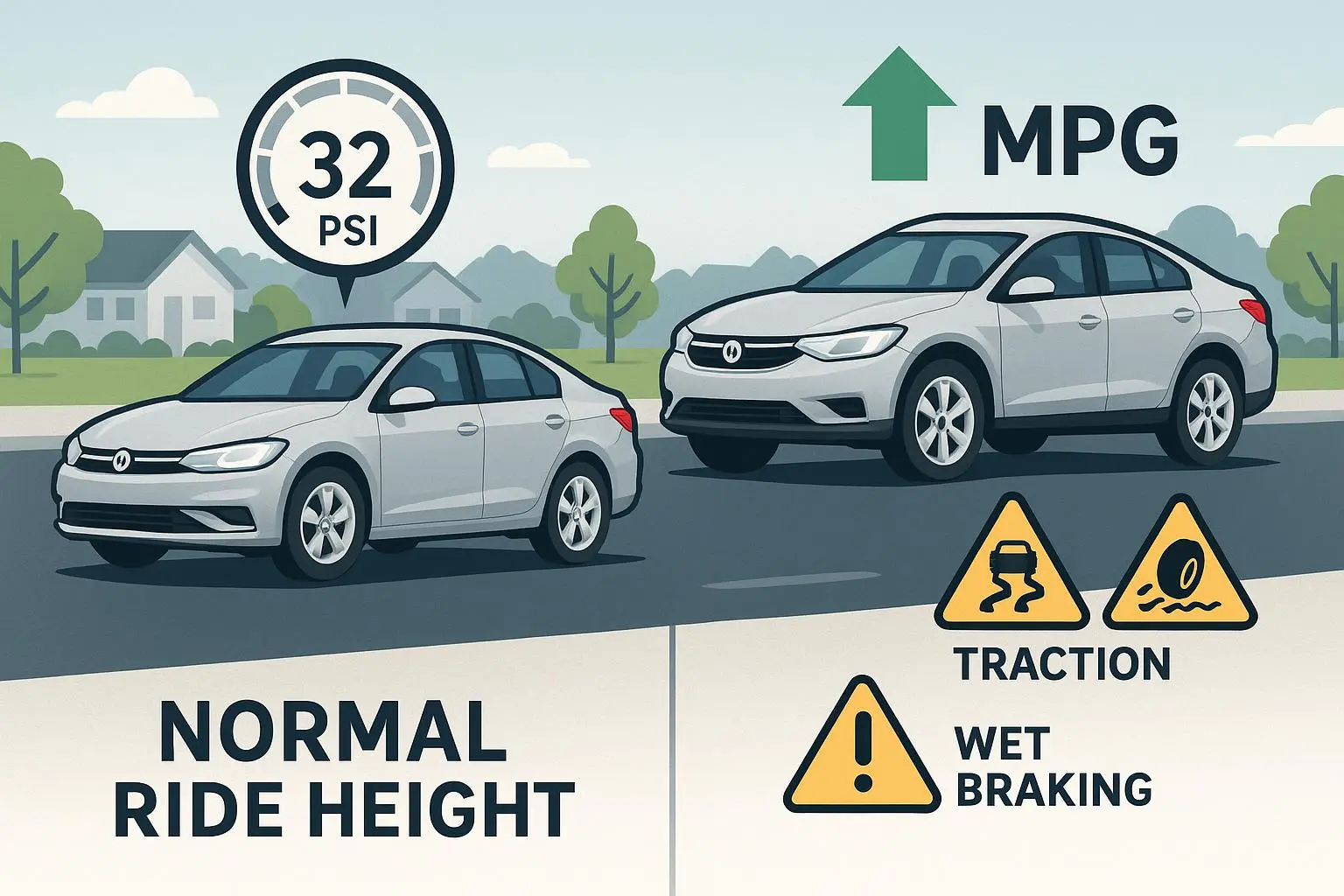
- Going the other way, adding 4–5 PSI above placard might give you roughly 1–2% better fuel economy. On a 30 MPG car, that equals roughly 0.3–0.6 MPG.
- Annual impact for a typical driver (15,000 miles) is small—often $20–$60 per year, depending on fuel price and how much you overinflate.
Those are averages. Your ride, tires, and driving mix change the math. Highway driving amplifies the small gains because rolling resistance is a larger share of losses at steady speeds.
The safety and wear trade-offs (the real cost)
Here’s where people get sentimental about a decimal point of MPG and forget the consequences.
- Traction: Overinflation reduces the contact patch. That increases braking distance and reduces grip in wet or slippery conditions.
- Handling: A tire that’s too stiff reacts poorly during sudden maneuvers. You’ll feel the car as "skittish" or twitchy.
- Ride comfort: Higher PSI transmits more road shock to the chassis and occupants.
- Tire wear: Overinflation causes center-tread wear; underinflation wears the shoulders. Both shorten tire life.
- Mechanical stress: Concentrating load on a smaller area can transfer more shock to shocks, struts, and suspension bushings. Over years, that adds repair cost.
There’s also a regulatory or practical fence: never exceed the maximum cold inflation pressure printed on the tire’s sidewall. That’s a hard physical limit. The door-jamb placard, however, is the vehicle manufacturer’s engineered recommendation for ideal balance.
Door-jamb number vs. sidewall MAX — which to use?
Simple: the door-jamb is the manufacturer’s recommended cold PSI for your vehicle and usual loads.
The sidewall MAX is the tire manufacturer’s maximum safe pressure for that tire, not a suggested setting for everyday driving.
Use the door-jamb number for normal driving. Use the sidewall MAX only as an absolute upper bound and only when you understand why you’re approaching it (e.g., certain load charts for towing). Do not confuse the tire max with a recommended target.
When higher PSI can make sense
There are clear, limited cases where adding a few PSI is defensible.
- Sustained highway cruising (70+ mph): A 1–2 PSI increase can lower rolling resistance slightly with negligible traction consequences in dry conditions.
- Fully loaded vehicle (passengers + cargo + towing): The manufacturer’s load chart often recommends higher pressures. This isn’t about MPG; it’s about stability and preventing excessive sidewall flex.
- Short-term trip optimization: If you have a long, empty highway run in good weather and want the tiniest MPG edge, a controlled +1–2 PSI is a reasonable, reversible tweak—if you reset afterward.
- Fleet or commercial operations where tight data logging shows consistent gains and technicians monitor tire wear and braking performance.
If you try any increase, keep it small (1–3 PSI), keep it within the tire's MAX, and monitor handling and wear.
When higher PSI is a terrible idea
- City stop-and-go driving: the fuel benefits vanish and ride/traction penalties matter more.
- Wet, icy, or snowy roads: more contact patch is better; higher PSI reduces grip.
- Heavily potholed roads: overinflated tires transmit shocks that can damage wheels and suspension.
- When you can’t reliably check and re-set pressure: if you’ll forget and never bring pressures back, don’t start.
A quick, practical math example
Let’s say you drive a 30 MPG compact sedan and are thinking about increasing from 32 PSI (placard) to 36 PSI (+4 PSI).
Estimate: 0.25% fuel economy gain per PSI → 1% total gain.
- 30 MPG × 1% = 0.3 MPG; new average ~30.3 MPG.
- Over 15,000 miles a year: 15,000 / 30 = 500 gallons baseline. At 30.3 MPG, 15,000 / 30.3 ≈ 495.05 gallons. You save ~5 gallons/year.
- If gas is $4.00/gal, that’s $20/year saved.
Compare that with the downsides: possible earlier tire replacement, reduced safety margin, stiffer ride. For most people, $20/year isn’t worth it.
How temperature plays into PSI
Air expands with heat. A cold morning reading will be lower than the same tire hot after highway driving.
A general rule: expect about ±1 PSI for every 10°F change in ambient temperature. Check tires cold (car parked for several hours or first thing in the morning) and base adjustments on the cold reading.
That means a +3 PSI tweak you make in a 40°F morning might be +5 or +6 PSI once temperatures rise—so plan for the extremes.
Micro-moment: I once dialed my pressures to a "perfect" +3 PSI on a chilly morning—then hit a 90°F afternoon. Sidewall readouts climbed, and the steering felt oddly light. Lesson: don't make big permanent changes based on a single morning reading.
Practical rules: the decision checklist
Here’s the checklist I actually use before changing tire pressure. I’ve run it for years on my personal cars and for a small fleet at a previous job. It keeps me from chasing decimal-point savings and getting burned.
- Look at the door-jamb placard. This is your baseline.
- Check the tire sidewall for MAX PSI. Never exceed it.
- Consider load: full cargo/towing? Add PSI per the vehicle load chart—this is safety, not fuel economy.
- Consider conditions: wet, icy, urban? Leave it alone. Highway and dry? You can consider +1–2 PSI.
- Keep changes small: 1–3 PSI maximum for passenger vehicles, unless the manual says otherwise.
- Record baseline MPG for a week before and after any change. Measure, don’t guess.
- Revert to placard for daily driving and wet/icy conditions.
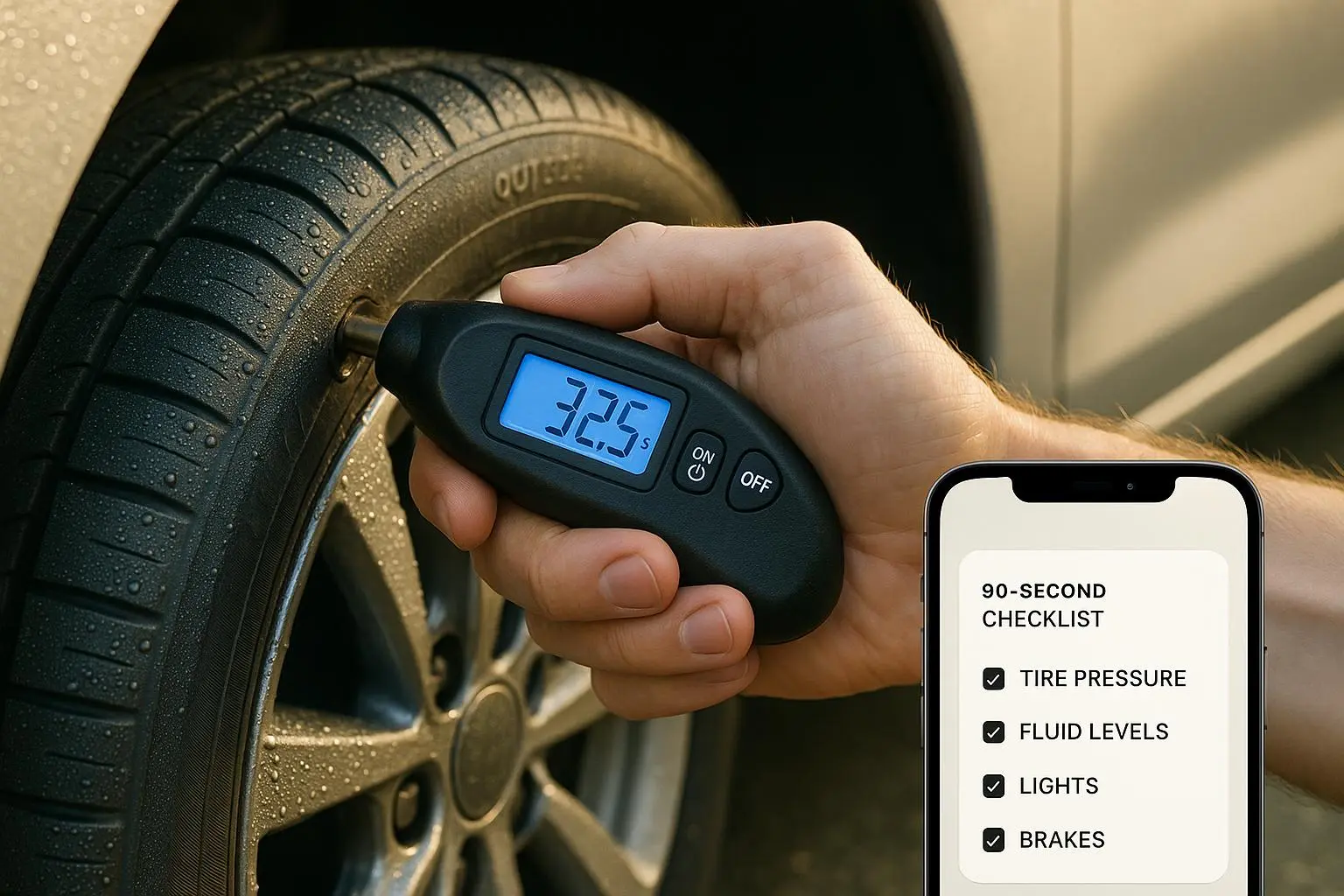
- Check tires monthly and after major temperature swings.
My story (100–200 words)
Two summers ago I decided to squeeze efficiency out of my daily commute. My Civic was doing 34 MPG highway, the door sticker called for 33 PSI, and the tires were good. I upped all four tires to 37 PSI (+4). The first week, steady 75-mph highway drives showed a 0.4 MPG bump—sounds great.
Two weeks in, after a rainstorm, I braked for a box that had fallen off a pickup. The car felt lighter underfoot; I took longer to stop. That nervous feeling was enough. I pulled the tires back to 33 PSI and ordered a digital gauge so I’d never guess pressure again. The tiny fuel gain wasn’t worth the extra braking distance I experienced. I kept the gauge and the habit of checking monthly. Small gains are tempting; the safety trade-off taught me to respect the placard.
Vehicle-specific quick notes
- Compact cars: Very sensitive to pressure changes. Stick close to placard; +1 PSI is often the practical ceiling.
- Midsize sedans: Slightly more forgiving. +1–2 PSI on long highway trips is acceptable for many drivers.
- SUVs and light trucks: Designed for heavier loads. Use the load chart when towing—extra PSI there is about stability, not MPG.
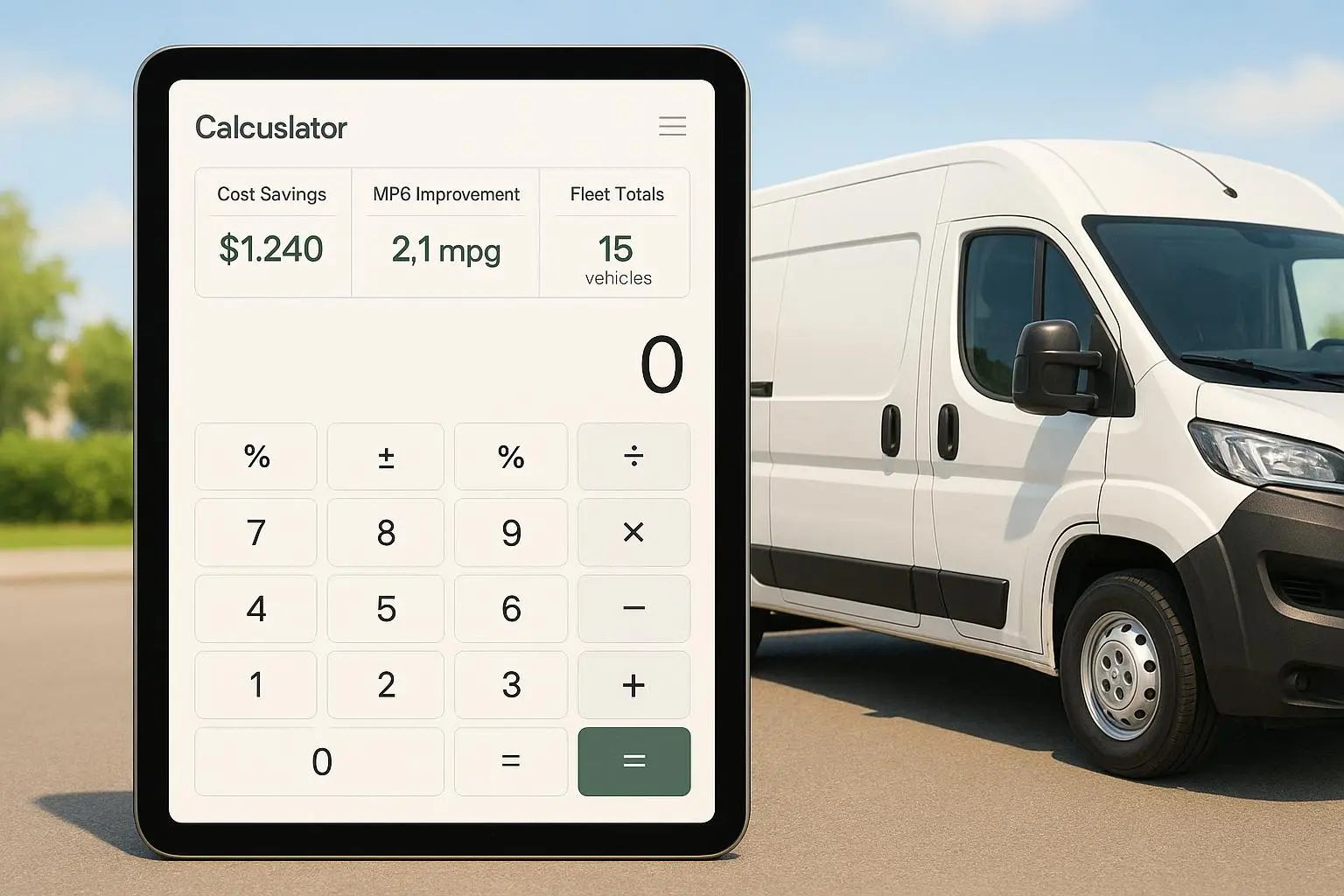
- Fleet vehicles: If you run a fleet, track data. Slight overinflation can pay off when standardized and monitored, but you must manage wear and safety metrics.
Tools worth using
If you care about doing this right, use a good digital tire pressure gauge and log readings. Apps can track history, but the physical measurement matters. TPMS alerts are useful but aren’t precise enough for small tweaks. For towing, consult the vehicle’s load chart in the manual or a reputable source.
Recommended baseline gear:
- Digital tire pressure gauge (accurate to ±0.5 PSI)
- A small air compressor with a pressure regulator
- A simple log (spreadsheet or app) of cold PSI and MPG
Summary and my short verdict
- Underinflation definitely costs fuel. Keep tires at the placard pressure at minimum.
- Slight overinflation can give a small MPG bump—generally 0.5%–2% for modest increases.
- Those gains rarely justify the trade-offs for everyday driving: reduced traction, increased wear, harsher ride, and possible stress on suspension and brakes.
- Use overinflation deliberately and temporarily for long dry highway runs, or follow the load chart for hauling. Always stay below the tire sidewall MAX and monitor handling and wear.
If you want a takeaway: check your tires monthly, keep them at the manufacturer’s recommended cold PSI, and consider tiny, informed adjustments only when you have a clear reason and a plan to revert.