Narrow Your Niche: Sector-Specific Pricing Scenarios & Templates
Jan 21, 2026 • 9 min
You can’t price everything the same way. I know—I've seen freelancers, small agencies, and consultants try that for years. It usually ends with lost margin, awkward client conversations, or a scramble to explain why you charged what you did.
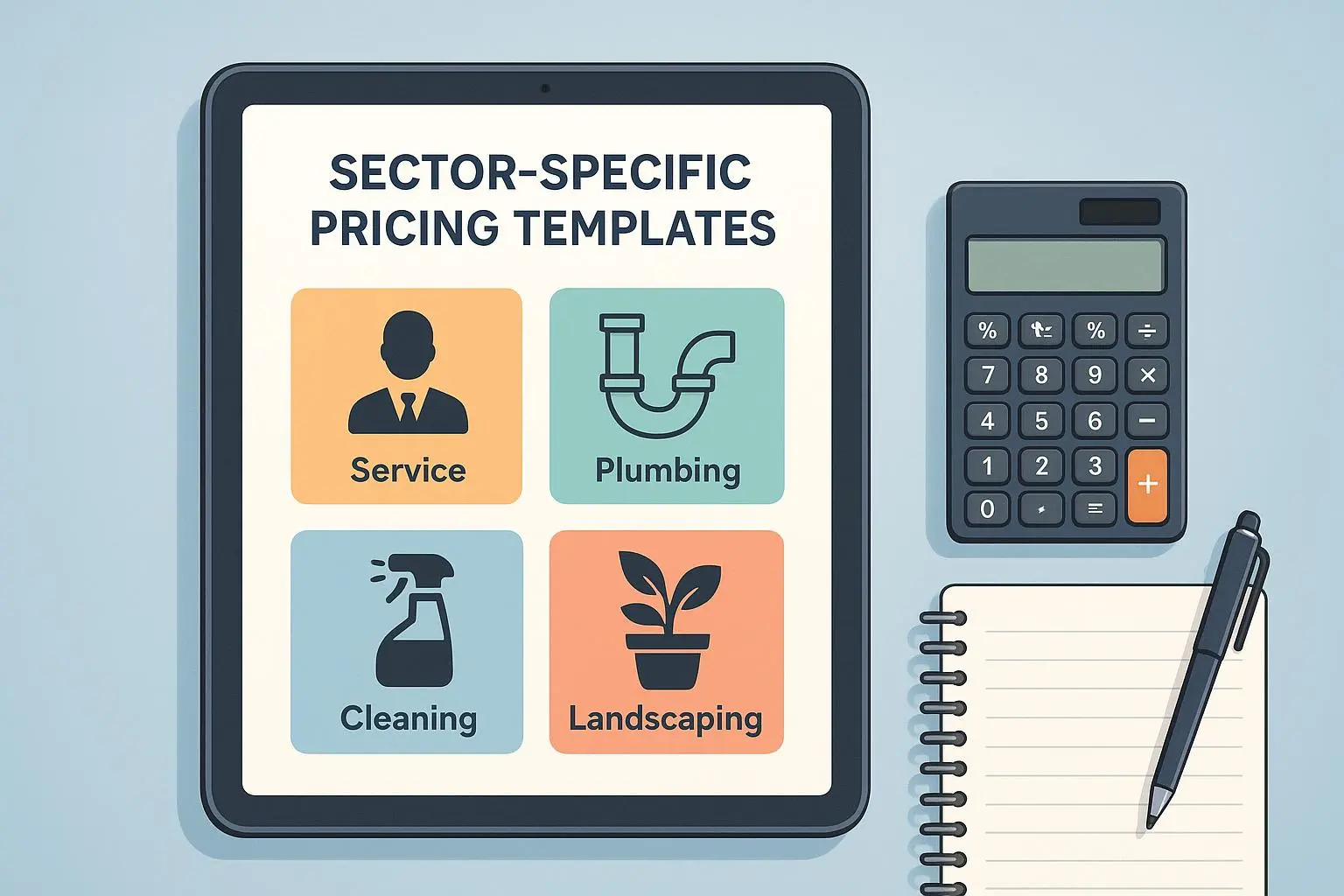
Here’s the honest version: pricing is a signal. It tells prospects how you solve problems, how you package risk, and whether you’re for bargain shoppers or premium partners. The trick is matching that signal to the specific market you serve. Below I’ll walk through four common service sectors, give concrete scenario-based templates you can copy and tweak, and share the small, practical moves that preserve margins without losing deals.
If you skip to the end: there are ready-made tier templates, a short checklist for margin protection, and a sample phrasing for proposals that reduces scope disputes.
Why sector-specific pricing matters (short version)
Generic pricing models do two bad things: they leave money on the table, or they repel the clients you actually want.
Different sectors have different buying cycles, risk tolerances, and ways they measure ROI. A SaaS buyer expects tied-to-revenue outcomes. A small retailer wants predictability and a launch that doesn’t break the bank. Coaches sell transformation, not hours.
Treat pricing like product design. If you design for “everyone,” you design for nobody.
What most people get wrong (and the one fix)
Most service providers use hourly billing because it feels safe. But hourly rates shift risk to the client and make value invisible.
Here's what I learned the hard way: stop charging for time and charge for outcomes. Not always exclusively—sometimes hybrid—but make outcomes the anchor.
The one fix: choose a primary model that fits the sector, design two clear tiers, and add a transparent out-of-scope policy.
Now, let’s get practical.
1) Consulting & Professional Services (marketing, HR, strategy)
Why this sector needs a different approach
- Buyers care about direct impact (leads, hires, cost savings).
- Decision cycles are often longer and involve sign-offs.
- Results are measurable, so value-based pricing scales well.
Scenario: You’re a marketing consultant hired by a mid-market SaaS company to improve lead generation.
Problem: Hourly billing is opaque. The client wants to see revenue impact.
Solution: Tiered value-based packages plus a performance bonus.
Example templates (plug numbers for your market)
- Bronze — Foundation
- Deliverables: market analysis, 1 high-impact campaign, baseline tracking.
- Fee: $6,000 fixed.
- Timeline: 6 weeks.
- Silver — Growth
- Bronze + monthly campaign management, A/B testing, and reporting.
- Fee: $4,000/month (3-month minimum).
- Gold — Accelerate
- Silver + dedicated account manager, attribution modeling, and a performance bonus.
- Fee: $8,000/month + 5% bonus on incremental revenue attributable to campaigns (over agreed baseline) for 6 months.
How to pitch the bonus without scaring clients
- Define the baseline clearly (average monthly MRR for the last 3 months).
- Limit the bonus window (e.g., 6 months).
- Cap the bonus if needed for predictability.
Micro-moment: I once asked a CFO what they'd gladly pay for. He said, “Predictable pipeline.” That single phrase changed how I framed deliverables and why the Gold package started selling.
2) Creative Services (graphic design, web dev, content)
Why this sector is different
- Scope creep is the enemy.
- Small business budgets dominate.
- Outcomes are often qualitative but still tied to business metrics (conversion, time to launch).
Scenario: A web designer building an e-commerce site for a boutique retailer.
Problem: Hourly billing invites endless revisions and a slow bleed on margins.
Solution: Fixed packages with clear deliverables and add-on pricing for extras.
Example templates
- Starter Store
- 5 custom pages, up to 10 product uploads, responsive design, basic SEO.
- Fee: $3,500 flat. 4-week timeline.
- Growth Store
- Starter + payment gateway setup, product variations, review integration.
- Fee: $7,000 flat. 6-8 week timeline.
- Premium Store
- Growth + custom features (subscriptions, advanced product rules), 3 months support.
- Fee: $15,000 flat.
Add-on pricing (examples)
- Extra page: $200 each
- Custom plugin or complex integration: $1,200–$3,000 depending on scope
- Rush delivery under 2 weeks: +25%
Practical clause that saves arguments: “Included = X revisions per page. Additional revisions billed at $75/hour or $150 per revision pack.” That line has saved more than one project from derailment.
3) Tech & SaaS Services (custom dev, IT support)
Why this sector needs hybrid models
- Requirements evolve.
- Clients want predictability but can’t always specify everything up front.
- Long-term maintenance matters.
Scenario: Building a custom internal tool for a mid-sized firm.
Problem: Full fixed-price contracts get destroyed by changing requirements; pure T&M scares clients.
Solution: Phased fixed-fee discovery + T&M sprints + monthly support retainer.
Example templates
- Phase 1 — Discovery & Blueprint
- Deliverables: requirements, technical spec, wireframes.
- Fee: $12,000 fixed. (2–4 weeks)
- Phase 2 — Core Development (sprints)
- Time & Materials: $140/hour, estimated X hours per 2-week sprint.
- Weekly demos; scope adjustments documented in sprint tickets.
- Phase 3 — Deployment & Training
- Fee: $5,000 fixed.
- Ongoing Support
- Retainer: $3,500/month (up to 20 hours). Additional hours at $120/hour.
Client communication rule: Weekly reports with hours logged, completed tickets, and risks. Transparency prevents sticker shock.
Real story (100–200 words) I burned a client relationship early in my career by underestimating scope. We quoted a fixed price for a “simple” internal tool, and two months in the stakeholder list doubled. I swallowed the cost and learned two lessons: always run a discovery sprint, and sell flexibility as a feature. Now I start every custom dev engagement with a three-week discovery for $7k–$15k depending on size. That upfront investment saves time, surfaces hidden work, and—critically—lets me quote fixed phases with far fewer surprise change orders. Since switching, my project overruns dropped from about 30% of contracts to under 8%, and renewal/retainer conversion improved by 40% because clients trusted the plan.
4) Coaching & Education (coaches, tutors, course creators)
Why this sector is outcome-focused
- Buyers want transformation, not hours.
- You can productize parts of the service (courses, templates, frameworks).
- Community and recurring access increase lifetime value.
Scenario: Business coach selling programs to founders.
Problem: Charging per session undervalues long-term transformation and incentivizes short-term thinking.
Solution: Tiered program bundles that combine sessions, resources, and community.
Example templates
- Jumpstart (3 months)
- 6 one-on-one sessions, a growth plan template, email support.
- Fee: $2,500.
- Growth Accelerator (6 months)
- 12 one-on-one sessions, group workshops, private Slack, priority email.
- Fee: $6,500.
- Elite Mentorship (12 months)
- Monthly intensives, unlimited chat support, bespoke resources, quarterly retreats.
- Fee: $25,000.
How to justify higher prices
- Frame sessions as milestones toward specific business metrics (e.g., revenue targets, fundraising readiness).
- Offer a money-back guarantee tied to adherence (e.g., “If you show up to every session and complete key deliverables and don’t see X results, we’ll refund”).
Coach tip: Sell the result, not the time. Lead with outcomes in your proposal header.
Preserving margins — the checklist that actually works
- Know your true cost. Include overhead, tools, taxes, and your desired profit margin.
- Build at least two fixed-price tiers and one bespoke option. Most clients choose middle-ish offers.
- Add clear out-of-scope language. Give examples of what’s included and what isn’t.
- Use discovery fees for complex work. They reduce risk and qualify clients.
- Include a small contingency line item for larger projects (5–10%).
- Price in cadence: refundable deposits, milestone payments, and final payment on delivery.
- Track time and report it for T&M work. Weekly transparency reduces disputes.
- Measure and iterate every quarter. Drop offers that never sell, raise prices for those that do.
Short negotiation script that works “When we scoped this, we agreed on X features. This request falls into ‘out of scope,’ so we can add it as a paid change. I can give two options: a one-off fixed quote of $Y or add it to the next development sprint at our hourly rate.”
How to communicate value (so you don’t get pushback)
- Lead with outcomes, not features. “We’ll increase qualified leads by X%” or “reduce onboarding time from 10 days to 2.”
- Use evidence—case numbers, percent improvements, or client testimonials.
- Offer payment terms that reduce friction (installments, milestones).
- Be transparent about limits and risks. Clients respect honesty.
- Use anchor pricing: show a high-end package first, then the mid-tier which looks reasonable.
Micro-moment: I once framed a web redesign as “cut your checkout friction by 30%” and a store owner signed within 48 hours. Specific promises open wallets.
Tools that make this scalable
- Proposals & contracts: PandaDoc or HoneyBook for clean pricing tables and e-signatures.
- Time tracking: Harvest or Toggl for T&M transparency.
- Billing & accounting: FreshBooks for invoices and expense capture.
- Pricing analytics (for subscription/retainer): ProfitWell.
Use tools to reduce friction, not as a replacement for clear communication.
Common questions and quick answers
Q: When should I use hourly vs fixed? A: Use hourly for undefined, exploratory work. Use fixed for predictable outputs or phases. Mix them for evolving projects.
Q: How much should I add for contingency? A: 5–10% for small projects, 10–20% for high-uncertainty builds.
Q: Can performance-based fees backfire? A: Yes—if you don’t control the variables. Only tie to metrics you can influence and define the measurement method.
A quick pricing template you can paste into a proposal
Proposal header: [One-sentence outcome] Package options:
- Bronze — [Core deliverable] — $X — [Timeline]
- Silver — [Core + ongoing] — $Y/month — [Minimum commitment]
- Gold — [Full service + performance structure] — $Z/month + bonus (defined) Payment terms: 30% deposit, 40% milestone, 30% on delivery. Out-of-scope changes quoted separately.
Final thought: pricing is iterative, not permanent
Most of us set prices and forget them. Don’t. Review quarterly. Ask for feedback. Track which packages win and why. The goal isn’t to charge the most—it’s to charge the right clients the right price, so your business is sustainable and your work actually creates results.
If you take anything from this: start with a discovery or blueprint phase. It will pay for itself in fewer surprises, clearer contracts, and better margins.