Nocturnal Bird Identification: Detecting Owls and Night-Flying Migrants Through Audio Recognition
Jun 23, 2026 • 8 min
You don’t always need a flashlight to find birds at night. Sometimes you just need better ears.
Between dusk and dawn there’s a whole avian world that most daytime birders miss: owls calling from deep cover, nightjars over open fields, and thousands of migrants whispering flight calls as they pass overhead. Visual chances are slim. But audio technology—small recorders, smart apps, machine learning models—has turned nights from quiet mysteries into data-rich soundscapes.
This isn’t science fiction. It’s a practical toolkit you can use to confirm a Barred Owl, document a migration pulse of thrushes, or contribute real data to conservation projects.
Why audio matters after dark
At night, visibility collapses. Owls hide in canopy shadows and fly silently. Migrants fly high, often beyond binocular range, but they vocalize with short “flight calls” that carry. Traditional surveys—spotting with a headlamp, playback—work sometimes. They miss a lot.
Passive acoustic monitoring (PAM) changes the equation. You can leave a recorder on a pole for weeks, capture hundreds of hours of sound, and run those files through recognition tools that flag species. That’s how researchers moved from "we think they passed through" to "we recorded 4 species on this date between 1:32–1:35 a.m."
The upside is obvious: more detections, less disturbance, and time-stamped evidence. The downside? Batteries, noise, and nuance. The tech helps you find signals — you still need judgment to interpret them.
The tech that actually works (and what it costs)
You don’t need a PhD to get started. Here’s a practical view of tools people actually use.
- Recorders: AudioMoth is the go-to budget device. It records high-quality audio, is weatherproof with the right case, and costs under $100. Haikubox is a commercial alternative that streams and sends alerts.
- Mics and preamps: For rooftop or high-sensitivity setups, a shotgun or parabolic mic plus a recorder reduces distant noise and boosts flight calls. Expect $300–$1,200 for decent kits.
- Software and models: BirdNET (Cornell/Chemnitz) and BirdCall-style apps use deep-learning to tag files. Wildlife Insights and Xeno-Canto serve as libraries and analysis backends. Audacity and simple spectrogram viewers let you double-check the automated calls.
Total entry cost depends on ambition. A backyard starter kit (AudioMoth + phone app + free analysis) can be under $150. A long-term, multi-site research array—solar power, 4G data links, redundancy—runs into thousands per site.
How detection actually happens
There are two common use-cases: calling owls and migrating songbirds.
Owls: Most owl calls are relatively loud, distinctive, and tonal. Algorithms look for patterns in frequency and duration; a classic hoot pattern makes a clean match. For species like Great Horned Owl or Barred Owl, automated ID can be very accurate when recordings aren’t noisy.
Night migrants: Flight calls are tiny—50–300 ms blips that occur at altitude. They’re high-pitched and short. Detecting them requires sensitive mics, lower noise floors, and models trained on flight-call libraries. That’s where projects like Nighthawk (research models) and BirdNET improvements have made big gains: finding species like Swainson’s Thrush or Blackpoll Warbler during peak migration nights.
But there’s always confusion. Airplanes, insects, and even distant frogs produce energy in overlapping frequency bands. Good noise filtering and human verification remain essential.
A real night: my first convincing flight-call capture
One night a couple of years ago I set an AudioMoth on my attic eave, pointing up. I’d been fiddling—battery swap, firmware update—and then I forgot about it. Two weeks later I ran the files through BirdNET.
At 2:14 a.m. on a humid September morning, the software flagged three very short calls in a 12-second window. On the spectrogram they were tiny slashes—easy to miss if you were listening live. BirdNET suggested “Swainson’s Thrush” with moderate confidence.
I called a local researcher, who said the timing matched peak migration for that species. We cross-checked with nearby radar migration data and—bam—an agreement. I felt, honestly, a little giddy. I’d never seen that bird. But the recorder had given me a timestamp, a species hypothesis, and a reason to look at the migration maps.
What I learned: leave devices running during expected migration windows. Don’t expect every automated ID to be final—use it as a pointer. And always save the raw file; you’ll want to reprocess with better models later.
Micro-moment: a small detail that stuck with me
When I first listened back, I nearly dismissed the calls as wind. But the calls repeated at consistent intervals—flight-call cadence is a subtle habit that stood out. That tiny rhythm convinced me to keep digging.
Common pitfalls and how to avoid them
- False positives near airports: Planes make broadband noise. Solution: exclude obvious airplane signatures with filters and avoid placing recorders where aircraft lanes are dominant.
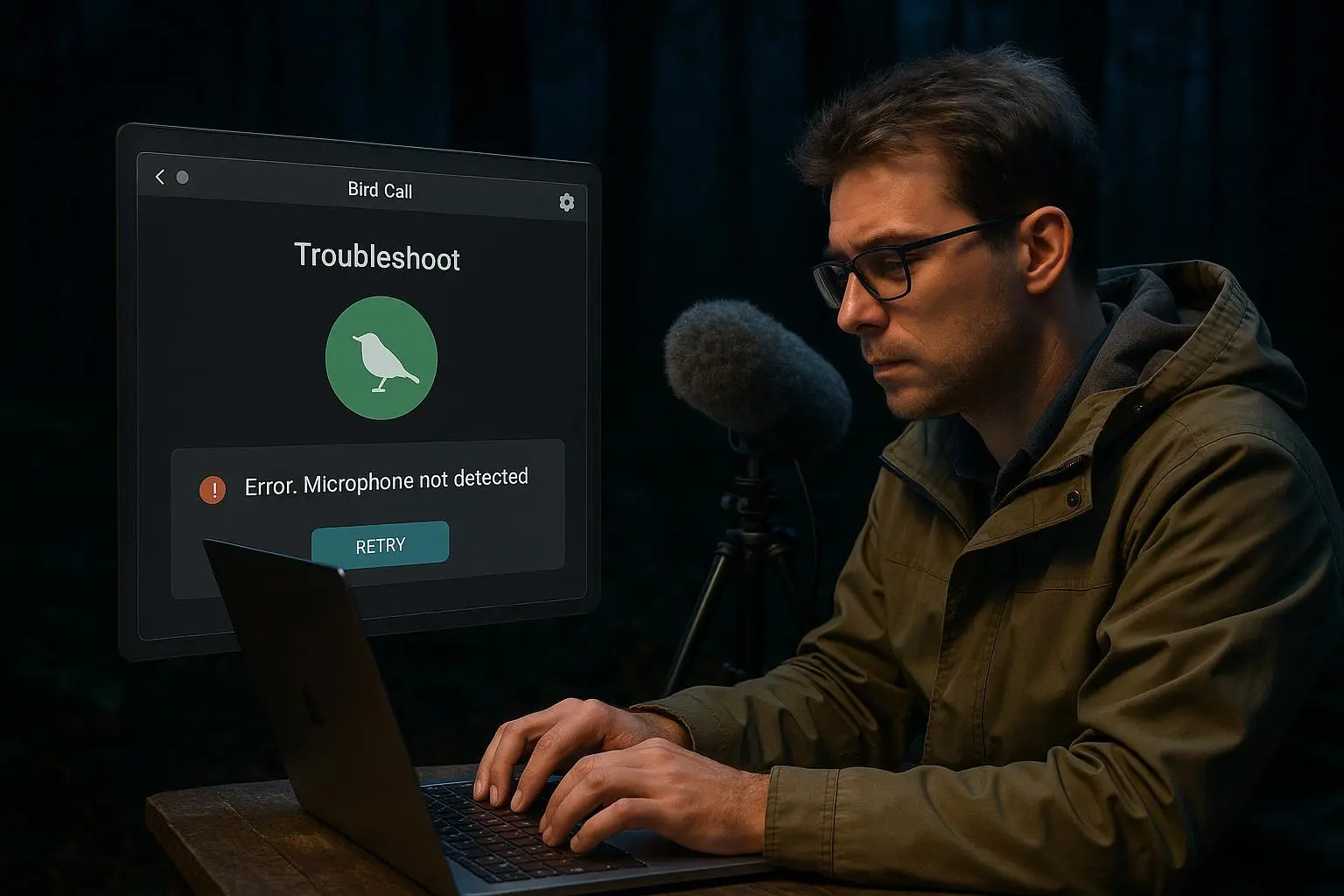
- Battery and data headaches: Months of recording need power. Solution: schedule duty-cycling (recording bursts), use solar for long deployments, or swap batteries on a rotation.
- Overreliance on the app: Algorithms make mistakes. Solution: always review spectrograms and keep a human-in-the-loop for rare or conservation-critical IDs.
- Noise masking: Urban environments create constant low-frequency hum. Solution: place recorders in small green pockets or use directional mics to isolate upward flight calls.
What the data actually offers conservation
Acoustic detections are more than bragging rights. They feed population trend analyses, map migration timing shifts, and identify risky urban corridors—especially where birds collide with lights and glass.
Examples:
- Baseline data: Agencies can detect years with unusually high or low migrant volume.
- Mitigation: Time-stamped detections tell city planners when to dim lights during peak migration.
- Rare species discovery: Passive arrays have rediscovered species absent from visual surveys for years.
One conservation team I followed recorded four species at a site they hadn't visually confirmed in five years after deploying acoustic sensors. That kind of finding can trigger targeted habitat protection or further research.
How to set up your first nocturnal recording project
You don’t need perfection. Start practical.
- Pick timing: Peak migration nights (spring and fall) are obvious targets. Owls: winter and breeding seasons.
- Choose location: Rooflines, open fields, forest edges for flight calls; dense tree stands near known territories for owls.
- Use duty-cycling: Record in 10–15 minute bursts around midnight or during predicted migration peaks to conserve power and storage.
- Process: Run files through a tool like BirdNET. Flag high-confidence calls, then validate spectrograms manually.
- Share: Upload validated calls to Xeno-Canto or BirdNET’s submission portals to improve future models.
Start small: one recorder for a season. Learn battery patterns, noise sources, and species you’ll likely hear. Then scale.
The debate: does tech ruin birding skills?
You’ll hear passionate takes. Some birders fear skill erosion—if an app does the ID, do you bother learning calls? I get that. But from my conversations and posts I’ve read, most people use tech as a tutor.
I train my ear with the app’s help. If BirdNET flags a Barred Owl, I pull up the clip repeatedly until I can hear the pattern without the spectrogram. Apps accelerate learning; they don’t replace the joy of recognition.
That said, you should practice manual listening, too. Turn off the app sometimes and try to identify calls yourself. Use technology to confirm, not to outsource curiosity.
What the future looks like
Expect better noise reduction, richer flight-call libraries, and more real-time alerting in consumer devices. Models will keep improving as more validated clips flow into repositories like Xeno-Canto and as researchers fine-tune algorithms for urban noise.
Also watch for integrated systems: acoustic arrays combined with radar or light-level geolocators could give us altitude, species, and timing in a single dataset. That’s huge for understanding migration ecology and informing policy.
Quick checklist before you go out at night
- Charge batteries, bring backups.
- Place recorder up and away from immediate traffic.
- Note local light sources and weather—both change detection probability.
- Record metadata: time, coordinates, moon phase, temperature.
- Run automated ID but always validate rare finds manually.
Final thought
Listening is the low-cost, high-impact way to discover birds we rarely see. You’ll miss some calls, and the software will sometimes be wrong. But with a thoughtful setup—good placement, the right duty cycle, and human verification—you’ll start seeing migration like a map of sound. That’s a small revolution: the night finally has a voice.