Pocket Progress: 12 Predictive Micro‑Milestones You Can Use This Week
Feb 4, 2026 • 8 min
Goals fail for two reasons: they’re too big, or they ask you to be someone you’re not today.
Micro-milestones fix that. They’re tiny, predictive actions you can do right now that reliably indicate actual forward movement. Not motivation theater—real, measurable signals that say, “Yep, you’re on the path.”
Below are 12 copy‑and‑paste micro-milestones across learning, fitness, creative work, and household projects. Each one includes: why it predicts long-term progress, when to run it, a logging line you can copy, and a scaling rule so you can make it harder when it’s easy.
Pick 1–3, do them perfectly for seven days, and notice how momentum feels different.
How I actually learned to trust tiny wins
A few years ago I was mid-novel and stalled for months. I kept rewriting the first page, then stressing I hadn’t written “enough.” One evening I tried a ridiculous rule: write 150 terrible words before breakfast. I set a 10-minute timer and ignored editing.
In two weeks I had 12 short scenes—none were great, but each was something to shape. My productivity app counted streaks; that visual streak mattered more than any pep talk. After six weeks I’d turned one of those scenes into a chapter that friends liked. The real lesson: shipping small things beats polishing nothing.
That experiment changed how I plan everything. Small, predictive steps compound into outcomes you can actually point to.
(Quick micro-moment: I still remember the cheap mug I drank from during those 10-minute sessions. Silly, but it became a ritual anchor. Rituals stick.)
Domain 1: Learning & Skill Acquisition
When starting a new subject, consistency beats intensity. These milestones force retrieval, reduce friction, and make future learning predictable.
- The 15-Minute Deep Dive
- Why it predicts progress: Shows you can secure focused attention. Retrieval practice and spacing win here.
- When to run it: Daily, right after a consistent trigger (morning coffee, lunchtime, before bed).
- Logging line: "Spanish: 15 min focused study on verb conjugations."
- Scaling rule: If you hit 5/7 days, add 5 minutes the following week.
- The "Explain It Simply" Test
- Why it predicts progress: Teaching equals understanding. It forces you to retrieve and reframe.
- When to run it: Once a week after a study block.
- Logging line: "Explained [Concept] in <2 minutes to a friend/rubber duck."
- Scaling rule: If clear, explain the next related concept; if not, review foundations.
- Resource Curation Lock-In
- Why it predicts progress: Prevents research paralysis. A curated stack is momentum insurance.
- When to run it: One-time setup when starting a topic.
- Logging line: "Locked: 3 core courses + 5 high-quality tutorials for [Topic]."
- Scaling rule: Don’t start new resources until the trio is 50% complete.
Domain 2: Fitness & Health
Fitness collapses when preparation is hard. These micro-milestones remove friction and protect energy.
- The Gear-Ready Ritual
- Why it predicts progress: Removing prep friction makes showing up easy.
- When to run it: Night before a planned workout.
- Logging line: "Workout gear laid out + water bottle filled."
- Scaling rule: Gear ready 6/7 nights → add a 5-minute dynamic warm-up.
- The Hydration Baseline Check
- Why it predicts progress: Hydration affects energy, recovery, and decision-making.
- When to run it: Mid-day (around 2 PM).
- Logging line: "Hit 50% of water goal by 2 PM."
- Scaling rule: If consistent, increase daily target by 8 oz.
- The 5-Minute Mobility Slot
- Why it predicts progress: Prevents the small pains that derail training plans.
- When to run it: Immediately on waking.
- Logging line: "Completed 5 min mobility: hips & shoulders."
- Scaling rule: Pain-free after two weeks → increase to 8 minutes.
Domain 3: Creative Output
Perfectionism kills momentum. These milestones force output first, critique later.
- The Ugly First Draft Commitment
- Why it predicts progress: Output is the raw material for improvement.
- When to run it: Dedicated creative time (morning or evening).
- Logging line: "Wrote 200 words (no edits)."
- Scaling rule: Hit the count → allowed 10 minutes to edit the previous day’s work.
- The Idea-Capture Quota
- Why it predicts progress: Volume breeds patterns and breakout ideas.
- When to run it: Anytime; aim for once a day minimum.
- Logging line: "Captured 3 distinct ideas in idea bank."
- Scaling rule: Review on Friday; if one idea is promising, spend 30 minutes expanding it.
- The Feedback Loop Initiation
- Why it predicts progress: External perspective prevents self-referential dead ends.
- When to run it: When a segment is about 80% done.
- Logging line: "Sent segment X to one trusted reviewer."
- Scaling rule: Don’t begin the next segment until feedback is incorporated.
Domain 4: Household & Life Admin
Small admin tasks accumulate; these micro-milestones keep life from creating noise.
- The 10-Minute Tidy Blitz
- Why it predicts progress: Prevents clutter creep and reduces mental load.
- When to run it: Before leaving the house or before evening relaxation.
- Logging line: "10-min tidy of high-traffic zone."
- Scaling rule: Visible improvement → increase to 15 minutes.
- The One-Thing Financial Check
- Why it predicts progress: Awareness reduces background stress and prevents leaks.
- When to run it: Monday morning.
- Logging line: "Checked balance + reviewed one recurring subscription."
- Scaling rule: If easy, next step is review one budget category.
- The Future-Self Email
- Why it predicts progress: Forces forward planning and saves future willpower.
- When to run it: Friday afternoon.
- Logging line: "Scheduled micro-milestone for next Monday."
- Scaling rule: If completed, reward yourself with 30 minutes of leisure.
Why these actually predict long-term progress
Two short explanations:
- Small wins repeatedly hit the parts of your brain that build habits. Completing a micro-milestone is a feedback loop: action → reward → repeat.
- Each item is diagnostic. If you can regularly do the micro-milestone, it’s a fair predictor you can scale. If you can’t, the micro-milestone tells you exactly where to fix the system.
These are based on proven behavioral ideas: self-efficacy (small wins increase belief), retrieval practice (teaching/testing improves learning), and friction reduction (preparation reduces activation energy).
How to pick and layer them this week
Start with one micro-milestone from different domains or two from one domain—the goal is non-overlap so wins stack.
Example week plan:
- Monday: Gear-Ready Ritual (fitness) + 15-Minute Deep Dive (learning)
- Tuesday: 15-Minute Deep Dive + 10-Minute Tidy Blitz
- Wednesday: Ugly First Draft + Hydration Baseline Check
- Repeat and log.
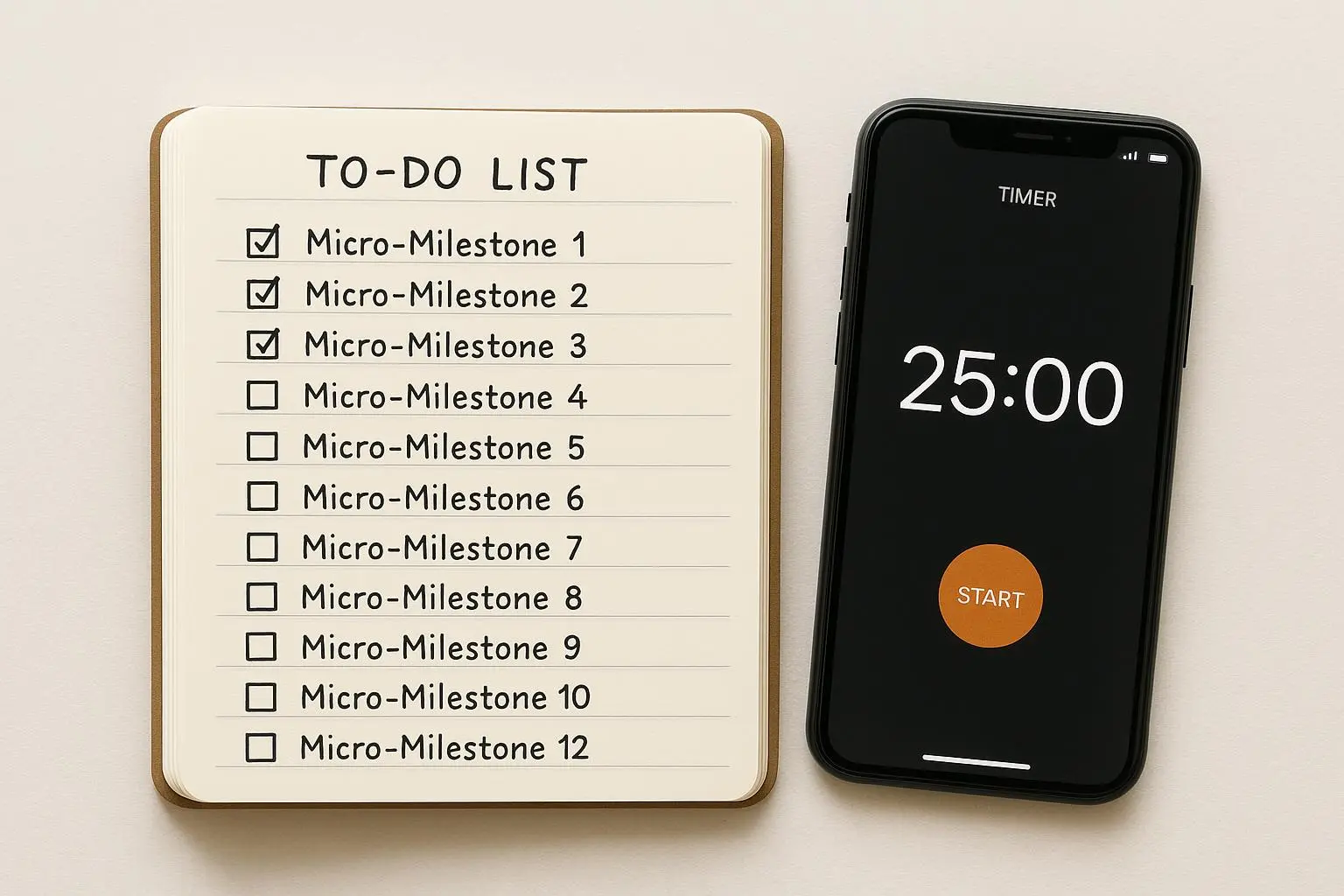
Logging matters. But keep it ruthless: minimal friction, maximum signal. Use a habit app like Streaks or a single-line note in your phone. If tracking becomes the chore, simplify: check the box, move on.
When to scale and when to stop
Scale when the micro-milestone is easy and you complete it reliably for 2–3 weeks.
Don’t scale if:
- You’re skipping more than one session a week.
- Tracking becomes more effort than the action.
- The scaled version removes the "easy" quality that made it work.
If a habit stops serving you, drop it. The point is momentum, not martyrdom.
A small caution (the contrarian 1%)
Micro-milestones are diagnostic, not micromanagement.
If you find yourself celebrating the logging rather than the outcome—stop. The goal is capability, not screenshots. A user on a productivity forum put it bluntly: he spent more time tracking tasks than doing them. Don’t be that person.
Quick starters you can copy right now
- Learning: "Spanish: 15 min focused study on past tense."
- Fitness: "Workout gear laid out and water filled."
- Creative: "Wrote 200 words. No edits."
- Admin: "10-min tidy of kitchen counter."
Do one of those today. Do it again tomorrow. Watch how the anxiety around big goals mellows.
What I’d change after using these for a year
Two tweaks I made after six months of testing:
- Reduce variety: I kept trying new micro-milestones and that diluted progress. Now I rotate three for 12 weeks, then swap one out.
- Batch logging: I log late at night for the day’s wins. It’s less interruptive and still keeps the feedback loop.
Those tiny changes turned sporadic momentum into something steady and boring—in the best way.