Safety & Headphone Etiquette for Outdoor Tabata Sessions
Jan 29, 2026 • 9 min
You want the rush of those 20-second all-out efforts. You also want to get home in one piece.
Outdoor Tabata is a tiny, intense universe: 20 seconds at max effort, 10 seconds to breathe, repeat. Music helps you hit the cadence and stay brutal. But it also has a nasty habit of stealing your ears.
This is a practical guide—not a product ad or a lecture. I’ll walk you through what actually works: when to wear what, how loud is too loud, playlist rules that don’t wreck your form, and the politeness/legal stuff most people ignore. I’ll tell you what I learned the hard way, share a short training story that changed my approach, and give you a decision tree and a one-minute safety checklist you can use before every session.
The trade-off: motivation vs. awareness
Music is a performance hack. It reduces perceived exertion, it syncs cadence, and it can pull you through that last round when your lungs are screaming.
But music also masks environmental sounds—car horns, cyclists, park staff yelling, an off-leash dog bounding toward you. During Tabata, when everything in you is turned inward, losing auditory cues is dangerous.
Here’s the blunt truth: the wrong headphone choice or reckless volume can turn a good workout into a bad story.
Real story: the sprint that taught me to respect my ears (150 words)
A few years ago I was timing myself on a short, quiet street for hill repeats. I had my favorite high-BPM playlist and both earbuds in. On the fourth rep I misjudged a corner because I didn’t hear a delivery truck reversing around the bend. I stumbled, scraped my knee, and lost two weeks of consistent training to a cranky hamstring. After that I stopped assuming “quiet” meant “safe.” I started using bone-conduction on roads, single-ear on trails, and haptic timers when visibility was low. The outcome was simple: fewer near-misses, more consistent training, and faster progression because I wasn’t nursing avoidable injuries.
That stumble is still the most expensive song on my playlist.
Headphone options, explained simply
You don’t need a PhD to pick wisely. Here’s what matters in plain language.
Bone-conduction
- How it works: Vibrates your cheekbones; ear canals stay open.
- Pros: You can hear traffic and shouts. Comfortable and secure for sprints.
- Cons: Weaker bass and overall sound. Can clash with hats or ponytails.
- Best for: Urban runs, hill repeats on roads, busy shared paths.
Open-ear (on-ear, speakers near but not in the ear)
- How it works: Small speakers sit near the ear, leaving canals mostly open.
- Pros: Better audio than bone conduction, still lets ambient sound in.
- Cons: Sound leaks outward (rude in parks), fit varies by model.
- Best for: Tracks, groomed, low-risk paths.
Single-earbud
- How it works: One ear gets the audio, the other stays open.
- Pros: Great compromise—strong tempo cue from one side, environment on the other.
- Cons: Balance can feel odd; still masks some directionality of sounds.
- Best for: Trails and mixed-use paths where you need to hear behind you.
In-ear noise-cancelling
- Verdict: Don’t. For outdoor Tabata it’s overkill. This is for flights and commutes, not sprinting past traffic.
Volume guidelines that actually work
The usual "keep it below 60%" rule is a decent start, but it’s vague. Here’s a simple, testable approach you can use in the parking lot before your session.
- Conversational test: With your headphones on and volume set for your work interval, have a friend speak at a normal voice from 3–4 feet away. If you can hear them without turning your head, the volume is acceptable.
- Work vs. recovery: You’ll need slightly higher volume during the 20s work bursts to overcome heavy breathing. Use the recovery 10s to actively lower volume or pause for a half-breath and re-center.
- Never combine noise-canceling with outdoor Tabata. Ever.
- When in doubt, drop one ear or choose bone conduction.
This dynamic volume discipline makes the work feel the same but keeps you alive.
Micro-moment: I swear by a three-beat, “lower it” habit—at the end of every recovery I take two deep breaths and physically press the volume down one notch. It takes two seconds and it keeps my brain from auto-cranking the music.
Playlist strategy: drive the cadence, don’t hijack the form
The song you pick can either push your form into garbage or be your metronome.
- Work intervals (20s): 150–180 BPM for running Tabatas. Pick tracks with a steady, prominent kick drum or beat.
- Recovery intervals (10s): 120–140 BPM. The contrast cues your brain to chill briefly.
- Avoid tracks with sudden loud drops, heavy vocal sections, or erratic tempo changes. Those will steal your focus.
- Instrumental or stripped-back mixes are underrated—fewer lyrics = fewer mental demands.
- Use 2–3 second deadspace between tracks to create natural reset points. A perfect Tabata playlist is more about transitions than one-hit songs.
A quick tip: use a BPM scanner app to batch-tag your library. It’s tedious once, and then your playlists just work.
Situational playbook: where and when to wear what
Not all Tabatas are created equal. Match your audio plan to the location.
Track sprints
- Environment: Controlled, predictable.
- Audio: Bone conduction or full earbuds OK. Volume moderate.
- Etiquette: Keep sound leakage low; people are often doing different workouts nearby.
Trail Tabatas
- Environment: Blind corners, cyclists, wildlife.
- Audio: Single-earbud or no headphones. Haptic timers are ideal.
- Etiquette: Many trails ban loud music out of courtesy and wildlife protection.
Urban hill repeats
- Environment: Traffic, intersections, construction.
- Audio: Bone conduction only. Volume conservative.
- Time of day: If possible, choose off-peak hours.
Group sessions
- Audio: No headphones, or bone conduction only. You must be able to hear instruction.
- Leadership: If you coach, set a no-headphones rule and enforce it.
Crowded parks / peak hours
- Audio: Skip music. Use a haptic timer on your wrist.
- Reason: Safety and courtesy trump music.
Park rules and etiquette (be a decent human)
Yes, legal rules exist. Many parks and trails have noise policies or specific language about personal audio devices. Even when enforcement is lax, use common sense:
- Don’t blast bass; sound leaks and it’s rude.
- If you’re in a group or near families, remove or lower music.
- Announce before you pass: a polite “on your left” works better than assuming people hear you.
- If signage forbids audio devices, follow it.
Being considerate is also safety: if someone can’t hear you coming, they won’t move predictably.
Decision tree: should you wear headphones for this Tabata?
Answer these quickly before you step out.
- Are you on a closed course (marked track or private field)? If yes -> headphones OK; keep volume moderate.
- Are there blind corners, fast cyclists, or vehicle crossings? If yes -> bone conduction or single-ear only.
- Is it a group class or are you coaching? If yes -> skip headphones.
- Is it peak park time with heavy foot traffic? If yes -> skip music, use haptics.
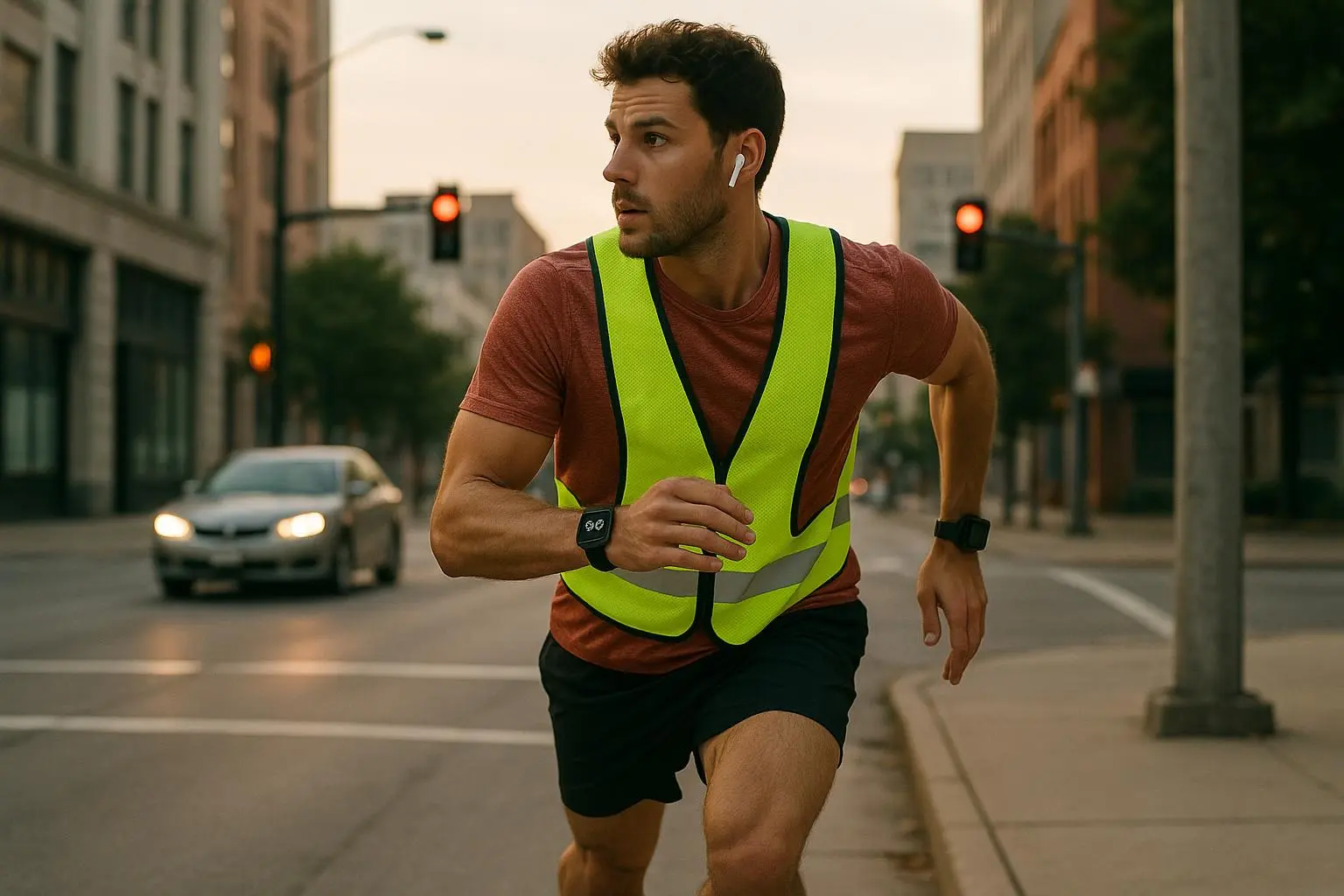
- Is it early morning or low visibility? If yes -> bone conduction and hi-vis clothing.
If more than one answer tells you “no,” don’t wear music. It’s not worth it.
Quick safety checklist (one minute)
Do this before each Tabata session.
- Headphones allow ambient sound (bone conduction/open-ear/single-ear)
- Volume passes the conversational test (hear someone 3–4 ft away)
- Route scouted for hazards (intersections, blind corners)
- Interval timer set with haptic backup
- Phone charged and accessible
- High-visibility clothing if near roads or in low light
- Headphone battery checked
- Park rules verified
Tick those boxes and you’ve removed most preventable risk.
Coach’s note: technique first, tempo second
Music can make you chase a beat at the expense of form. I’ve seen athletes speed up squats or shorten strides to match a track and then wonder why their performance plateaued.
If a song tempts you into sloppy technique, swap it. Use instrumental tracks or tempo-matched, lower-BPM options for strength-based Tabatas.
Gear suggestions (not sponsored)
- Bone-conduction: good for roads and shared paths. Look for secure fit and sweat resistance.
- Open-ear: decent for tracks and low-risk environments; check for sound leakage.
- One-earbud: cheap compromise; works well on mixed trails.
- Haptic timers/watches: essential backup. They keep you on time without sound.
If you’re buying, prioritize fit, battery life, and whether they stay put during explosive movement.
Extra: how auditory masking actually matters (short science bit)
Music masks high-frequency warning sounds (bells, quick shouts) first. Even at moderate volumes, those cues can disappear under a steady drum. That’s why a “hear a shout from 3–4 feet” rule is more practical than a percent-of-volume rule.
Final thought
Music makes Tabata better—when it doesn’t make you deaf to danger. The smartest workouts balance intensity with awareness. Commit to volume discipline, pick the right hardware for your environment, and respect the people and places you train in.
You’ll still get the psychological punch of a killer playlist. You’ll just keep your knees intact.