Teach Kids a 5-Minute Dog-Safety Routine: Calming Signals Made Simple
Jan 23, 2026 • 8 min
If you’ve ever watched a kid sprint toward a wagging tail and thought “this won’t end well,” you’re not alone.
Most dog bites involving children aren’t about a mean dog. They’re about misreading tiny signals. Dogs speak in body language—subtle things like a quick lip lick or a slow head turn—and kids usually miss them. Teach a child to spot three straightforward signals and follow four simple rules, and you cut a lot of risk out of everyday interactions.
This is a kid-friendly, repeatable routine you can do in five minutes. No jargon, no long lectures—just a handful of memorable moves, a role-play script, and printable flashcards you can hang on the fridge.
Why focus on calming signals?
Calming signals are the polite ways dogs say “I’m uncomfortable” or “please back off.” They’re what a dog shows long before a growl or a bite. Researchers and trainers have used these signals for years to prevent escalations, and the approach is simple: notice the early warning signs and stop the interaction.
But here’s the catch: kids tune out abstract ideas. Tell a 5-year-old “watch body language” and you’ll lose them. Tell them “look for yawns, lip-licks, and head turns” and you’ve got a checklist they can actually use.
The routine in a sentence
Spot the 3 C’s (yawn, lip lick, head turn) → Do the 4 R’s (respect space, remain calm, retreat slowly, report to an adult) → Practice with a 2-minute role-play.
That’s it. Repeat. Make it part of the morning routine or a before-playtime ritual.
The 3 C’s: what to teach first
These are quick to spot and hard to misinterpret when practiced.
- Yawning: Not “sleepy yawning.” If a dog yawns when a child approaches or during play, it’s a stress yawning. Teach kids: “If the dog yawns, stop.”
- Lip licking: A quick lick across the nose or lips when there’s no food present. Tell kids: “He’s tasting the air because he’s unsure.”
- Head turning: The dog looks away, turns its head, or moves bodyweight away. Explain: “Turning away means ‘no thanks.’”
Say the cues out loud. Make a silly chant like “Yawn, lick, turn—pause and learn.” Kids remember rhythms.
Micro-moment: I still remember my neighbor’s toddler pointing at our Labrador and whispering, “He’s tasting the worries.” That phrase—childmade and perfectly accurate—stuck with me.
The 4 R’s: the safety rules that actually work
When a child sees any of the 3 C’s, they should do these four things in order:
- Respect space: Stop moving toward the dog. Hands down.
- Remain calm: No screaming, no sudden leaps. Calm sounds calmer to dogs.
- Retreat slowly: Take two or three slow steps back, keeping the body relaxed.
- Report to adult: Tell the nearest grown-up what happened.
You can teach these as the “4 R’s” and make a flashcard for each. The steps are short enough a child can recite them while they act.
How to role-play in two minutes (and why it matters)
Kids need muscle memory. Saying “don’t run” isn’t the same as practicing “slow retreat.” Here’s a two-minute script you can use daily.
- Parent: Pretend to be the dog—yawn exaggeratedly, then lip-lick, then look away.
- Child: Shout the signal: “Yawning!” Then demonstrate the 4 R’s—hands down, small steps back, and say “I’ll tell Mom/Dad.”
Do this three times. Switch roles so the child plays the dog once; that helps them see pacing and signals from the other side.
Why it works: role-play puts kids in a safe practice loop. They learn the physicality of standing still, the feel of a slow step back, and how to say “I saw a signal” out loud. Trainers who use this approach report much higher retention than lectures do.
A short real story (100–200 words)
A few years back I brought home a hyper-curious foster pup for a weekend. My niece, age six, came over and asked to meet him. She’d seen the flashcards once. I told her our five-minute routine and asked her to show me. We did the role-play in the hallway once—two minutes. Later, when the pup sniffed and gave a quick lip lick, she froze, said “lip lick,” took two calm steps back, and told me. The pup wandered off to his bed and the moment passed.
That tiny pause changed everything. My sister (the kid’s mom) told me afterward that before, the niece would have hugged the dog immediately. Now she checks first. The best part? The kid felt proud, not scared. She knew she’d done the right thing. That’s the exact outcome this routine aims for: respect, not fear.
Approaching dogs: rules for known vs. unknown dogs
Two rules you must teach separately: unknown dogs are off-limits without permission; family dogs still have limits.
Approaching an unknown dog:
- Ask the owner: “May I pet your dog?”
- If yes, the child offers a closed fist at arm’s length for sniffing, then pets the shoulder or chest—never the face.
- If the dog moves away or shows a calming signal, back off.
Approaching a family dog:
- Family dogs are the most common bite source because kids assume permission.
- Even with your own dog, if you see any of the 3 C’s, follow the 4 R’s.
- Teach kids safe games that don’t involve face-to-face play or dressing up the dog.
When things escalate: simple steps for an aggressive approach
If a dog shows more serious signals—stiff body, growl, snapping—kids should:
- Put something between them and the dog (a jacket, backpack).
- Stand still like a tree: arms folded, eyes down, no running.
- Wait for an adult to remove the dog or guide them away.
This isn’t the core 5-minute routine, but it’s a critical add-on for older kids to learn as they mature.
Printable flashcards and visuals that actually help
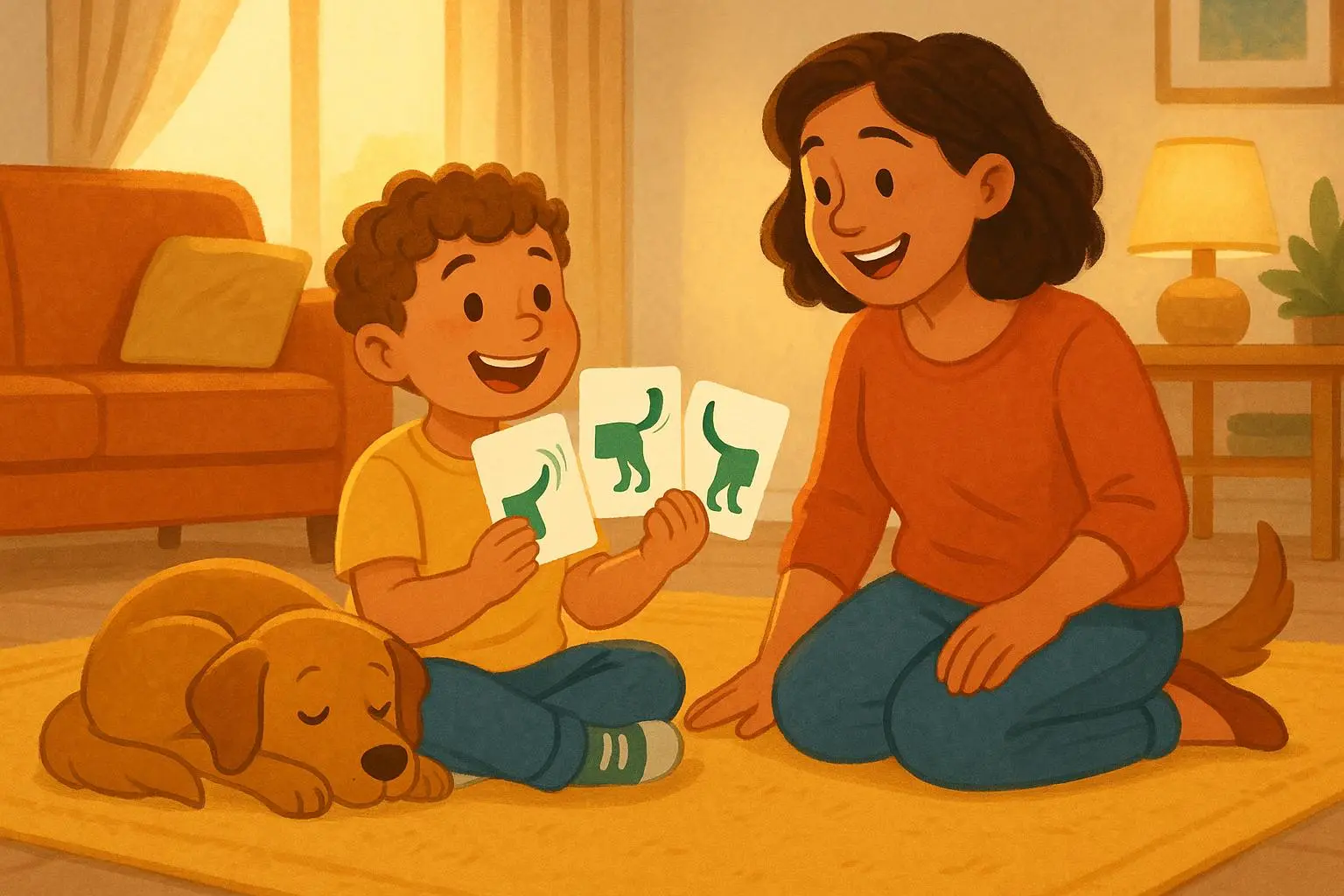
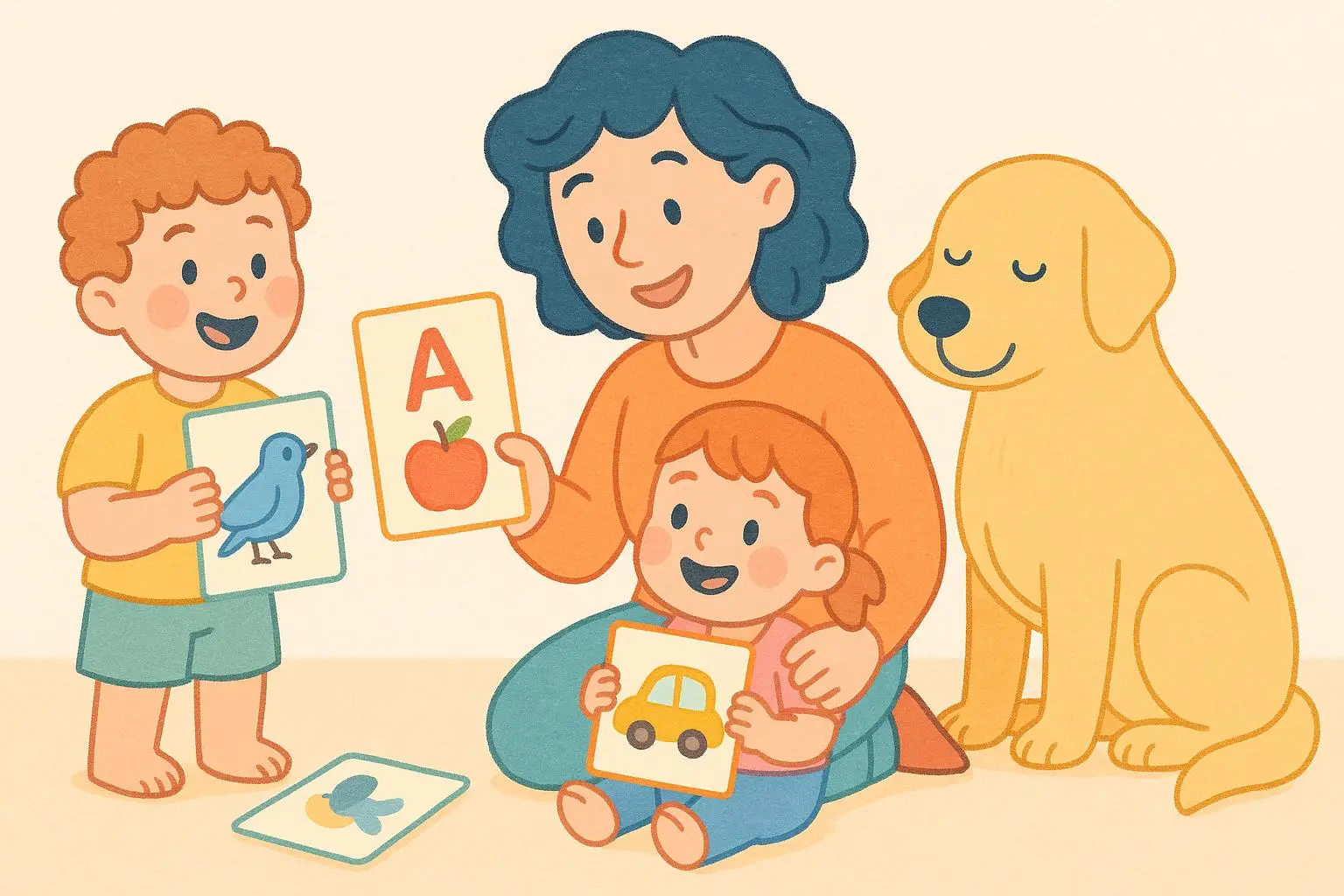
Visuals are the secret sauce. Flashcards should be single-sided, bright, and action-focused:
- Card 1: Yawn — image + caption “Stop. Give space.”
- Card 2: Lip Lick — image + caption “Taste the worries → back off.”
- Card 3: Head Turn — image + caption “He’s saying ‘no thanks.’”
- Card 4–7: The 4 R’s — short phrases and icons for each step.
Put them on the fridge, in the car, or near the dog’s food bowl. Quick daily reviews—60 seconds—beat a single long lesson. Teachers and therapists use a similar micro-practice approach with therapy dogs and report better compliance when kids review cards before visits.
Age guidance: when can kids reliably use this?
Young children (3–5) can learn the basics with repetition but are naturally impulsive. Expect reminders and supervise closely.
By age 6–8, many kids can reliably spot the 3 C’s and do the 4 R’s with periodic supervision.
A few realistic notes:
- Don’t treat this as a substitute for adult supervision or leashes.
- The routine reduces risk but doesn’t eliminate it.
Addressing common pushback
“I have a rambunctious toddler—this won’t work.” True: toddlers are impulsive. The routine helps, but you still need physical barriers, supervision, and strong household rules.
“Is focusing on only three signals safe?” It’s a starting point. Trainers recommend expanding to more signals (e.g., whale eye, freezing) as kids age. Start simple to build confidence; grow complexity later.
Tools and extras that make teaching easier
- Printable flashcards (download and print on cardstock).
- A 2-minute daily role-play timer (use your phone).
- The Pet First Aid app for immediate guidance if an incident occurs.
- Short videos showing real dogs performing calming signals—watch them with your child and pause to point things out.
Quick checklist you can memorize tonight
Spot: Yawn, Lip lick, Head turn. Do: Respect, Remain calm, Retreat slowly, Report to adult.
If you repeat that aloud once, you’ll catch onto how easy it is to make it a family rule.
Final note: make it positive
Kids learn better when things feel like a game. Turn “spot the signal” into a little detective game, praise correct moves, and never shame mistakes. The goal isn’t to make children scared of dogs—it’s to make them respectful and safe.
If you want a starting kit, download the printable flashcards and the 2-minute role-play script linked below. Practice three times this week and you’ll see how quickly kids pick it up.