Troubleshooting Headline Scores: Fix Common Issues That Kill CTR
Feb 25, 2026 • 9 min
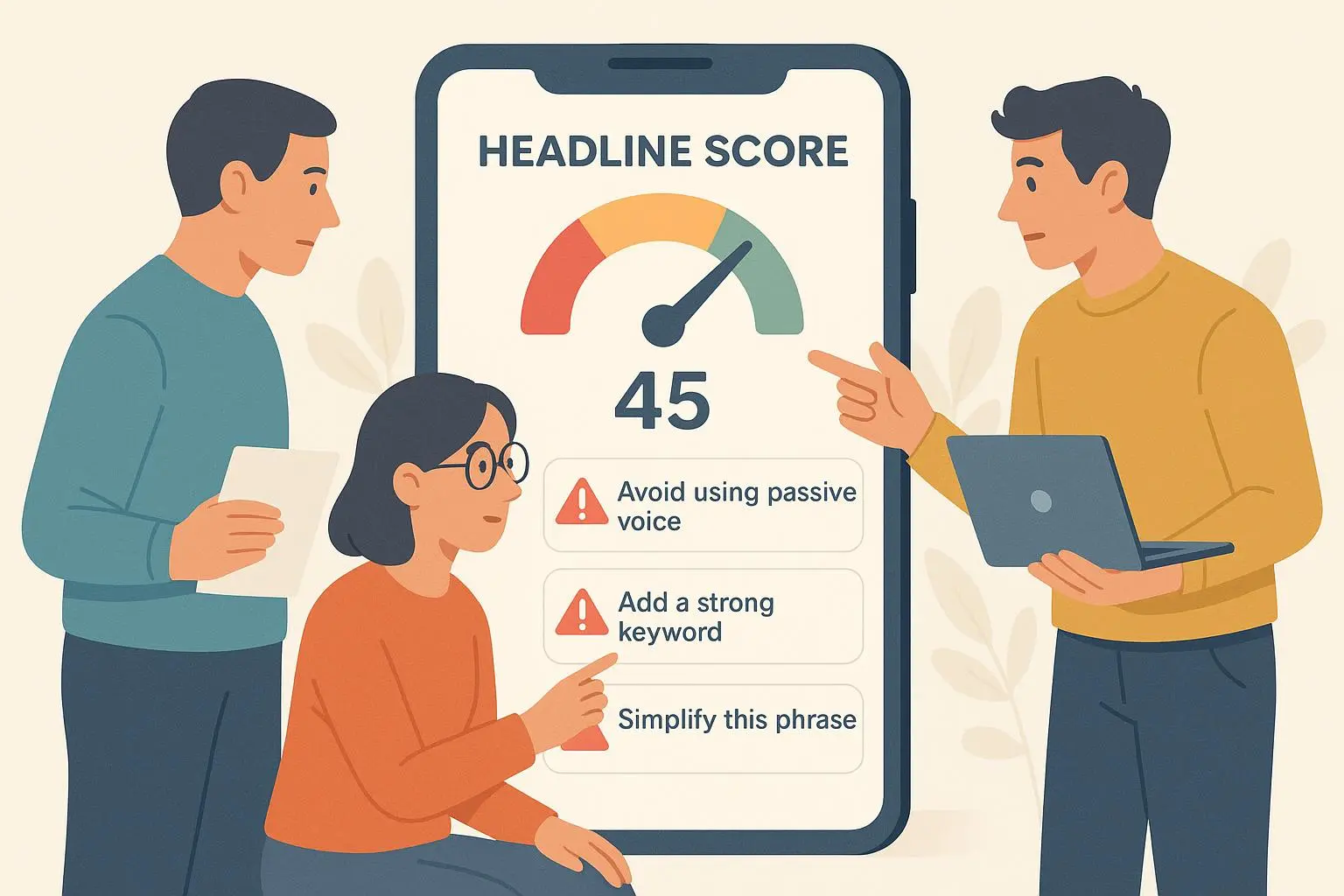
A perfect headline score is a good compass, not a guarantee. I learned this the hard way when I chased a shiny 95 in a headline analyzer, only to watch my click-through rate stumble and fall flat. The score said “go,” but the room didn’t show up. This post is how I debugged that gap and what I’d do differently if I started from scratch today.
If you’re here, you’re probably wrestling with a mismatch between what a headline tool says and what real people do once they land on the page. You’re not alone. Let me walk you through a practical diagnostic framework, with concrete steps, quick remediation templates, and prompts you can drop into your next user-test session.
The quick reality check: scores aren’t truth, people are
Headline analyzers are fabulous for shaping structure—the rhythm of words, the balance of common versus uncommon terms, the length. They’re not magicians. They won’t see your audience’s intent, trust signals, or the moment your reader lands on the article and realizes the promise wasn’t what they expected.
Here's the truth I learned: a headline can clock in at a perfect score and still trigger pogo-sticking. People click, skim, and bounce faster than you can say “SEO.” The score rewarded the mechanics; the content failed to deliver the value the reader imagined.
And a micro-moment that stuck with me: I was testing two headlines on a tech article. One scored 89 and sounded crisp; the other hovered at 72 but felt friendlier and more honest. The lower-scoring option won in the real world, because it matched the reader’s immediate pain point better. It wasn’t about clever phrasing—it was about clarity and trust.
If you skim this, you’re not alone. But you deserve a practical path to fix the gaps, not a sermon about balancing emotions or chasing a higher numeric score.
A real-world moment worth sharing
A couple of years back, I ran a headline experiment for an early-access release of a software toolkit. Our top-of-funnel page used a headline that hit a 92 on a well-known analyzer. The promise was big: “The Ultimate Toolkit for Builders: Faster Deploys, Fewer Bugs, Real-World Wins.” The article delivered… mostly. But the traffic that clicked the headline left as soon as they landed on the page. The first paragraph didn’t speak to the exact use case the reader cared about, and the result was a quick bounce. We revised the headline to emphasize a single, tangible outcome—“Cut Deployment Time by 40% with a 5-Minute Setup”—and the CTR improved while time-on-page rose. It wasn’t about being flashier; it was about aligning the promise with a precise outcome.
A quick aside: the small detail that stuck with me here is how much tone mattered more than we assume. A headline that feels like a promise you can actually keep tends to reduce bounce more than a clever turn of phrase ever will.
1. The misleading keyword trap: intent mismatch kills trust
No matter how clean your structure, if the headline promises one thing and the content delivers another, readers bail fast. The dangerous version is when you cram a high-volume keyword into a line that doesn’t match the article’s core value. The tool might reward you for including that keyword, but your readers will feel tricked, click, and bounce.
In practice, this looks like a headline that’s heavy on “best,” “ultimate,” or “essential,” plus a keyword phrase that isn’t the article’s true focus. The score improves, but trust erodes.
What I learned from a practical, hard-won example: I once built a headline around “Best AI Tools 2024” to chase a high keyword score. The article, however, was primarily about AI ethics and governance. Initial CTR spiked, then plummeted as users realized they’d clicked for tools and found a discussion of ethics instead. The analytics told the story: pogo-sticking, short dwell time, high bounce.
How to diagnose quickly:
- Look at your cumulative search console data: does your high-CTR at first glance fade fast? Do you notice a higher-than-usual exit rate on the landing page?
- Check first-paragraph alignment. If readers land and feel misled, you’ve got an intent mismatch.
Remediation template (clarity-first):
- Original (high score, low trust): The Ultimate Guide to Mastering Digital Marketing Secrets Today
- Revision (lower score, higher trust): Digital Marketing Strategy: 5 Actionable Steps for Small Businesses in 2025
Qualitative prompts you can deploy in quick user tests:
- “Based on this headline, what exactly will I learn in the first paragraph?”
- “If you opened this, what problem are you hoping to solve in the next 2 minutes?”
Concrete debugging steps you can add to your checklist:
- Run a focused content-audit: does the opening paragraph explicitly confirm the promise implied by the headline within the first 150 words?
- Compare your headline against three variants that clearly foreground one specific benefit versus multiple promises.
2. Over-optimization and the dilution of emotion
Power words and emotional language have their place, but overdoing it creates what I call the “yell-at-the-reader” effect. The tool might push you toward sequences like “Shocking, Essential, Incredible” with numbers peppered in for good measure. The result? A headline that sounds forced, like a late-night infomercial, which triggers skepticism rather than curiosity.
The data supports this in a general sense: emotional language drives engagement when it’s tethered to real value. But when every word feels like a melodramatic hammer, readers tune out, and search engines (and readers) reward clarity and trust over hyperbole.
A telling story from the trenches: I ran an A/B test where one headline used three power words and a number. It performed slightly better in early clicks, but the bounce rate was dramatically higher than the calmer variant. The calmer variant—focus on a single practical outcome—delivered a 12% higher conversion rate by the end of the test window. It wasn’t the wild emotion; it was the honest articulation of the benefit.
A quick diagnostic approach:
- Read the headline aloud. If it sounds like a late-night ad, trim two power words and swap in precise, utility-focused descriptors.
- Ensure the headline centers on one primary benefit, not five.
Remediation quick-start:
- Replace two blast-word adjectives with concrete adjectives that describe the actual outcome.
- Narrow the promise to a single, measurable benefit.
Qualitative prompts you can use in testing:
- “If this headline is true, what is the first paragraph going to prove to me?”
- “Would you be able to explain the benefit in one sentence after reading the headline?”
3. Personalization mismatch: the audience persona matters more than a broad score
Headline scores are built for general consumption. They don’t automatically account for the precise mental model of your target audience. A headline that works for a B2B executive—heavy on ROI and operational impact—will miss a Gen Z consumer who wants authenticity and a sense of experience.
If your piece is meant for a niche audience, the headline must reflect their vocabulary, their pain points, and their job-to-be-done. A generic high score won’t help if it doesn’t speak to the person you’re trying to reach.
A field-tested takeaway: one C-suite-focused headline scored mid-range in a general tool, but when we anchored the headline to a specific job title and a defined problem (e.g., “Cut Budget Waste in Cloud Deployments for Enterprise IT Leaders”), CTR improved dramatically within the same content. Specificity wins in niche audiences.
How to verify alignment:
- Define the persona with at least three concrete characteristics (role, industry, top pain point, and one expected outcome).
- Ask: would this headline feel relevant to that persona if they only had 2 seconds to decide?
Useful quick tests:
- A/B test two headlines aimed at different personas for the same article. Compare CTR and dwell time to see which persona is more engaged.
- Validate if the headline uses niche vocabulary. If not, consider a controlled revision that mirrors the persona’s language.
Interlude: a micro-moment that stays with you I once helped a team publish a piece aimed at product managers about “scaling feature flags.” The original headline used broad terms. We swapped in a persona-driven frame: “How Product Managers Cut Deployment Risk with Feature Flags in 15 Minutes.” The second variant didn’t just have a better CTR; it felt more trustworthy once readers buckled into the content. It wasn’t adding fluff; it was matching the reader’s mental model.
Quick remediation checklist:
- Define the exact audience segment and their language.
- Ensure the promise appeals to that segment’s top job-to-be-done.
- Run a small-scale test with the two headlines tailored to the personas to see which resonates more deeply.
Quick remediation framework: get your CTR back fast
If you’re staring at a stubborn CTR problem, here’s a practical playbook you can actually run in a day or two.
- Ground the promise
- Pick one concrete benefit you can guarantee in your article. It might be a step-by-step play, a measurable outcome, or a craft takeaway.
- Rewrite the headline to foreground that promise clearly, using plain language.
- Check intent alignment
- Audit your introduction within the first 150-200 words. Does it deliver on the promise stated in the headline?
- If not, adjust the lede so the reader’s expectation and the article’s value are aligned from the first paragraph.
- Test tone and emotion
- Create two variants: one descriptive and utility-focused, one more emotive but still grounded.
- Use a simple A/B test (two variants, equal traffic, a 5–10% change threshold) to gauge which format keeps readers in the article longer.
- Personalization nudge
- Create a persona-driven variation. Target a specific segment with vocabulary and pain points that matter to them.
- Compare CTR and engagement with the generic version to quantify the difference.
- Trust signals and clarity
- Add a line early in the article that signals credibility: a quick stat, a short case, or a concrete caveat (e.g., “Based on 12 client trials, not every method works in every field.”)
- Quick-dix templates you can steal
- Promise-focused, utility-first: “How to [achieve outcome] in [timeframe] with [tool/method].”
- Single-benefit clarity: “Cut [pain point] by [measurable amount] in [time].”
- Persona-appropriate: “For [role/industry], here’s how to [achieve outcome] without [friction].”
Debug prompts for your next headline testing sprint
- What is the top takeaway a reader should have after reading the article?
- If I can’t articulate that takeaway in one sentence, does the headline clearly reflect it?
- Which reader craving does this headline satisfy: curiosity, utility, or fear of missing out? Is it aligned with the article’s actual value?
- Does the opening paragraph verify the promise? If not, where does the mismatch occur?
- Are we overloading on power words? If you remove two, does the headline feel more trustworthy and easier to digest?
- Could this headline apply to five different audiences? If so, tune it to a single, specific audience.
Quick example: turning a low-CTR headline into a durable, effective one
Original headline (high score, low CTR): The Ultimate Guide to Mastering Digital Marketing Secrets Today Problem: Promise was broad, audience drifted, content didn’t deliver on the scope suggested.
Remediation path:
- Narrow the promise to a tangible outcome.
- Use language that signals a real, testable result.
- Align with a specific audience.
Revised headline: Digital Marketing Strategy: 5 Actionable Steps for Small Businesses in 2025
The new version communicates a concrete plan, a scope (small businesses), and a time horizon (2025). It invites the reader to expect a practical roadmap rather than a sweeping claim.
The human elements: trust, clarity, and consistency
I’ve learned that the best headlines aren’t the ones that hit the highest score in a tool; they’re the ones that align with a real reader’s intent and deliver on a specific promise inside the article. The trust signal you plant—candid, precise, and delivered—buys clicks that matter more than a clever turn of phrase.
Here’s another small, practical trick I’ve used: after writing the article, I’ll run the page through a readability checker and then read it aloud. If a sentence feels heavy or awkward when spoken, I’ll rewrite it. If I can’t say it in one breath, I probably shouldn’t have written it.
The micro-moment I return to: a line in a draft I almost cut—“If you’re aiming for a fast, clean deployment, this is the play you should run first.” That line wasn’t flashy, but it clarified intent and set a practical expectation for how readers would approach the content.
How I’d approach this today, start-to-finish (without the drama)
If I were handing this to a team tomorrow, here’s how I’d structure the sprint:
- Define three reader personas: a B2B executive, a product manager, and a solo marketer. Write a headline tailored to each persona.
- Run a quick two-variant test per persona: utility-focused vs. persona-focused language.
- Cut two power words from the strongest-performing headline variants and measure any uplift in credibility and dwell time.
- Check for keyword intent alignment with the article’s content. If there’s any mismatch, adjust the heading and the opening section to sync them.
- Add a one-sentence credibility line early in the article to reassure readers—what you know, who you helped, and what outcome you achieved.
In my experience, a disciplined, minimal set of experiments beats a sprawling, opinionated approach. You don’t need a dozen tests to find what sticks; you need to understand what your readers expect to learn and prove that your article actually delivers it.
Putting it into practice: a habit you can keep
- Build a lightweight testing ritual: two headline variants per article, a small audience slice, and a 3–5 day window.
- Keep the promise anchored to a single, measurable result.
- Invest in persona-driven phrasing. It pays off with higher engagement and more durable CTR.
- Use the tool as a structural guide, not a final verdict. Real-world data should always trump a numeric score.
If you take one thing away from this, let it be this: headline scores are a compass, not a map. They point you toward structure and balance, but the route to real engagement is built with clarity, honesty, and a sharp eye for the reader you’re trying to reach.