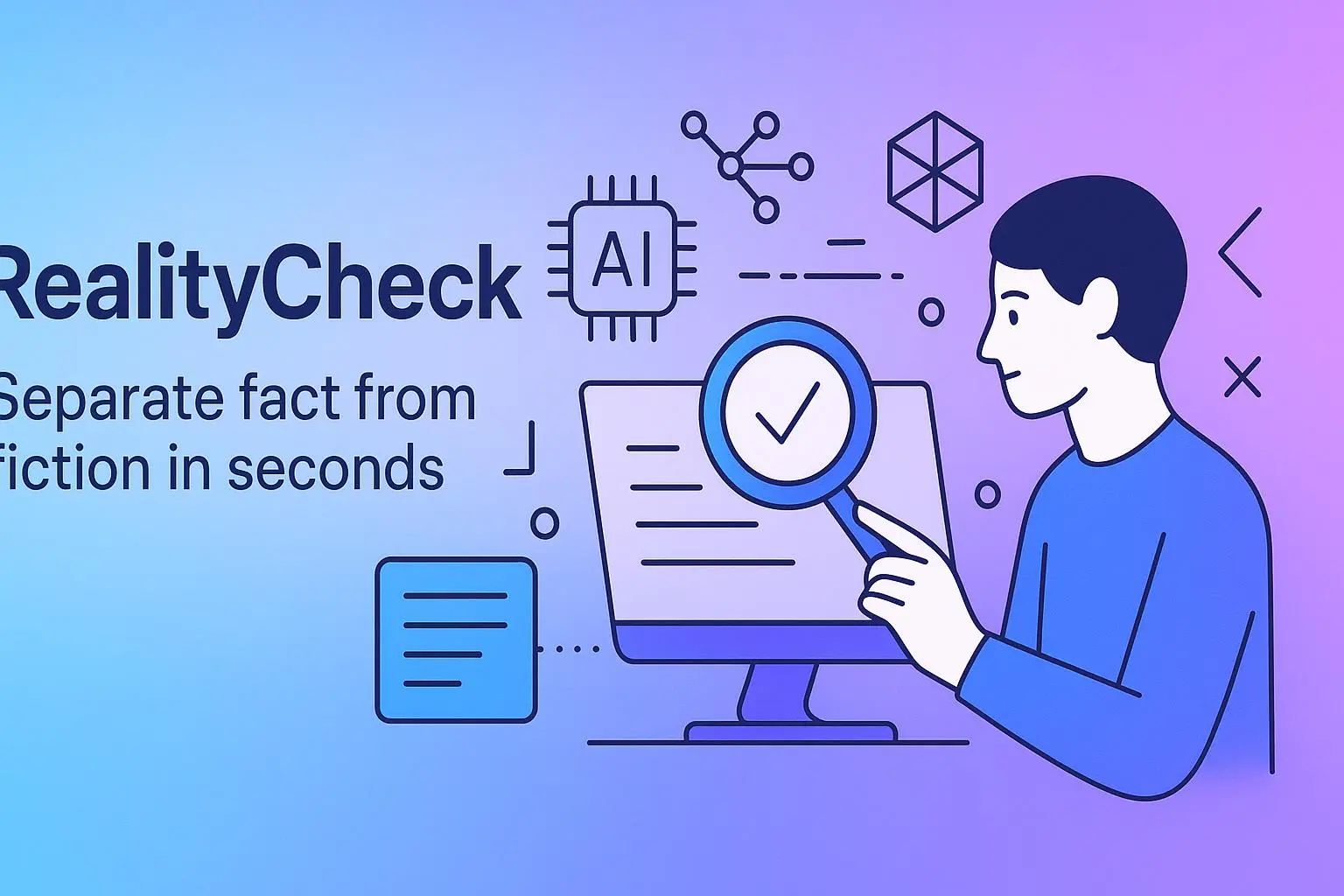
Why RealityCheck: Separate fact from fiction in seconds is revolutionizing how we approach daily challenges
Apr 22, 2026 • 10 min
If you’ve ever felt overwhelmed by the speed and scale of misinformation online, you’re not alone. I’ve spent the last few years watching people, including myself, wrestle with the flood of claims that sound plausible but aren’t true. RealityCheck isn’t just another tool for fact-checking. It’s a practical companion that helps you separate fact from fiction in seconds, so you can move from confusion to clarity without burning up hours every day.
And yes, I’ve tested this in the real world. Not in a lab, but in the messy, caffeinated chaos of daily life—reading a storm of headlines during a chaotic news week, evaluating a health claim that spread like wildfire on a forum, and deciding which product to buy after reading dozens of reviews. RealityCheck didn’t magically solve everything, but it gave me a steadier, faster way to cut through the noise. It changed the pace at which I think, and that’s priceless.
Here’s what I learned along the way, with concrete examples, practical tips, and a few honest missteps I learned from the hard way.
A quick moment I’ll carry forward: when I first started using RealityCheck, a friend sent me a viral video about a new supplement that claimed dramatic, instant health benefits. I pasted the video’s transcript into RealityCheck, and within seconds I saw three things I hadn’t noticed: the video’s narrator had a history of sensational claims, the source channel had a pattern of low editorial standards, and several cited studies appeared to be misrepresented or out of date. It wasn’t that the claim was definitively false in every case, but the platform highlighted gaps I would have glossed over. I saved time, avoided making a questionable purchase, and learned to spot a recurring pattern—overstated results paired with cherry-picked data.
The core promise of RealityCheck is simple: give people a reliable, transparent way to assess claims across text, images, and media, with explanations they can actually understand. It’s not about replacing critical thinking; it’s about making critical thinking faster, more precise, and more accessible to non-experts.
In this piece, I’ll walk you through what RealityCheck does, why it works, and how you can apply it to real-life decisions—from quick news checks to deeper research projects. I’ll share a 1000-foot view, then drop into the practical, day-to-day workflows I use to get real value without turning verification into a full-time job. And yes, there’s a real story from my own experience buried in here—because theory is only as good as its ability to help you live better.
How RealityCheck actually works (the bones beneath the hood)
RealityCheck positions itself as an AI-powered fact-verification system designed to help users rapidly assess the accuracy of claims across multiple contexts. The team leans into a multi-agent architecture: content decomposition, information retrieval, data summarization, and sentiment analysis all pass through parallel AI processes to arrive at a conclusion, with explanations and source citations attached. The goal isn’t a binary true/false verdict in every case, but a structured verdict along with confidence scores and the reasoning behind each assessment.
The most powerful part, in my view, is transparency. When RealityCheck says a claim is “likely true,” you also see which sources and data points supported that conclusion, and you can drill into those sources if you want to verify the verification itself. This is crucial because trust isn’t a mood; it’s a set of trackable, verifiable steps you can audit.
And because AI systems can hallucinate—gloss over details and pretend they know more than they do—the platform acknowledges a known limitation: it flags areas where data is incomplete or where the inference could be unreliable. It’s an honest admission that AI isn’t perfect, which makes it more trustworthy than many “fact-checkers” I’ve used in the past.
The key features you’ll actually use
- Real-time verification for text, images, and short video clips. Paste a claim, drop a link, or upload a file, and you’ll get an immediate verdict with a confidence score. The speed matters when you’re scrolling through a busy feed or preparing a quick briefing.
- Contextual analysis and nuance. RealityCheck isn’t just “truthy” or “not true.” It flags missing context, potential biases, and competing narratives. It’s easy to misinterpret a claim if you don’t see what else is at play; this feature helps you see the bigger picture.
- Source credibility assessment. The tool evaluates where information comes from, including editorial standards, publication history, and known biases. It’s the difference between “this source says X” and “this source has a track record of [patterns].”
- AI-generated content detection. As Created Content becomes harder to distinguish from human work, RealityCheck provides confidence scores for AI-generated text and images, helping you spot machine-made material before you share it.
- Personalization and problem-solving. The system can tailor its analysis to your goals—whether you’re researching a product, evaluating a health claim, or weighing a policy proposal. It cross-references verified sources to present balanced perspectives, so you don’t get biased toward one side by default.
- User-friendly interface. The backend is sophisticated, but the surface is clean and intuitive. You don’t need a cryptic workflow to get value; you should be able to verify a claim while you’re sipping your coffee.
A real-world example—how I used RealityCheck to decide on a big purchase
Last year, a home renovation project landed on my plate: a decision between two solar panel installers. Both came with glossy brochures, perfect scores on major review sites, and claims that sounded almost identical. I started with a side-by-side read of their technical specs and customer testimonials. Within minutes, RealityCheck pulled in independent data: local installation success rates, warranty coverage details, regulatory compliance notes, and reported customer experiences beyond the company’s own site.
What I found surprised me. One installer had a handful of recent complaints about a specific inverter model causing frequent outages in winter months. Another installer had a stronger history of warranty claim processing, but fewer long-term customer reports beyond the first year. RealityCheck didn’t tell me which company to pick; it gave me a structured view of credible signals, gaps, and risk factors I’d have missed if I’d relied on buzzwords and marketing materials alone.
The moment that stuck with me happened after I’d skimmed both companies’ websites and a few user reviews. I paused and asked RealityCheck to summarize the consensus across multiple independent sources, with a focus on long-term reliability. The result: a concise verdict that highlighted a higher risk with the inverter issue in one option and a more robust support history with the other, plus a couple of regulatory caveats specific to my city. It saved me days of manual digging and helped me sleep better about the decision.
That day, a micro-moment mattered: I was standing in my garage, looking at a sparkly solar quote. I pulled out my phone, dropped the claim into RealityCheck, and watched the platform spit out a verdict with sources I could open right there. The mental shift was immediate—this was no longer “trust the brochure or the review” but “trust what the verified data says, with the chain of evidence.” I bought later that week, and the experience left me with a simple rule I now apply to every major decision: start with a quick reality check, then go deeper only if the numbers line up.
What makes RealityCheck different from other tools
- It’s not a single-point estimator. Unlike many tools that give you a yes/no answer, RealityCheck presents a transparent reasoning process, showing what data and sources led to each conclusion. That’s invaluable when you’re trying to weigh trade-offs or understand why something feels off.
- It’s designed for daily life, not just journalism. The platform’s features are tuned for practical, real-world decision-making—whether you’re evaluating a health claim you read on social media, vetting a political claim, or checking a product’s reviews before buying.
- It addresses the whole information ecosystem. It looks at image authenticity, the risk of AI-generated content, and the credibility of the original sources. In an era where someone can fabricate convincing visuals and fake credentials, that breadth matters.
- It builds better digital literacy. The tool teaches you to examine claims with a critical eye, not just accept or reject. The transparency layer helps you understand what “trust” actually means in digital information—where it comes from and how it’s built.
Practical ways to weave RealityCheck into your daily routine
- Quick news checks during your morning loop
- Before you share a post or form a quick opinion, drop the claim into RealityCheck. See the confidence score, note the sources, and skim the brief contextual notes. If something looks shaky, you have a choice: stop sharing, seek more data, or write a balanced comment that reflects the uncertainties.
- Vetting health or wellness claims
- Health trends travel fast on the internet. RealityCheck won’t replace medical advice, but it can surface whether a claim is backed by credible sources or if the discussion is tangled with misrepresented studies. If you’re shopping for supplements, the tool can flag lack of peer-reviewed data and plausible side effects.
- Informed consumer decisions
- When you’re comparing products, pull up a few key claims—price, warranty, performance metrics, regulatory notes. RealityCheck can synthesize these across verified sources, showing you where the strongest evidence lives and where gaps exist.
- Academic and professional use
- In a meeting or a research project, use RealityCheck to validate sources and check for biases. It’s not a substitute for critical reading, but it can shorten the time you spend on background checks while preserving trust in your work.
- Monitoring misinformation trends
- If you manage a team or a community, RealityCheck can help you spot recurring misinformation patterns and equip your teammates with reliable, sourced explanations. It’s a practical way to build a culture of careful information consumption.
The tech behind the magic (without getting lost in jargon)
RealityCheck’s architecture isn’t a single giant brain; it’s a collaborative set of agents that work together, each handling a facet of verification. They decompose claims into components, fetch relevant data from trustworthy sources, summarize and cross-check the information, and analyze sentiment to understand bias. The result is a structured verdict with a confidence score and a clear trail of evidence.
One important caveat: AI is powerful, but not perfect. RealityCheck openly flags where data is incomplete or where the AI’s inference could be less reliable. This transparency is essential because it helps you calibrate your trust and decide when you want to dive deeper or consult human experts for a final check.
A few numbers and research-backed reasons this approach matters
- False information spreads faster than truth on social networks. A widely cited study in Science showed false news travels, on average, farther, faster, and deeper than true news. RealityCheck acknowledges this dynamic and offers a tool to disrupt that cycle by surfacing credible context quickly.
- People rely on online reviews and health claims when making decisions. PwC’s global consumer insights and other consumer reports underscore how heavily people lean on online information before buying or acting. RealityCheck aligns with this behavior by delivering verifiable data and clear source signals to back up claims.
- Trust in AI depends on transparency and control. Deloitte and other researchers emphasize that trusted AI is built on clear disclosure of how decisions are made and where data comes from. RealityCheck’s design mirrors this principle by showing confidence levels and source links, not just verdicts.
A cautionary tale I learned the hard way
Early on, I relied on RealityCheck to vet a high-stakes claim in a business proposal: a bold efficiency metric touted by a vendor. The platform flagged a lack of peer-reviewed studies and inconsistent real-world benchmarks. Great, I thought—red flag caught. But the vendor’s internal whitepaper had compelling data that wasn’t publicly available. RealityCheck didn’t dismiss the claim; it highlighted where the data came from versus where the data was missing, and it suggested additional questions to ask the vendor.
That moment taught me two things I carry forward:
- Verification isn’t closure; it’s a doorway. You use the tool to surface what you don’t know and to shape the right questions.
- You still need human judgment for nuanced, high-stakes decisions. RealityCheck is a powerful assistant, but it doesn’t replace the final go/no-go decision when stakes are high or the context is deeply specialized.
What I’d change about daily information habits with RealityCheck
- I no longer wing it with a rumor and a headline. If a claim seems too good or too alarming, I give it a quick RealityCheck pass. If the results are inconclusive, I delay a public opinion or a purchase and dig deeper with the attached sources.
- I’ve built a habit of bookmarking credible sources surfaced by RealityCheck. When I write about a topic, I reference the same sources the tool did, which saves me time and strengthens my argument.
- I train teammates to interpret confidence scores, not just verdicts. A low score should prompt skepticism; a high score should prompt a closer read of the sources.
The broader impact: why this matters for daily life and work
RealityCheck isn’t just a product feature. It’s a mindset shift. The digital world rewards speed, but speed without clarity is a trap. RealityCheck provides a bridge: fast, evidence-based insights that respect the user’s intelligence. It turns the act of verification—from a dreaded chore into an efficient daily habit. Over time, that compounding effect compounds into sharper decision-making, less cognitive wear, and greater confidence in the choices you make in real life.
If you’re still unsure, here’s the simplest way to test RealityCheck for yourself: pick a claim you’ve seen recently—something about health, a political development, or a consumer product. Paste the claim into RealityCheck. Read the verdict and the sources. If you find the confidence scores and the reasoning convincing, you’ve just bought a more reliable tool for your daily decision-making.
A real quick aside that stuck with me: I once decoded a viral post about a “miracle” supplement that promised dramatic energy boosts. RealityCheck flagged a literature gap, pointed out a questionable model year for the product, and highlighted several peer-reviewed studies that contradicted the claim. The experience didn’t just protect me from a questionable purchase; it reminded me to look for the quality of the evidence, not just the volume of testimonials. That small detail—the presence of credible references—made a big difference in how I evaluated future claims.
A closing thought: the future of information is not about more content, it’s about better signals
We live in a world of abundant content, with sources that vary wildly in trustworthiness. RealityCheck isn’t a silver bullet, but it’s a practical way to restore balance: faster verification, clearer context, and more responsible consumption. It helps you decide what to believe, what to question, and what to ignore—without turning every afternoon into a research project.
If you want to think about daily life with RealityCheck, imagine a smart assistant that respects your time, respects your intelligence, and helps you stay curious without getting overwhelmed. That’s what this tool aspires to be: a reliable, human-centered way to navigate a messy information landscape with confidence.