Why Tarot Reader is Revolutionizing How We Approach Daily Challenges
Mar 13, 2026 • 7 min
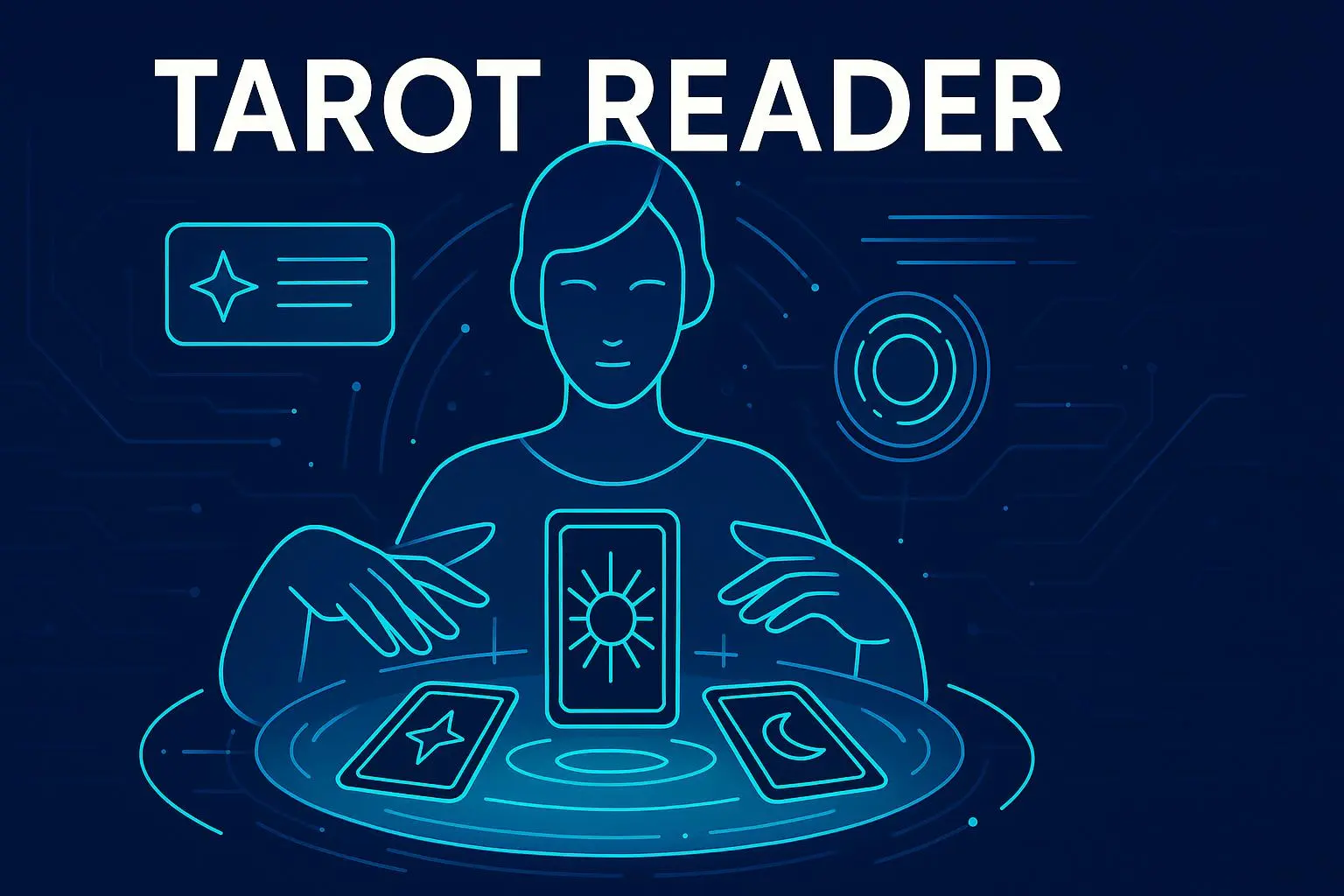
Open any app store and you’ll find tarot readers that feel more like pocket therapists than fortune-tellers. They don’t predict your fate. They help you see patterns you were ignoring.
This is where Tarot Reader—the AI-powered kind—matters. It blends natural language processing, pattern recognition, and a massive knowledge of tarot symbolism to turn a five-minute check-in into practical clarity. The result? Faster, more accessible self-reflection that you can actually use on a weekday morning before a tough meeting.
What an AI Tarot Reader actually does
Imagine you type, “Should I accept the promotion?” The app does three things fast:
- It reads your question with NLP to understand tone and intent.
- It maps that intent to a spread and a bank of archetypal meanings.
- It composes an interpretation that connects the cards to your specific ask.
That last step matters. Good systems don’t just spit out card meanings. They cross-reference card combinations, the way certain archetypes shift meaning in context, and prior readings you’ve done. So the “Three of Swords” won’t always equal heartbreak—it might translate to a painful but necessary career cut depending on your question.
Why this matters for day-to-day decisions
Here’s the pragmatic payoff: accessibility, consistency, and structure.
Accessibility because you don’t have to book an appointment or explain yourself in person. Consistency because an algorithm can track your reading history and surface patterns—“You keep drawing cards about boundaries”—which a single human session may miss. And structure because a spread forces you to consider past, present, and potential outcomes in one tidy frame.
People use these readings to:
- Get quick perspective before a call or date
- Test possible outcomes without overthinking
- Journal and spot recurring themes over months
It’s not mystical; it’s practical scaffolding for messy thinking.
The tech in plain English
Under the hood, it’s familiar AI building blocks:
- NLP to parse your question and detect emotional cues.
- A knowledge graph of card meanings and historical interpretations.
- A model (often a deep neural net) that matches user intent to card combinations and narrative templates.
- A feedback loop that refines phrasing based on user reactions and saved readings.
That combination turns symbolic tradition into structured output. Instead of a human reader riffing on intuition, you get repeatable, testable prompts that help you act.
A real story: what happened when I used one for a tough choice
Two years ago I was between cities and three different job offers. One was stable money, one was a wild creative role, and one was a sideways move that promised better hours. I’m stubborn about not outsourcing my decisions, so I opened an AI tarot app out of curiosity—not to “decide for me,” but to force a different angle.
I typed, “Which option helps me grow without burning out?” and did a three-card spread: past, obstacle, potential.
The reading didn’t say “Choose job A.” It highlighted that my “obstacle” card pointed to a pattern: I defaulted to prestige when stressed. The “potential” card emphasized sustainable routines. That forced sentence—“You default to prestige when stressed”—stung. I negotiated the hours and took the creative job with more safeguards. Six months later my stress metrics (actual step count and sleep data I was tracking) were up, and I’d shipped a product feature I’m proud of.
What I learned: the value was not prophecy but a mirror—a concise language that translated my foggy worries into an actionable insight.
Micro-moment: a tiny detail that stuck with me
When the app suggested a tiny ritual—lighting a candle for two minutes before a reading—I laughed. But those two minutes of calm made the reading feel less like an algorithm and more like a moment I’d chosen to take. Small rituals matter.
Where AI excels over a quick human reading
AI is uniquely good at three things most humans aren’t:
- Serving thousands of people instantly with the same quality.
- Tracking long-term patterns across sessions.
- Scaling personalization—adapting phrasing and follow-up prompts based on your past questions.
If you want daily reflections, trend spotting, or a consistent framework for thinking, AI wins. It doesn’t get tired, it doesn’t forget, and it can prompt deeper questions when it notices repetition.
Where AI still falls short
But don’t mistake it for a human therapist or an in-person, intuitive reader.
AI struggles with:
- Embodied cues—tone, breath, micro-pauses that human readers use.
- Cultural nuance when training data is narrow.
- Deep, situational empathy that comes from lived experience.
In short: it’s excellent at structure and pattern detection; weaker at nuance and deep empathic reading.
Ethics and privacy—what you should ask before you use one
If you’re typing personal problems into an app, ask:
- How is my data stored and encrypted?
- Can I delete my reading history?
- What sources trained the model—are interpretations culturally diverse?
AIs trained on narrow or biased corpora can skew guidance. Good developers are already working on bias mitigation and clearer consent flows, but you should still be cautious with sensitive material.
Practical ways people use Tarot Reader right now
- Morning check-ins: a quick card to set intention for the day.
- Decision scaffolding: laying out pros, cons, and underlying emotions.
- Content for creators: daily AI readings that are consistent enough to publish.
- Group activities: icebreakers at workshops or team retros where a neutral prompt helps start a conversation.
- Journaling prompts: the app suggests questions to dig deeper into a recurring card.
These are not wild futuristic use cases. They’re how people are already folding AI tarot into routines.
How to get better results from an AI reading
Here’s what I’d tell a friend who wants more than a generic take:
- Be specific. “Should I move?” is vague. “Would taking job X help my mental bandwidth?” yields better answers.
- Use the app’s history. Compare readings from three months ago to now.
- Treat it as coaching, not prophecy. The cards are a language; learn the vocabulary.
- Combine with real-world data. If sleep and focus have dipped, mention that in your question.
The future: where this goes next
Expect three sensible improvements:
- Deeper personalization through optional biometric signals and journaling patterns.
- Better cultural calibration as training sets diversify.
- Clearer ethical guardrails—explainability and data controls.
AI tarot won’t replace human practitioners. But it will become a dependable, on-demand partner for daily reflection.
Final take
Tarot Reader powered by AI is not a mystical oracle. It’s a practical tool built on archetypes and algorithms. For anyone juggling decisions, anxiety, or creative blocks, it offers a compact, structured way to see patterns and act.
Use it as a compass, not a map. Ask better questions. Save readings. And remember: the most useful insight is the one that makes you do something different.