Beginner’s Checklist: Getting Started with Micro-Defusion for Sleep
Jan 17, 2026 • 9 min
If you’ve tried cutting screens, counting sheep, and pricey gadgets—and still wake up groggy—micro-defusion might be the missing piece.
Micro-defusion is simple: you slowly and deliberately reduce the “stimulus dose” your brain gets before bed. Not an all-or-nothing blackout, but a gentle turn-down over a few hours so your biology can do what it’s built to do—release melatonin, cool your core, and drift into sleep.
I’ll walk you through a checklist you can start tonight: timeline, light choices, posture, mental prep, and tracking. No jargon-heavy theory, just specific actions that actually work.
Why the slow fade matters
Sudden darkness or a last-minute attempt to “relax” rarely works because your circadian system responds to intensity and timing. Light—especially blue light—presses the brake on melatonin. Cognitive arousal (planning, problem-solving) keeps your nervous system switched to “on.”
Micro-defusion uses two levers: sensory (light, sound, posture) and cognitive (what you let your brain do). When you adjust both slowly across a few hours, you’re aligning behavior with biology. The research backing this is clear: evening light timing and intensity influence sleep timing, and semi-recumbent postures can support parasympathetic activation and easier breathing[1][2][3].
The 4-hour rule: set your timeline
Here’s the simplest structure: pick your target bedtime (T‑0) and start a 4-hour micro-defusion window.
- T-4 to T-2: begin lowering overall stimulation.
- T-2 to T-1: critical reduction—cut non-essential screens, start the brain dump.
- T-1 to T-0: low-arousal activities, dim lights, semi-reclined posture, and wind-down rituals.
Why four hours? It gives melatonin production room to ramp naturally without sudden shocks. In practice, the first two hours are behavioral (lighting, workload), the next two are physiological and psychological.
Step 1 — Light phasing: your light “budget”
Light matters more than most people think. Melanopsin-containing retinal cells are highly sensitive to blue/green light and tell your brain it’s daytime.
Actionable items:
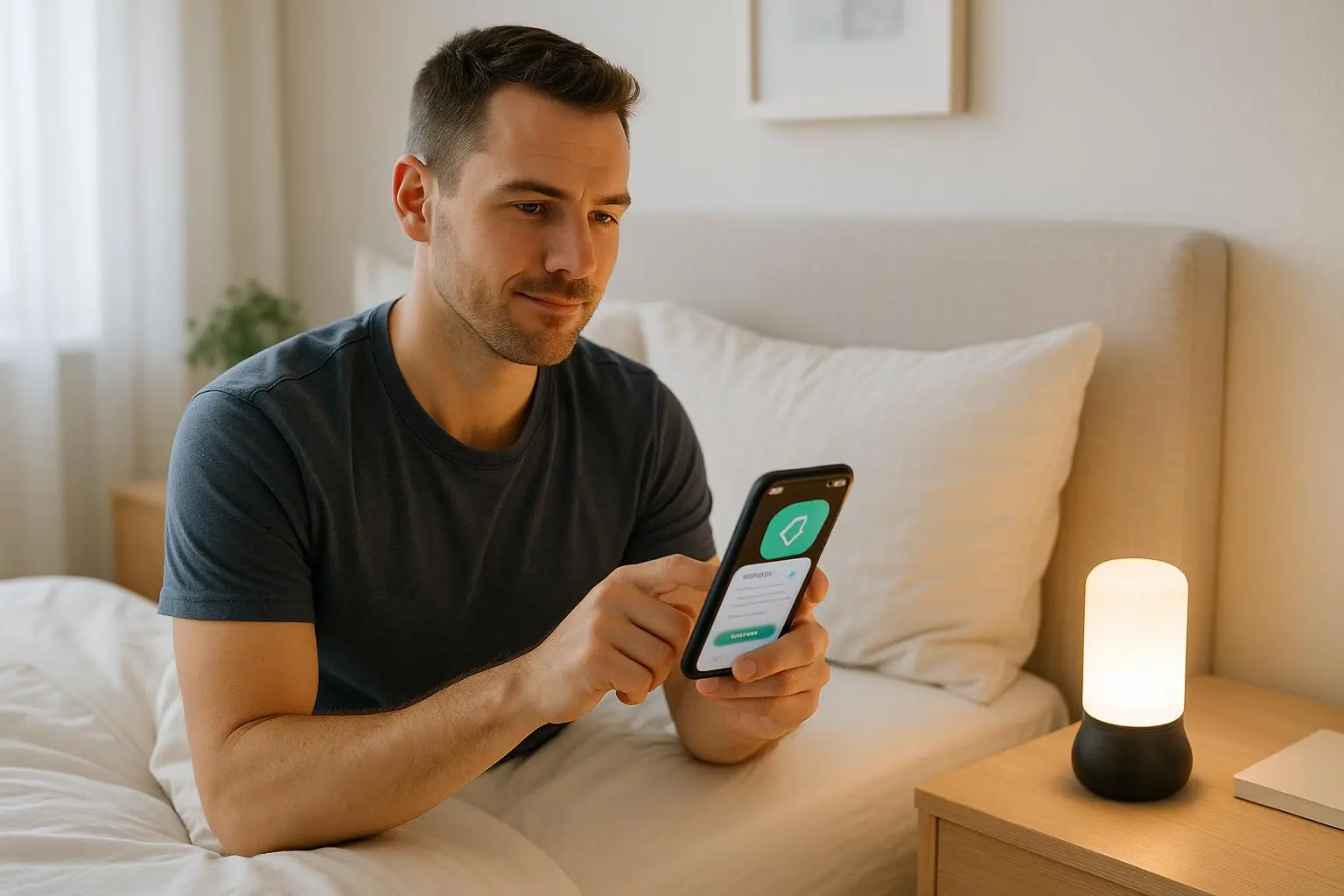
- T-4 to T-2: swap bright overhead lights for warm bulbs (below ~3000K). If you use screens, run f.lux or Night Shift at max warm setting. Lower screen brightness manually if you can.
- T-2 to T-1: eliminate non-essential screens. If you must read, use an e-reader with warm backlight or a paper book under a dim amber lamp.
- T-1 to T-0: consider blue-blocking glasses or near-total warm light. If you’ve got Red Light Man–style glasses, this is their moment.
Specific numbers: prefer bulbs under 3000K; ideal bedroom temp between 15–19°C (60–67°F) for sleep onset. These aren’t magic—they’re proven ranges where your body prefers to drift into sleep[1][4].
Quick tool picks: f.lux for desktop color shifting, warm 2700K bulbs for reading lamps, and red/amber bedside lamps for the last hour.
Micro-moment: I bought a cheap amber bulb for my corner lamp. The first night I noticed the room looked cozy instead of “hospital bright,” and my shoulders unclenched before I even sat down.
Step 2 — Posture and environment: small changes, measurable gain
Posture does two things: it cues your brain that “daytime work” is over and it physically eases breathing and digestion.
Actionable items:
- T-1 to T-0: avoid lying flat on your back watching a glowing screen. Try a semi-reclined posture (about 135°) on a chair or sofa for reading or listening.
- Move work activities out of the bedroom at least T-3 hours. Your brain should associate that spot with rest, not spreadsheets.
- Control the room: cool temperature (15–19°C / 60–67°F), and white/pink noise if ambient sounds wake you.
People report modest but reliable improvements: better breathing, less reflux while reading, and a small uptick in subjective sleep scores when the semi-reclined posture is used consistently[2][5].
Pro tip: a folded blanket behind your lower back gives a surprisingly comfortable 135° angle on a regular armchair.
Step 3 — Cognitive defusion: get the thoughts out of your head
This is where the “micro” in micro-defusion really helps. You don’t need an hour-long meditation—just a 10-minute pre-light-dimming habit.
Actionable items:
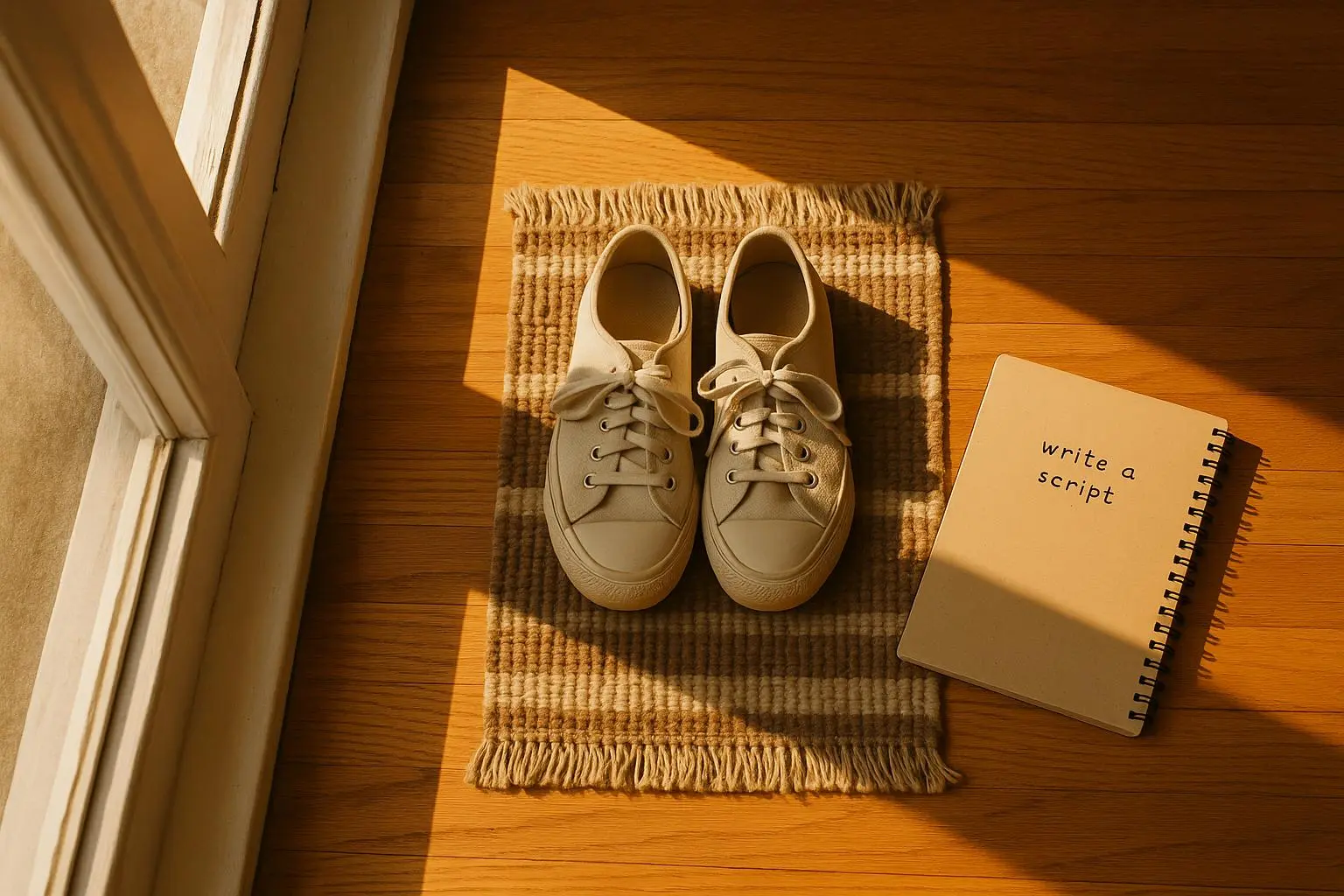
- T-2: do a 10-minute brain dump. List tomorrow’s tasks, worries, and anything floating in your head. Put the note in a dedicated “tomorrow” notebook or an app tagged “night.”
- T-1 to T-0: choose only low-arousal activities—light stretching, guided breathing, fiction reading, or a sleep story. Avoid news, work email, and anything that spikes your planning circuits.
- If anxiety keeps intruding, try a 4-4-8 breathing cycle (inhale 4, hold 4, exhale 8) for two minutes. It’s short, repeatable, and effective.
I learned this the hard way: for a month I kept telling myself I’d “think of it later.” My nights were a loop of problem-solving. Once I wrote everything down—and closed the notebook—I slept better. Not perfect, but better. Over two weeks my subjective sleep score climbed from 4/10 to 7/10.
Micro-moment: the physical act of closing the notebook felt like a subtle boundary my brain respected.
Step 4 — Track it: simple data, big decisions
You don’t need a lab setup. A basic log reveals patterns fast.
Track nightly, for two weeks minimum:
- Time you started dimming lights (start of defusion)
- Time you entered bed
- Sleep quality (1–10)
- Notable daytime confounds (caffeine after 3 pm, late exercise, alcohol)
Look for correlations: does earlier dimming = higher sleep score? Do late caffeine days erase benefits?
Tools that help: Sleep Cycle or a simple spreadsheet. If you want precision, use Toggl to log your T-4 start time so you can calculate adherence easily.
Be patient. Circadian shifts take time. Expect noise for the first week; more consistent signals after 10–14 days[3].
Dealing with common objections and failure points
“I tried it three nights and woke up at 3 AM—does it work?” Short answer: maybe not immediately. Your circadian system needs consistency. Also check daytime habits—afternoon caffeine, irregular light exposure, or late vigorous exercise blunt the effect.
“My job keeps me on screens late.” If you can’t fully avoid screens, prioritize stepping away from work at T-3 and use aggressive screen warmers plus a dedicated amber lamp for the last hour. Create a non-work ritual—make tea, change into softer clothes, and sit in a different chair.
“Is posture weird?” Yes. It feels odd the first few nights. Give the semi-reclined position five nights; your body usually adapts and the breathing improvement is what sells it.
“Can I take melatonin?” That’s an intermediate question. Melatonin supplements can help phase-shifting but aren’t a substitute for properly timed light exposure. Talk to a clinician if you’re considering regular supplementation.
Real results: what to expect and how long
What most people report:
- Week 1: subtle changes—less mental fog before bed, slightly faster sleep onset some nights.
- Week 2: clearer pattern—earlier melatonin onset, fewer awakenings for many users.
- 2–4 weeks: significant alignment for consistent practitioners, particularly when daytime light and caffeine are managed.
Remember: micro-defusion is a behavior-based nudge to biology. It’s most powerful when combined with daytime cues—morning bright light, regular activity, and limited late caffeine.
Quick-start checklist (one-page)
Tonight, try this sequence:
- T-4: switch overhead lights to warm bulbs; enable screen warmers.
- T-2: do a 10-minute brain dump; relocate work outside the bedroom.
- T-1: stop all non-essential screens; switch to an amber lamp; sit semi-reclined.
- T-0: get into bed after a calm, low-arousal activity; record the start time and your sleep quality.
Repeat nightly for two weeks before judging effectiveness.
Tools that make it easier
- f.lux / Night Shift — automatic screen warming (T-4 to T-2)
- Red/amber bedside lamp or blue-blocking glasses — last-hour immersion
- Sleep Cycle — simple sleep tracking and morning data
- Toggl — if you want precise adherence logging
Final thought: less forcing, more letting go
Micro-defusion isn’t about tricking sleep with gadgets. It’s about setting up a gentle, predictable fade from day to night. You’re not trying to force sleep; you’re letting biology take its course by removing the things that keep it from starting.
If you’re skeptical, do a two-week trial with the exact timeline above. Track the start time of dimming, your bedtime, and a sleep-quality score. Adjust one variable at a time—move the T-4 start earlier or swap in a red lamp—and you’ll see what matters for you.
You’ll probably be surprised how much a soft light and a closed notebook can change the end of your day.
References
Footnotes
-
Wright Jr, K. P., Boivin, D. B., & Czeisler, C. A. (2013). Impact of light on human timekeeping. Physiology & Behavior. Retrieved from https://doi.org/10.1016/j.physbeh.2013.05.001 ↩ ↩2
-
Kuno, Y., Mizuno, K., & Takahashi, M. (2019). The effect of semi-recumbent posture on respiratory function and autonomic nervous activity. Journal of Physical Therapy Science. Retrieved from https://www.ncbi.nlm.nih.gov/pmc/articles/PMC6790706/ ↩ ↩2
-
Foster, R. G., & Hankins, M. W. (2008). Circadian rhythms: light, the eye and the brain. Current Biology. Retrieved from https://doi.org/10.1016/j.cub.2008.06.011 ↩ ↩2
-
Chang, A. M., Aeschbach, D., & Duffy, J. F. (2015). Evening use of light-emitting screens significantly suppresses melatonin and delays circadian timing: a randomized, crossover trial. Proceedings of the National Academy of Sciences. Retrieved from https://www.pnas.org/doi/10.1073/pnas.1505648112 ↩
-
National Sleep Foundation. (2021). Benefits of Semi-Reclined Posture for Sleep and Breathing. Retrieved from https://www.sleepfoundation.org/physical-health/semi-reclined-sleep-benefits ↩