Designing a Statistically Sound Proofreading Experiment
Jun 20, 2026 • 9 min
You want an answer to this: can AI proofread as well as humans for your content? Great question. But "does it work?" is not the same as "how do we know it works?" The experiment you run determines whether you'll get reliable, actionable answers—or fancy-looking numbers that mean nothing.
I’ve run three internal experiments comparing automated checks to human edits. Two of them produced useful change; one almost convinced us to switch tools because we’d executed the study poorly. In this post I’ll walk you through a practical, no-fluff blueprint: how to form a testable hypothesis, pick the right sample size, randomize properly, choose the right statistical test, and report results so your team can act on them.
Brief warning: none of this is magic. Good experiments are boring, precise, and documented. But they deliver trustworthy decisions.
Why this matters (fast)
You can save time and money with AI—but only if it solves the right problems.
AI often catches mechanical typos quickly. Humans still win at context, tone, brand voice, and ambiguous phrasing. Your experiment should show not just whether AI finds errors, but what errors it finds, which ones it invents (false positives), and where human judgment matters.
If you skip this and just adopt a tool because "it seems faster," you’ll pay for that choice later with rework, brand drift, or worse: published errors that damage trust.
Start here: a clear, testable hypothesis
Here's the single most common mistake: vague goals.
Bad: "We want to see if AI proofreading is good."
Better: "We believe AI will detect more mechanical errors (spelling, punctuation) per 1,000 words than human proofreaders, while humans will detect more contextual and style errors. We'll test whether these differences are statistically significant."
Your hypothesis should state:
- the independent variable (proofreading method: AI vs human),
- the dependent variables (error detection rate, false positive rate, error type distribution, time per document),
- the expected direction or difference,
- a concrete refutation condition (what would make you reject your expectation).
Write this down in one paragraph. If the team can't agree on it, stop and clarify.
Define your metrics (no vague "accuracy")
You must operationalize "accuracy." Make it measurable.
Choose primary and secondary metrics. Example:
Primary
- Error Detection Rate = (True Errors Detected) / (Total True Errors) per 1,000 words
Secondary
- False Positive Rate = (Incorrect Flags) / (Total Flags)
- Time per Document (minutes)
- Error Type Distribution (grammar, punctuation, spelling, style)
Create a concise rubric that defines each error type. Train humans on that rubric and record edge cases.
Micro-moment: I once watched two senior editors argue for 20 minutes about whether a sentence was "awkward" or "acceptable." We captured that disagreement as "ambiguous - crew decision" and learned more from the disagreement than from the error tallies.
Experimental design choices
Pick the design that answers your question and fits your capacity.
Between-subjects design
- Different documents go to AI and humans.
- Pros: no practice/order effects; simpler to run.
- Cons: needs larger sample sizes because document variability adds noise.
Within-subjects (paired) design
- Same documents are proofread by both AI and human.
- Pros: controls for document variability; more statistical power.
- Cons: ordering effects (if the same human sees the AI's suggestions) and risk of contamination.
Mixed design
- Some documents are paired, others are unique per arm.
- Pros: tradeoff between power and logistics.
For most content teams I recommend a paired design when feasible: have the same documents evaluated by an expert "ground-truth" reviewer and both treatments (AI and human). That gives you direct comparisons per document and reduces noise.
Sampling and randomization
Pick a representative content pool. That means a realistic mix: blog posts, help-center articles, product descriptions—whatever you publish daily.
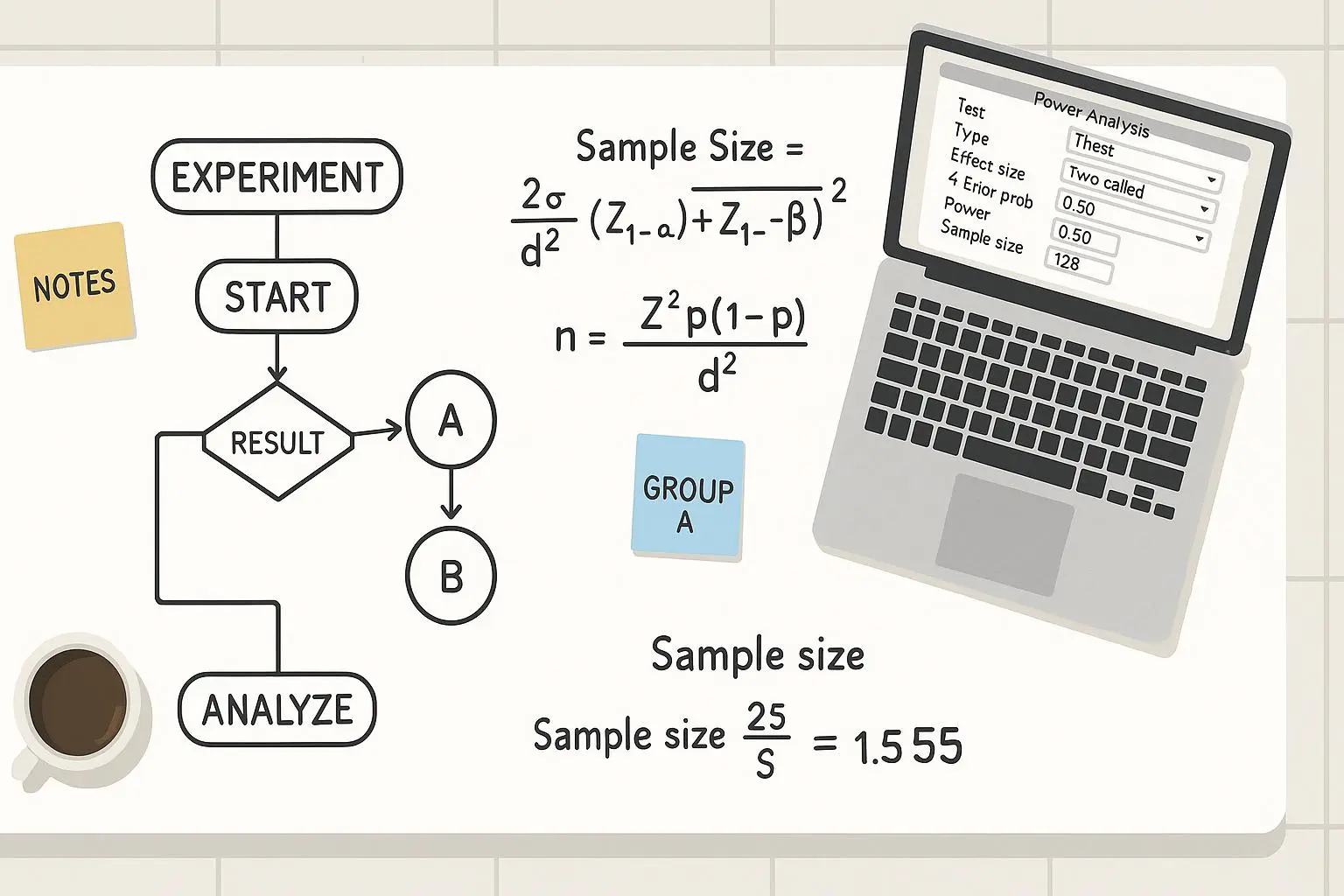
Sample size matters. Do a power analysis before you start.
Quick rules of thumb
- If you expect a large difference (Cohen’s d ≈ 0.8), 20–30 documents per arm might suffice.
- For moderate differences (d ≈ 0.5), aim for 50–80 per arm.
- For small differences (d ≈ 0.2), you’ll need hundreds.
If you don't have a statistician, use a free tool (JASP, G*Power) or conservative rules: aim for at least 30–50 items per group for basic tests.
Randomization
- Randomly assign documents to conditions (AI vs human) or randomize the order in which reviewers see documents.
- If multiple human proofreaders participate, randomize which proofreader sees which document to avoid confounding skill with document difficulty.
- Log the random seed or method used for reproducibility.
Practical note: randomization doesn’t mean chaos. Stratify if necessary—create buckets by document type or length, then randomize within buckets to keep groups balanced.
Ground truth: where the "truth" comes from
You need a reliable reference to compare both methods against.
Best approach
- Have one or two senior editors (not the same ones who acted as study proofreaders) create a ground-truth set.
- They should mark every true error and label its type.
- For ambiguous cases, include a short justification.
Measure inter-rater reliability (e.g., Cohen’s kappa) when you use multiple ground-truth reviewers. If kappa is low (<0.6), your rubric needs work.
Pro tip: treat the ground-truth pass like code review. One reviewer creates the baseline, another audits a sample for consistency.
Choosing the right statistical test
Your test depends on the data type and design.
Categorical outcomes (counts/frequencies)
- Chi-square test: compare distributions of error types, or proportion of documents with at least one missed error.
- Use Fisher’s exact test if cell counts are small.
Continuous-ish outcomes (error counts, scores)
- Independent samples t-test: comparing means between two independent groups (different documents per group).
- Paired samples t-test: comparing the same documents under two conditions (paired design).
- Report means, standard deviations, p-values, and effect sizes (Cohen’s d for t-tests).
Nonparametric alternatives (if assumptions fail)
- Mann-Whitney U: independent samples, non-normal data.
- Wilcoxon signed-rank: paired, non-normal data.
- Kruskal-Wallis or ANOVA for >2 groups.
Always check assumptions: distribution, variance homogeneity, and independence. If you have small sample sizes or skewed error counts (common!), nonparametric tests are safer.
Beyond p-values
- Report confidence intervals for effect sizes.
- Report absolute differences (e.g., "AI detected 12.4 fewer errors per 1,000 words [95% CI: -18.1, -6.7]")—those are easier to act on than p < 0.05 alone.
Handling false positives and edge cases
False positives matter. An AI that flags 30% correct text wastes time and destroys trust.
Decide ahead how to score flags:
- Counted as false positives immediately? Or flagged for human confirmation?
- Track how many suggested corrections are accepted vs rejected.
Document rules for ambiguous fixes: e.g., suggestions that change tone or brand voice should be tagged as "style" and handled separately.
Inter-rater reliability for human proofreaders
If you use multiple humans, measure agreement.
Steps:
- Have at least 10% of documents reviewed by two humans independently.
- Compute Cohen’s kappa or percent agreement.
- If agreement is low, retrain with clearer rubric examples and re-run a calibration subset.
Real story (150 words) My team once ran a "prove AI can do our job" sprint. We picked 40 support articles and split them between our best proofreader and a popular AI tool. We used a paired design so each article would be annotated by both the AI and the human, then compared to a senior editor's ground truth. We thought we’d saved the day when the AI got 35% of errors. Except the senior editor's pass exposed a problem: the AI flagged a lot of low-value style quirks (false positives), and the human missed several repeated wording inconsistencies that mattered for compliance. Our initial headline—"AI matches human accuracy"—fell apart after we looked at false positives, types of errors missed, and time-to-fix. We re-ran the experiment with a clarified rubric and a larger sample. The final result: AI was great for mechanical cleanup, but humans remained essential for contextual checks. The experiment changed how we mixed workflows, not whether we used AI.
Reporting: what to include in the experiment report
Treat this like a lab notebook that executives can read quickly.
Must-have sections
- Abstract: one-paragraph summary of what you tested and the bottom-line result.
- Methods: sample, randomization, metrics, ground-truth method, statistical tests chosen (pre-registered if possible).
- Results: descriptive stats, test statistics, p-values, confidence intervals, effect sizes, and a short interpretation.
- Limitations: sample representativeness, proofreader experience variance, versions of AI models used.
- Practical recommendations: what changes to make tomorrow based on results.
Visuals: simple bar charts for error rates, confusion matrices for error types, and a table showing false positives vs true positives.
Common pitfalls and how to avoid them
Pitfall: Small sample size
- Fix: run a power analysis or conservative minimum (50+ per arm).
Pitfall: Vague rubrics
- Fix: define error types with examples and run a calibration session.
Pitfall: Cherry-picking metrics after the fact (p-hacking)
- Fix: pre-register the analysis plan and stick to it.
Pitfall: Treating time savings as success without quality checks
- Fix: always balance time metrics with quality metrics like false positives and user trust.
Tools and templates (quick)
Data collection
- Google Docs or Airtable for structured error logging.
- Use columns: Document ID, Proofreader Type, Error Type, Location, Ground-Truth? (Y/N), False Positive (Y/N), Time.
Analysis
- JASP or RStudio for t-tests, chi-square, and power analysis.
- Export tables and charts to your reporting doc.
Proofreading AI to test
- Grammarly, DeepL Write, Hemingway—pick what your team actually considers using.
What success looks like
This experiment should give you:
- A clear answer about which error types AI handles reliably.
- Quantified trade-offs (time saved vs. errors missed).
- A decision rule: e.g., "Use AI for initial mechanical pass; human review only if content is long, legal, or brand-sensitive."
If you can translate your results into a change in workflow that reduces total editing time by X% while keeping error rates within an acceptable window, you’ve won.
Final checklist before you run
- Hypothesis written and agreed on
- Rubric defined with examples
- Ground-truth reviewers assigned
- Power analysis done (or conservative sample chosen)
- Randomization procedure documented
- Data collection template ready
- Statistical analysis plan pre-registered
- Plan for interpreting false positives and edge cases
Run the experiment slowly and document everything. The point isn't to prove one side right—it's to learn exactly how, where, and when AI belongs in your proofreading pipeline.