EMOM Hypertrophy Hacks: Time-Based Sets That Build Muscle Without Endless Reps
Apr 11, 2026 • 9 min
If you’re chasing muscle growth but dread marathon workouts, EMOM training is your secret weapon. Every Minute On the Minute—EMOM—sounds gimmicky, but it’s a serious way to dial in hypertrophy without burning yourself out. I’ve used EMOMs to break through plateaus, shave down workout time, and keep recovery sane. This isn’t a gimmick; it’s about precise tempo, tight time-under-tension, and smart weekly volume. And yes, you’ll get three ready-to-use templates you can plug into your next training block.
I’ll start with a simple truth I learned the hard way: you don’t need infinite reps to grow. There’s a sweet spot where you maintain enough mechanical tension, metabolic stress, and controlled muscle damage to trigger growth while staying fresh for the next session. EMOMs give you that sweet spot when you apply the right tempo, keep your sets within a minute, and manage your weekly volume like a grown-up accountant.
A quick micro-moment that stuck with me: during a phase of EMOMs, I aimed for a 45-second TUT per set on a goblet squat. I was surprised how the extra seconds under tension—not extra reps—made my quads burn in a good way. The floor mat smelled faintly of chalk, and my shoes squeaked on the gym floor. That sound was a reminder that control beats chaos; tempo becomes your edge when fatigue raises its head.
And one more quick note before we dive in: if you’re skimming for quick wins, you’ll want to bookmark the templates and the logging form at the end. They’re designed for progressive overload without turning your life into a spreadsheet quest.
Now, let’s break it down—without the fluff, with real-world usefulness.
Why EMOMs make hypertrophy sense (and how to keep them real)
EMOMs are a form of time-based training: you start a movement at the top of the minute, perform a prescribed work interval, and then rest for the remainder of that minute. In hypertrophy work, that structure does three things well:
- It enforces a consistent time-under-tension (TUT) per set. You’re not chasing a random rep count; you’re chasing a target TUT that’s heavy enough to recruit sarcomeres but not so fatiguing you crash on volume.
- It helps manage fatigue. If you’re lifting with intention, the short rest windows keep your CNS from fully tanking, which means more quality work across the week.
- It nudges you toward progressive overload. With a logging system, you can push weight, reps, or tempo in small, trackable steps.
One thing I’ve learned through testing EMOMs with athletes and regular gym-goers: the default “just add more reps” mindset isn’t always the best path for growth. You don’t need endless reps; you need the right signal at the right time. EMOMs, when set up with the right tempo and a thoughtful weekly volume plan, deliver that signal efficiently.
A short personal aside: several years ago, I ran a 6-week EMOM block focusing on upper and lower body hypertrophy. I stuck to 20–24 total minutes per session, four days a week. The goal wasn’t to lift heavier every week but to preserve quality reps and maintain a steady weekly volume. By week four, my squat and bench both looked more solid in form, I noticed a better pump, and I recovered enough to push for small progressive overload gains in a controlled way. It was a win because there was no dread—just a clean, predictable structure you could replicate.
Tempo, TUT, and pairing matter most here. You’ll read more about how to engineer that below, but the core idea is simple: you pick a baseline tempo, target a TUT per set (generally in the 30–70 second window for hypertrophy), and keep the rest dictated by the minute. If you miss that target, you adjust next week—not mid-block.
Minute-by-minute tempo prescriptions that actually work
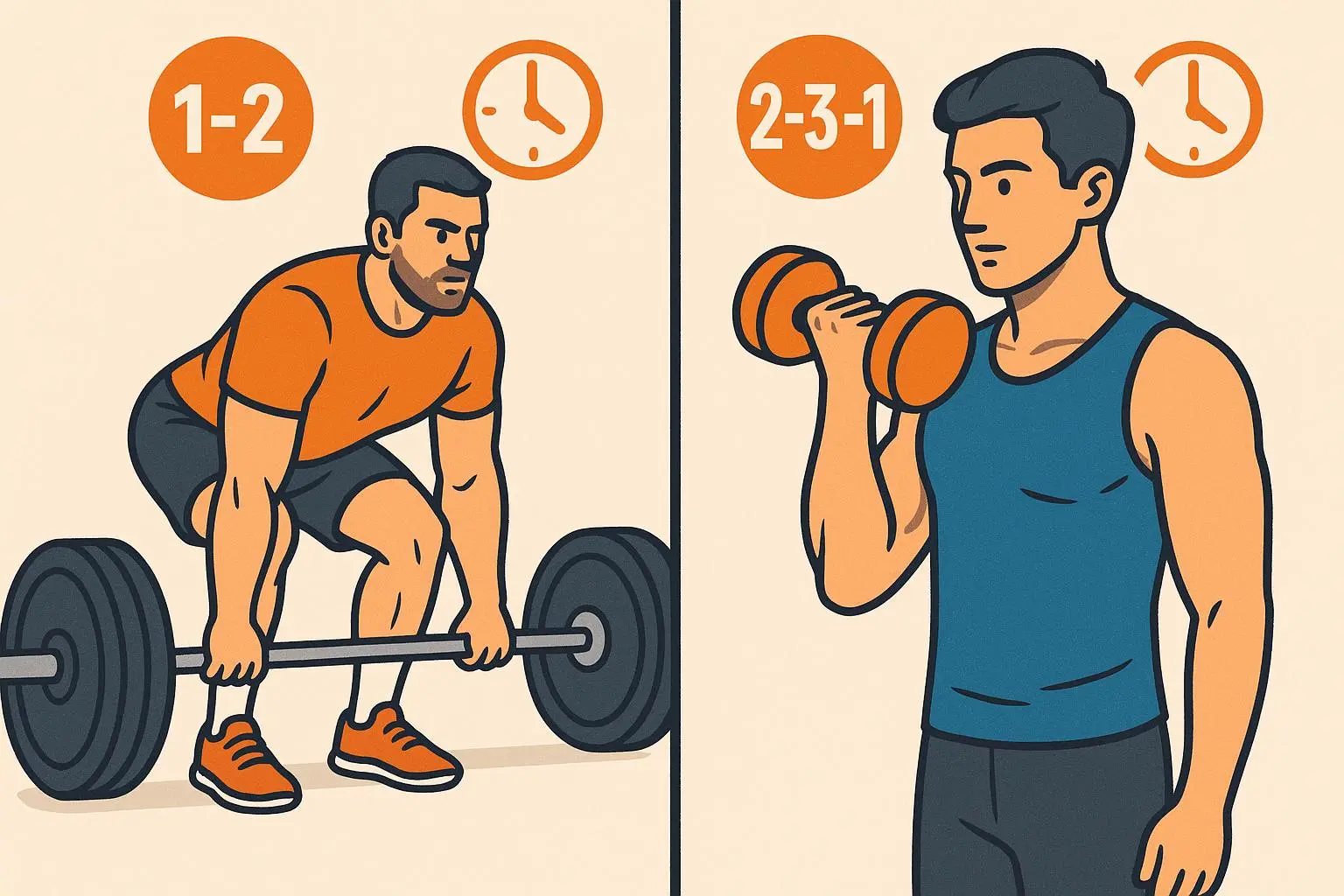
Tempo is the dial that tunes hypertrophy in EMOM sessions. Four numbers are typical: eccentric, pause at the bottom, concentric, pause at the top. A lot of people default to “slow on the eccentric, fast on the concentric.” I’ve learned that the best tempos for hypertrophy with EMOMs tend to sit in a range that’s challenging but controllable.
- Eccentric: 3–4 seconds
- Pause: 0–1 seconds at bottom
- Concentric: 1–2 seconds
- Pause after concentric: 0–1 seconds
That 3-1-1-0 or 3-1-2-0 pattern is a reliable starting point for most compound movements. You’ll see a lot of rows, presses, and squats in that zone.
Here are practical templates you can start with:
- Compound movement (squat, deadlift, bench): 3-1-1-0
- Target: 45–60 seconds TUT per set
- Accessory movement (lateral raises, curls): 2-1-2-0
- Target: 40–50 seconds TUT per set
- Isolation movement (leg extensions, triceps pushdowns): 2-0-2-1
- Target: 35–45 seconds TUT per set
Pro tip: begin with a tempo that feels challenging but sustainable. If you’re grinding early, you’re undershooting your form; slow it down a notch or two so you can keep the signal consistent across rounds.
Time-under-tension targets you can actually hit
In hypertrophy work, TUT matters because it informs how much mechanical tension your muscles experience. The research consistently supports that longer TUT within reason correlates with greater hypertrophy signals, provided recovery and total weekly volume are reasonable.
- Hypertrophy sweet spot: roughly 30–60 seconds per set per exercise, depending on the rep range and tempo.
- For heavier compound work, aim closer to 20–40 seconds per set with slightly heavier loads.
- For lighter accessory work, push toward 40–70 seconds per set to maximize metabolic stress and pump.
Let me give you a concrete example: a goblet squat EMOM using a 3-1-1-0 tempo aims for about 8 reps per set. If each rep takes about 2–3 seconds, that’s roughly 16–24 seconds of actual concentric/eccentric work per rep, times 8 equals about 48 seconds of TUT per set. That lands squarely in the hypertrophy window if you pair it with the right weekly volume.
Pairing compound and accessory movements: a smarter way to hit more muscle in less time
The real magic of EMOMs comes from how you pair movements across minutes. You’re not just cranking out squats; you’re orchestrating a micro-circuit that touches multiple muscle groups, keeps fatigue manageable, and still drives growth.
Two simple pairing templates work well:
- Upper/lower alternating EMOMs:
- Minute 1: Barbell back squat (compound)
- Minute 2: Dumbbell row (compound/upper)
- Minute 3: Lateral raise (accessory)
- Minute 4: Leg curl (accessory)
- Push/pull rotation with short rests:
- Minute 1: Barbell bench press (compound)
- Minute 2: Dumbbell row or pull-apart (pull)
- Minute 3: Overhead press (compound)
- Minute 4: Triceps extension (accessory)
Pro tip: rotate between upper-lower days or push-pull blocks so you aren’t fatiguing the same CNS pathways every session. Recovery will thank you, and you’ll stay sharper for the next workout.
If you’re pressed for time, you can also run three EMOMs per 20-minute session and call it a day. The key is still tempo control, TUT targets, and honest weekly volume tracking.
Weekly volume management to avoid interference and keep gains coming
Volume is the main driver of hypertrophy, but too much too soon kills progress. The EMOM approach makes this easier because you can see your total weekly output by muscle group and adjust deliberately.
A practical starting point:
- Compound movements: 10–20 sets per muscle group per week
- Accessory movements: 8–12 sets per muscle group per week
The goal isn’t to max out every week. It’s to ensure your volume sits in a productive range while you maintain quality reps. If you’re tired or sore, pull back one set here or there or swap a heavy day for a lighter EMOM session with the same TUT targets.
Here’s a clean example weekly skeleton you can adapt:
- Day 1: Lower Body EMOM (10 sets quads, 8 sets hamstrings)
- Day 2: Upper Body EMOM (12 sets chest, 10 sets back)
- Day 3: Rest or light mobility
- Day 4: Full-Body EMOM (8 sets quads, 6 sets hamstrings, 8 sets chest, 6 sets back)
The rest days aren’t just breaks; they’re opportunities to train tempo accuracy and technique when you’re fresh.
Logging becomes your best friend here. Use a simple sheet or a dedicated app to track date, exercise, weight, reps, tempo, and notes about how you felt. The data tells you when you’re ready to push, and when you should pull back.
Three ready-to-use EMOM hypertrophy templates (plug-and-play)
Template 1: Upper Body Hypertrophy EMOM (20 Minutes)
- Minute 1: Barbell Bench Press (6 reps, 3-1-1-0)
- Minute 2: Dumbbell Row (8 reps, 2-1-2-0)
- Minute 3: Dumbbell Lateral Raise (10 reps, 2-0-2-1)
- Minute 4: Barbell Curl (8 reps, 2-1-2-0)
- Minute 5: Triceps Extension (10 reps, 2-0-1-1)
- Minute 6: Rest
- Repeat for 3–4 rounds
Template 2: Lower Body Hypertrophy EMOM (24 Minutes)
- Minute 1: Barbell Sumo Deadlift (6 reps, 3-1-1-0)
- Minute 2: Dumbbell Goblet Squat (8 reps, 3-1-1-0)
- Minute 3: Leg Press (10 reps, 2-1-2-0)
- Minute 4: Leg Curl (12 reps, 2-0-2-1)
- Minute 5: Calf Raises (15–20 reps, 1-0-1-1)
- Minute 6: Rest
- Repeat for 4 rounds
Template 3: Full-Body Hypertrophy EMOM (20 Minutes)
- Minute 1: Barbell Deadlift (5 reps, 3-1-1-0)
- Minute 2: Dumbbell Bench Press (8 reps, 2-1-2-0)
- Minute 3: Dumbbell Goblet Squat (8 reps, 3-1-1-0)
- Minute 4: Dumbbell Row (8 reps, 2-1-2-0)
- Minute 5: Plank (hold as long as possible)
- Minute 6: Rest
- Repeat for 3–4 rounds
If you’re newer to EMOMs, start with Template 1 on a 16–20 minute block, then graduate to Template 2 or 3 as you gain comfort with tempo control and volume.
Tempo cheat sheet (quick reference)
- 3-1-1-0: 3s eccentric, 1s bottom pause, 1s concentric, 0s pause
- 2-1-2-0: 2s eccentric, 1s bottom pause, 2s concentric, 0s pause
- 2-0-2-1: 2s eccentric, no bottom pause, 2s concentric, 1s pause
- 3-1-1-1: 3s eccentric, 1s bottom pause, 1s concentric, 1s pause
- 1-0-1-0: 1s eccentric, no bottom pause, 1s concentric, no pause
Use these as building blocks. Your actual tempo for each exercise should feel challenging but controllable for the entire set.
Logging for progressive overload (simple and effective)
Keeping a clear log is the difference between “this felt good” and “this is working.” I’ve found a simple table works best for most people:
- Date
- Exercise
- Weight (or load)
- Reps
- Tempo
- TUT
- Notes
Progression can be small: add 2.5–5 pounds to a lift, or squeeze out 1–2 extra reps at the same weight, or tighten the tempo by a few tenths of a second. The key is consistency over intensity spikes.
If you want something fancier, look at interval timer apps and a logging app to sync data, but do not rely on tech alone. You still need to load the weights purposefully and reflect on how you feel week to week.
Real-world results you can expect
A well-executed EMOM hypertrophy plan isn’t a magic trick; it’s a discipline. If you lock in tempo, respect TUT targets, and manage weekly volume, you can expect:
- More muscle fullness and improved pump within 4–6 weeks
- Similar or better gains in strength compared to longer, monotone workouts this year, with less time spent in the gym
- Better recovery and reduced fatigue between sessions, thanks to the predictable minute-by-minute structure
It’s not unusual to see beginners pick up a noticeable improvement in muscle tone and confidence within a month. For intermediate lifters, the consistent progression in either weight or tempo often translates to steady hypertrophy without wrecking the system.
Troubleshooting common pitfalls (and fixes)
Pitfall: You’re not hitting the target TUT consistently.
- Fix: Slow down the eccentric phase by 0.5–1 second. Use video to check tempo in real time.
Pitfall: Fatigue messes up form mid-block.
- Fix: Drop the weight by 5–10% and keep tempo strict. It’s better to stay clean than push through sloppy reps.
Pitfall: Volume feels too high across the week.
- Fix: Rebalance by reducing one accessory lift’s sets or shifting one lower body day to a lighter EMOM variant.
Quick check: If you only feel the pump and never see strength improvements, you might be missing progressive overload in weight or reps. The logging form is your friend here; aim to push something in a sustainable way every week.
The bottom line: EMOMs that actually build muscle, without turning you into a data nerd
EMOM hypertrophy isn’t about risking your joints for more reps. It’s about precise tempo, meaningful time under tension, and weekly volume that fuels growth while letting you recover. The three templates are plug-and-play and, when paired with a simple log, become a strong engine for your hypertrophy journey.
If you’re ready to try something different this block, start with Template 1, keep your tempo honest, and log every session for a month. After 4 weeks, reassess: did you hit the target TUT on most sets? Did you move the weight or reps in a measured way? If yes, you’ve found your EMOM sweet spot.
And if you want a quick alcohol-free takeaway: EMOMs aren’t about more is more. They’re about smarter. The minute you realize you only need 20–25 minutes to train with intent, you’ll never look at “longer is better” the same way again.
Ready-to-use templates, cheat sheets, and logging forms (download-friendly)
- Three EMOM templates (Upper, Lower, Full-Body) ready to print and fill in
- Tempo cheat sheets you can tape to your training log
- A simple logging form for progressive overload
If you want, you can copy these into Google Sheets or a notes app and keep them as your steady template library for the next 8–12 weeks.