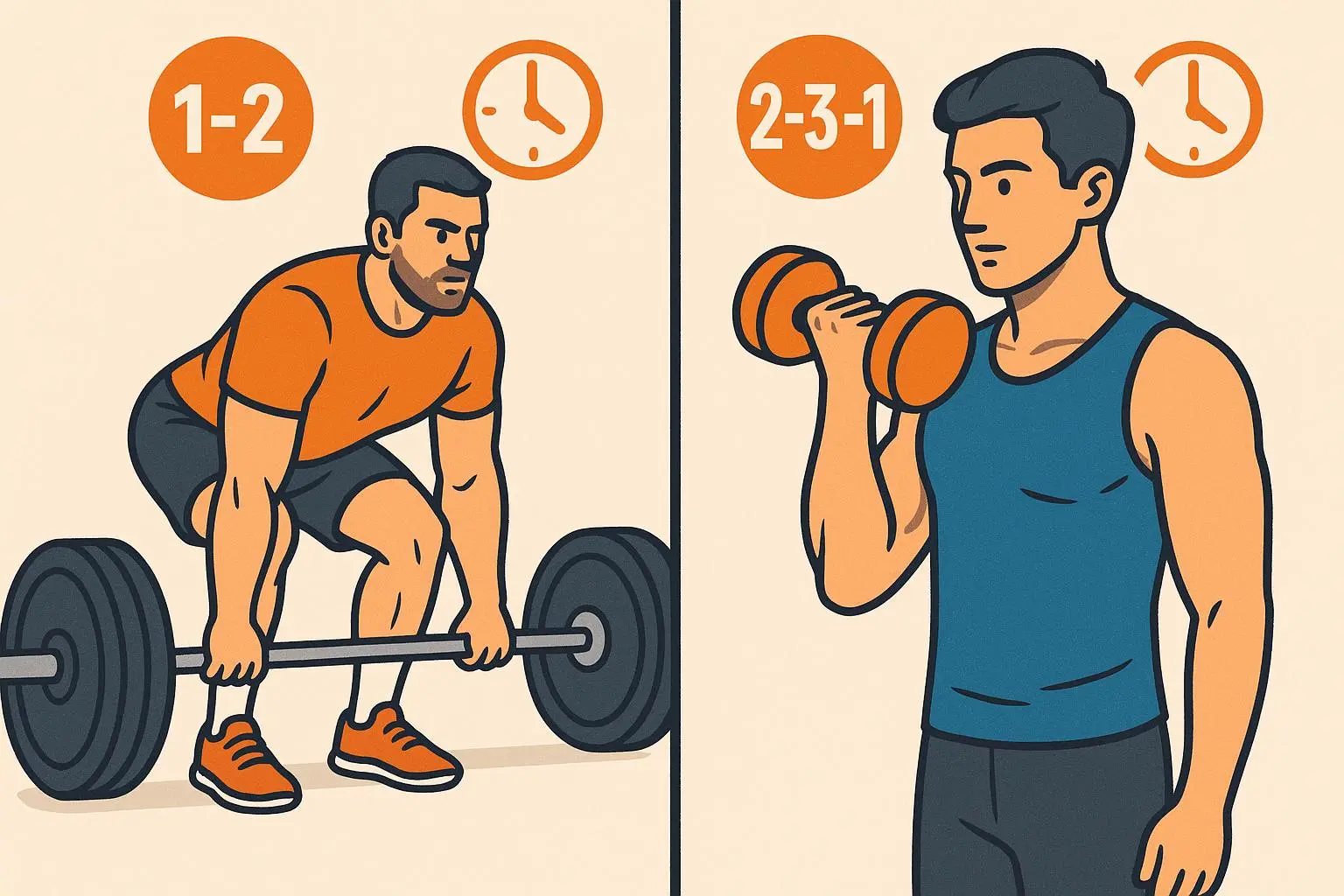
TUT for Compounds vs Isolations: Exact Durations and Loading Rules by Muscle Group
Feb 17, 2026 • 9 min
Time Under Tension (TUT) is one of the most powerful, underutilized tools in a hypertrophy program. You can be lifting heavy and still miss growth if you don’t structure tempo and load properly. I learned this the hard way during a stretch of inconsistent results where I kept chasing single-factor changes—more weight, faster reps, longer sets—without balancing the two engines of growth: mechanical tension and metabolic stress.
And here’s the quick takeaway you’ll be able to apply today: compounds thrive on mechanical tension, so long, controlled eccentrics paired with heavy loading and enough time under tension to recruit high-threshold units. Isolations shine when you tilt toward metabolic stress—slow eccentrics, peak contractions, and longer sets that push you into fatigue without risking your big lifts. The best programs blend both, with muscle-specific targets so you aren’t guessing about when to slow down or push harder.
Before we dive in, a small moment I’ll carry with me. I was coaching a trainee through a leg day that started with a heavy squat, then moved to leg extensions. I expected him to hammer the squat and move on. Instead, we cut the squat set a touch shorter and spent the next 60 seconds on a 4-0-1-2 tempo on leg extensions. The pump was ridiculous, but the real win was the way the leg extensions felt like they soaked the nervous system with metabolic fatigue, not just a tired mind. It reminded me: tempo isn’t a decoration. It’s a signal to your muscles and your joints about what you’re asking them to do.
In this piece, I’ll lay out the tempo rules for compounds vs isolations, give you muscle-specific targets, show sample pairings, and share a practical weekly template you can plug into your current program. I’ll also cover field tests to confirm adaptation and simple regressions if joints start barking.
A quick micro-moment you can steal: the tempo you choose isn’t about artful perfection; it’s about knowing where your load sits on the tension vs fatigue spectrum. If you’re feeling joint niggles, you’re probably drifting toward too much eccentric time or too much pause time. The fix is rarely “add more time”—it’s mostly “adjust the ranges and help your joints feel pain-free again.”
How I actually apply TUT in real life
When I first started tracking tempo seriously, I treated every exercise like a single blueprint: a set tempo, a fixed rep range, and a rigid total time. The problem appeared quickly: what works for a squat doesn’t work for a curl. My quads and hamstrings responded to different demands; my back and lats demanded different tempos. I learned to break the rule “one tempo fits all” and started using muscle-group-specific targets. The results were tangible: stronger lifts, better squat depth control, and more consistent arm work that didn’t beat up my elbows.
Here’s the practical line I now live by: for compounds, you’re trying to maximize tension while holding steady form at heavier loads. For isolations, you’re trying to maximize the time under peak contraction and fatigue without inviting technique breakdown.
Now let’s get into the specifics so you can apply this immediately.
TUT rules for maximizing mechanical tension (compound lifts)
Compound movements are multi-joint powerhouses: squats, deadlifts, bench presses, rows, pull-ups. They permit heavier weights and demand stable technique. The objective with compounds is to keep substantial tension on the working muscles throughout the set while not letting the load crash due to inefficient tempo.
Optimal tempo heuristic: 3-1-X-0
- Eccentric (3 seconds): Slow and controlled. A deliberate descent trains muscle-daining mechanics and often increases time under load without exploding the spine or joints.
- Pause (1 second): A brief bottom pause eliminates the stretch reflex and forces you to reinitiate tension without cheating with momentum.
- Concentric (X seconds): The explosive part. You want to recruit high-threshold motor units, but the overall set duration remains controlled.
- Post-contraction pause (0 seconds): You move straight into the next rep if possible, maintaining control and tension.
Set duration target: 20–40 seconds.
Loading rule: Use the heaviest weight that allows you to maintain the 3-second eccentric for the target rep range (roughly 4–8 reps). If the controlled eccentric forces you to drop the weight by more than about 20% of your standard working weight, the tempo is too slow for that movement.
Real-world note: I’ve seen this play out in the wild. A trainee who tried 5-second eccentrics on a heavy bench press often found their lift drop too far and wondered why the “tempo” was ruining their strength progression. Shortening the eccentric to 2–3 seconds restored load and led to better gains in the long run. Tempo should serve the load, not derail it.
TUT rules for maximizing metabolic stress (isolation lifts)
Isolation movements isolate a single joint and muscle group: leg extensions, cable flyes, bicep curls, lateral raises, calf raises, etc. With these, you’re aiming for sustained fatigue in the target muscle to provoke metabolic stress and the pumping signal that accompanies it.
Optimal tempo heuristic: 4-2-1-2
- Eccentric (4 seconds): A slow, controlled lengthening that recruits a broad range of muscle fibers.
- Pause (2 seconds): A short bottom pause to increase time under tension and emphasize the stretched position.
- Concentric (1 second): A controlled, deliberate lift.
- Peak contraction hold (2 seconds): A deliberate squeeze at the top to occlude blood flow just enough to maximize metabolic stress.
- Set duration target: 40–70 seconds.
The idea here is to push the muscle into fatigue without heavy loading that could compromise form or cause joint discomfort. It’s a mental test as much as a physical one: can you stay locked in on the emphasis of the peak contraction and the slow negative?
You’ll see comments online about the marvel of slow negatives for shoulders and arms. I’ve used 4-second negatives for lateral raises and a two-second peak contraction hold for triceps extensions. The result was a more purposeful mind-muscle connection and, honestly, more noticeable pumps and soreness—without wrecking my joints.
A quick caution: if your joints start nagging, dial back the eccentric time, or flip the pause to a shorter bottom position. The goal is sustained stimulus, not pain.
Muscle-specific TUT targets
Different muscle groups respond to different tempo signals because of fiber composition and function. Here are practical targets you can actually apply.
Quads/Glutes (compound moves like squats, lunges)
- Recommended TUT per set: 25–40 seconds
- Primary tempo focus: Heavy eccentric (3-1-X-0)
- Rationale: You want solid loading on the quadriceps and glutes while keeping knees safe, so a 3-second descent and a brief bottom pause works well.
Hamstrings (isolation like leg curls, Romanian deadlifts)
- Recommended TUT per set: 45–65 seconds
- Primary tempo focus: Slow eccentric and peak stretch (4-2-1-0)
- Rationale: Hamstrings respond to controlled lengthening and sustained tension, especially with the hip hinge that compounds the stretch.
Lats/Back (compound like heavy rows, weighted pull-ups)
- Recommended TUT per set: 20–35 seconds
- Primary tempo focus: Explosive concentric (3-0-X-0)
- Rationale: You want to maximize force production and motor unit recruitment on the row or pull, while keeping the eccentric under enough control to avoid hitting the ceiling.
Biceps/Triceps (isolation like curls, extensions)
- Recommended TUT per set: 40–60 seconds
- Primary tempo focus: Peak contraction hold (4-0-1-2)
- Rationale: A longer peak contraction helps with metabolic buildup and a clean squeeze without relying on momentum.
These targets aren’t carved in stone; think of them as starting points you can adapt as you learn how your joints and tendons respond.
Programming and balancing stress
The magic happens when you pair heavy, low-TUT compounds with higher-TUT isolations. A simple, effective approach is to place a heavy compound in the same session as a higher-TUT isolation for the same muscle group, a pairing that trains both tension and fatigue in a single workout.
Sample superset (quads focus):
- Compound: Barbell squat, tempo 3-1-X-0, 4–6 reps, around 30 seconds TUT
- Isolation: Leg extensions, tempo 4-0-1-2, 12–20 reps, around 60 seconds TUT
This pairing hits mechanical tension and metabolic stress without sacrificing form or joint health. And you don’t need a million different sets to feel a difference—quality over quantity wins here.
If you’re pressed for time, swap a compound for an athletic-lift that still targets the same muscle group, but keep the tempo logic intact. For example, replace a heavy back squat with a leg press at a slightly lighter load but maintain the 3-second eccentric and 1-second bottom pause, then pair with a slow-isolation set.
Weekly templates you can steal
Here are two straightforward templates you can slot into a typical 4-day or 5-day split. Pick the one that fits your current schedule and recovery.
Template A (Balanced, 4 days)
- Day 1: Quads + glutes
- Barbell back squat (3-1-X-0, 4–6 reps)
- Leg extensions (4-0-1-2, 12–18 reps)
- Day 2: Push (chest/shoulders/triceps)
- Bench press (3-1-X-0, 4–6 reps)
- Tricep extensions (4-0-1-2, 12–18 reps)
- Day 3: Hamstrings + posterior chain
- Romanian deadlift (3-1-X-0, 5–7 reps)
- Hamstring curls (4-2-1-0, 12–20 reps)
- Day 4: Back + arms
- Barbell row (3-1-X-0, 4–6 reps)
- Curls (4-0-1-2, 12–18 reps)
Template B (Time-efficient, 3 days)
- Day 1: Full-leg day with focus on compounds
- Squat (3-1-X-0, 4–6 reps)
- Leg press (3-1-X-0, 6–8 reps)
- Leg extensions (4-0-1-2, 12–18 reps)
- Day 2: Upper-body push and pull
- Bench press or incline press (3-1-X-0, 4–6 reps)
- Barbell row (3-1-X-0, 4–6 reps)
- Lateral raises (4-0-1-2, 12–18 reps)
- Day 3: Isolation emphasis
- Romanian deadlift (3-1-X-0, 5–7 reps)
- Curls + extensions superset (4-0-1-2 for curls, 4-0-1-2 for extensions, 12–18 each)
If you’re working around injuries or joint concerns, here’s a quick regression toolkit you can apply immediately:
- If eccentric time hurts: reduce from 4 seconds to 2–3 seconds.
- If the bottom pause hurts: remove the pause or shorten it to a quick breakpoint pause.
- If the load is too heavy: drop the weight by 5–15% and prioritize tempo control over raw weight.
- If you experience sharp pain: stop the movement and consult a clinician or a qualified trainer to adjust your technique.
Field tests and joint-regression checklist
- Field test 1: Do a non-failure set of your main compound lift with 3-1-X-0 and record RPE. If RPE is high but technique remains solid, you’re in a good place. If the form breaks down, reduce the weight and maintain tempo.
- Field test 2: Do a 1–2 isolation movement at 4-2-1-2 and measure the fatigue level after 24–48 hours. A solid pump and soreness in the targeted muscle group indicate you’re hitting metabolic stress well.
- Field test 3: If joints feel good after 1–2 weeks, you’re likely on the right track. If you notice nagging pain in the knees, elbows, or shoulders, dial back eccentric time and consider eliminating the bottom pause or lightening loads.
Injury-focused adjustments aren’t about giving up on training; they’re about preserving your ability to train consistently. The goal is sustainable progress, not heroic feats that leave you sidelined for weeks.
Field notes: real-world tweaks from athletes and coaches
There’s a lot of chatter online about tempo, but the feedback I trust most comes from hands-on coaching and lifters who actually apply these strategies in the gym. A few notes I’ve gathered align with the literature and my own practice:
- A Reddit user found that too-long eccentrics on heavy bench shrank their working weights and hampered progress. Shorter eccentrics and steady concentric work led to better strength gains. That’s the key: tempo is a tool for preserving load, not an obstacle to progress.
- A bodybuilding forum user reported that 4-second negatives on lateral raises produced a noticeable improvement in shoulder engagement and the mind-muscle connection, with a punishing pump. We’re not chasing magic here—this approach often helps people feel the target muscle doing the work rather than letting momentum drive reps.
- A discussion board member dealing with knee pain preferred reducing eccentric time on leg-press work while maintaining a slow concentric and a focus on the peak contraction. If joints don’t tolerate the acceleration and slow negatives, adapt. Good tempo practice is adaptable, not dogmatic.
Prudent progression and tracking
To keep this practical, you’ll want a simple way to track what actually happens in your workouts. I’m a fan of:
- Recording tempo (3-1-X-0 or 4-2-1-2) per exercise
- Noting the load and reps at the target tempo
- Tracking RPE and the level of pump 24–48 hours after the session
- Logging any joint discomfort and what you changed to address it
Over time, you’ll notice patterns: some lifts tolerate longer eccentrics with heavier loads; others need shorter eccentrics and more peak contraction work. Your body will tell you what it needs if you listen consistently and avoid chasing a single variable in isolation.
Quick recipes you can plug into your week
- Superset recipe: Heavy compound (3-1-X-0) paired with a high-TUT isolation (4-2-1-2) for the same muscle group. This approach hits both tension and fatigue without overdoing overall volume.
- Tempo-first leg day: Start with squats (3-1-X-0), move to leg press (3-1-X-0), finish with leg extensions (4-0-1-2). This sequence primes with tension and finishes with fatigue and pump.
- Arm day with a twist: Ditch the pure 4-4-4 tempo for arms; instead, use curls (4-0-1-2) and extensions (4-0-1-2) for a focused pump, followed by a lighter compound to cap off the session with clean technique.
Final quick-regressions for joint concerns
If you notice joint discomfort:
- Shorten the eccentric time to 2 seconds on the problematic movement.
- Remove the bottom pause entirely for that movement.
- Maintain a strong concentric and peak contraction; the goal is to keep the target muscle under tension without stressing joints.
- If pain persists, substitute the movement with a safer alternative that still targets the same muscle group (e.g., replace a heavy leg press with a supported knee-friendly alternative under professional guidance).
These adjustments don’t derail progress; they preserve it.
A simple field test to confirm adaptation
After 4–6 weeks of focusing on these muscle-specific TUT targets:
- Pick one compound and one isolation movement per muscle group and compare progress against your baseline. Are you lifting the same or more weight while maintaining tempo? Is your pump and soreness in the isolation moves more pronounced but still comfortable? If yes, your adaptation is on track.
- If you’re not seeing progress, review your tempo choices, rest intervals, and weekly frequency. Sometimes, simply shifting a single movement away from a brutal 3-1-3-0 into a controlled 3-1-X-0 with a slightly lighter load can unlock a new plateau.