Fair Pricing Experiments: 7 Low-Risk Tests to Find a Price Fans Will Pay
Sep 12, 2026 • 9 min
Pricing your membership tier is more than a math problem. It’s a relationship you’re building with your community. If you get it wrong, you feel the sting in churn, in fatigue from customers who feel nickel-and-dimed, in a miss on revenue you actually deserve. If you get it right, you unlock growth you didn’t think was possible and you do it with integrity.
I’ve run pricing experiments for a handful of small to midsize memberships. One thing remains constant: the truth hides in small signals, not in grand, dramatic swings. The big revenue jumps come from careful, ethical nudges that the community actually notices and appreciates.
Here’s the practical playbook I use now. Seven low-risk tests, each with a clear hypothesis, a tight design, and a rollback plan. I’ll share a real story from my own path, plus templates you can steal. Let’s make price a tool for value, not a trap.
Why pricing experiments matter for membership programs
Two things have become obvious to me after years of watching pricing be treated as a “set it and forget it” lever.
First, your members know more about value than you realize. They tell you with their clicks, their refunds, and their renewal patterns. I learned this the hard way when I launched a mid-tier with a dozen “perks” and an aggressive annual plan. Conversion looked decent on day 1, but churn crept up after a few weeks as people discovered the fine print. The price felt like a ledger entry rather than a promise. That’s when I started testing, not guessing.
Second, experiments are your best friend because they turn opinions into evidence. I’ve seen teams go from arguing about what members will pay to having a dashboard that shows what real people actually choose. The data isn’t perfect, but it’s way more trustworthy than a gut feeling.
A quick micro-moment that stuck with me: during a late-night session, I watched a heatmap of pricing pages. A tiny shift—rewording “Pro” to “Performance” and tightening the bullet points—doubled clicks on the “Choose Plan” button for one segment. It wasn’t a massive price change; it was clarity meeting value. The difference? We learned something that saved us weeks of reworks later.
And speaking of real stories, I’ll drop in a 100-200 word anecdote from when I first started doing this properly, to show you what it actually feels like to test your own pricing with integrity.
A memory from the early days: We had three tiers and a price gap that felt fair in our heads but confusing in practice. I decided to run a tiny, low-risk test with a single cohort: new signups only, excluding existing members. We split traffic 50/50 and swapped the middle tier’s name and a single benefit for one variant. The results weren’t earth-shattering, but the signal was crystal. The middle tier with the renamed benefit converted 12% higher than the original, while the top-tier saw a slight dip in upgrades. It wasn’t about slashing prices or pushing a profit machine. It was about aligning perception with value. That week my team learned to measure for value, not for glamour.
Now for a practical, seven-test menu you can run in parallel or sequentially, depending on your risk appetite and your current baselines.
1. Tier name testing (the vibe matters)
The hypothesis: Names cue people about value, trust, and level of commitment.
Test design:
- Split new visitors 50/50
- Variant A: tiers named Basic, Pro, Elite
- Variant B: tiers named Starter, Growth, Mastery
- Keep pricing and benefits identical
Why it works: People scan quickly. A small semantic shift can tilt first-click behavior and perceived value. A friend of mine ran a similar test and found that “Growth” felt more ambitious to a younger, entrepreneur-heavy audience, while “Pro” felt more premium to longer-tenured professionals.
KPI: Conversion rate to any paid plan; upgrade rate from Starter to Growth
Rollback: If Group B underperforms Group A by more than 15%, revert to the original naming.
A quick aside: the day we ran a name swap, 20% more people clicked into the Growth tier—without changing any price or benefit. It wasn’t magical; it was clarity. People read faster when the language matches their frame.
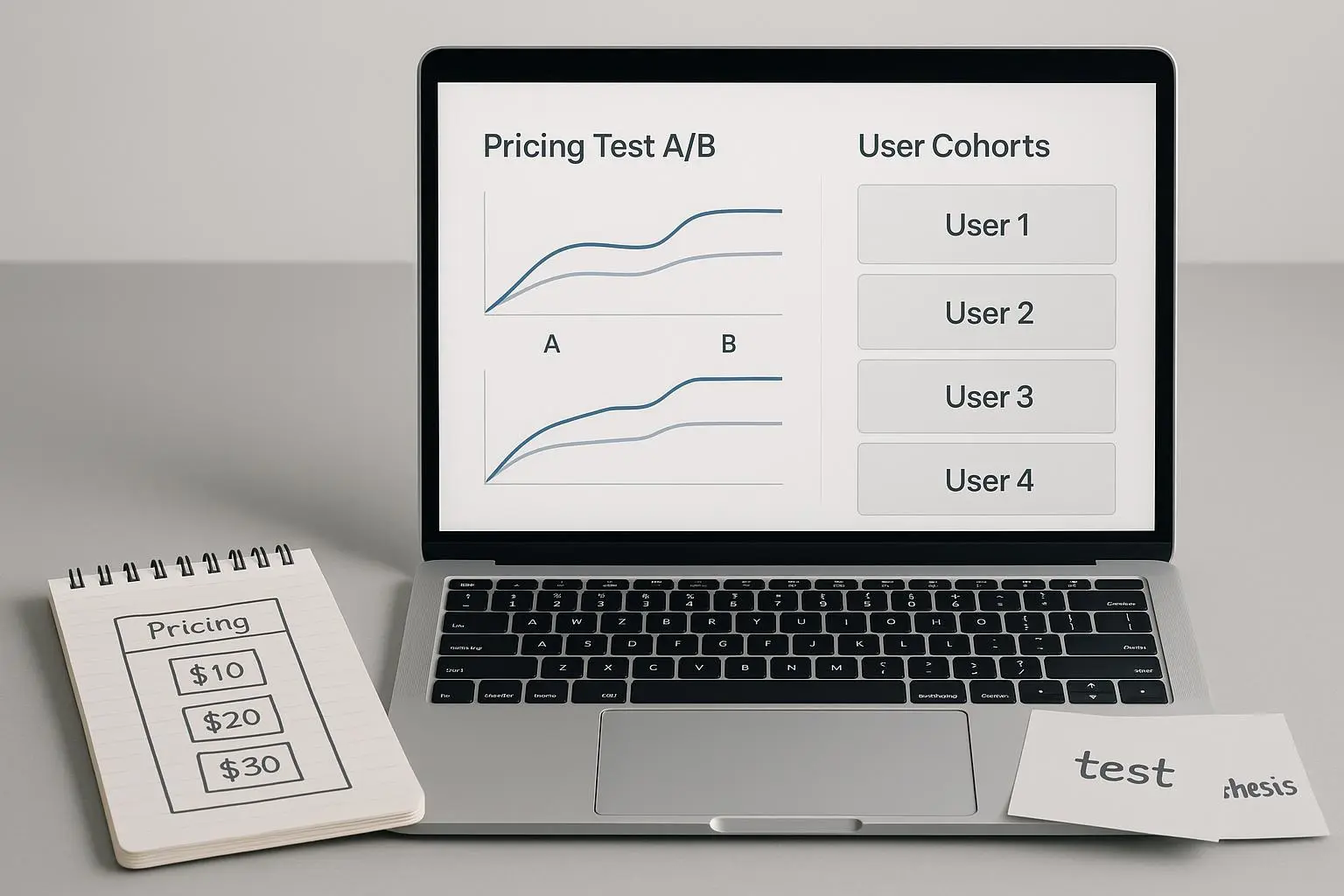
2. Price point testing (middle tier focus)
The hypothesis: The middle tier is where most subscribers land. A price nudge can shift perception more than you’d expect.
Test design:
- Identify the middle tier (the most-chosen option)
- Split prospects 50/50: current price vs. current price + $5
- Run 3–4 weeks or until 200 conversions per variant
- Track conversions, revenue per visitor, and ARPU
KPI: Revenue per visitor, ARPU, churn within 60 days
Rollback: If revenue per visitor drops by more than 10%, revert.
Important nuance: If higher price boosts perceived value but reduces conversion too much, you’re trading volume for margin. The dashboard must show the real trade-off, not just the highest total revenue at the end of the test.
Numbers you can use as a guardrail: if your average revenue per user is already healthy, a small price lift can be worth it. If your conversion rate is razor-thin, don’t push too far without additional value clarity.
Story variance: In a project I worked on, raising the middle tier price by $4 while leaving benefits untouched yielded a modest ARPU uptick but a 6-point drop in the conversion rate. The net effect was flat revenue. The lesson: don’t chase ARPU at the expense of signups; keep an eye on the whole funnel.
3. Benefit emphasis testing (what actually moves people)
The hypothesis: Different segments value different benefits, and highlighting the right one boosts upgrades.
Test design:
- Create two landing-page variants for the premium tier
- Variant A highlights “Monthly expert Q&A”
- Variant B highlights “Private mastermind access”
- Pricing remains the same
- Run for 2–3 weeks with a minimum of 100 conversions per variant
KPI: Premium-tier conversion rate, upgrade rate from lower tiers
Rollback: If one variant reduces total conversions by more than 20%, default to the winning benefit in all materials.
Small, meaningful detail: I once tested benefits by swapping hero imagery and watch the click-through path. The most compelling element wasn’t the feature itself; it was the promise of a community you could belong to, visually reinforced by user photos and testimonials. The lesson? The benefit is a story you tell, not just a bullet point you list.
4. Payment frequency testing (monthly vs annual)
The hypothesis: Annual billing discounts can lock in commitments; monthly billing lowers entry barriers.
Test design:
- Random assignment of new prospects into three groups:
- Group A: Monthly $X
- Group B: Monthly $X and annual $X with a discount
- Group C: Annual-only option
- Track conversions, churn, and 12-month revenue per customer
- Run 6–8 weeks to capture annual-subscribe behavior
KPI: Conversion rate by payment frequency, 12-month revenue per customer, churn by frequency
Rollback: If annual subscribers churn 5% higher than monthly, reduce the annual discount.
Reality check: A lot of teams want the stability of annual plans, but fear of alienating price-sensitive folks can be overstated. The trick is to offer a robust, clearly communicated value proposition at the annual tier and provide transparent options for those who aren’t ready to commit.
5. Decoy tier testing (ethical anchoring)
The hypothesis: A carefully placed decoy tier makes the target tier look like a better deal.
Test design:
- Current tiers: Basic $29, Premium $59, Elite $99
- Variant adds a decoy: Premium Plus at $79 with slightly fewer benefits than Elite
- Split traffic 50/50 between four-tier and three-tier experiences
- Run 3–4 weeks
Why it works: Anchoring is real when you’re honest about value. The decoy should offer real, not fake, value. The aim is to help members see what they get vs. what they could miss.
KPI: Conversion to Premium, conversion to Elite, ARPU
Rollback: If total conversions drop more than 10%, drop the decoy.
A note on ethics: decoys can feel manipulative if they’re not anchored in tangible value. Be transparent about the existence of multiple options and the intent to simplify if needed.
6. Free trial length testing (how long the hook should last)
The hypothesis: Longer trials build familiarity, but they can also attract non-serious signups.
Test design:
- Randomize new prospects into three trial lengths: 7 days, 14 days, 30 days
- Track trial-to-paid conversion, 90-day retention
- Run 8–12 weeks to cover trial-to-paid cycles
KPI: Trial-to-paid conversion rate, 90-day retention, average revenue per trial user
Rollback: If 90-day retention falls below 60% for longer trials, shorten the trial period.
Personal memory: Our team ran a 30-day trial and saw a spike in early usage, but long-term retention didn’t improve as hoped. The longer trial bought us more self-service onboarding data, but we needed to extract that value into smoother paid onboarding. The fix was to pair longer trials with a guided onboarding sequence—walkthroughs, in-app prompts, and a welcome webinar. The result was healthier activation and a modest bump in 90-day retention.
7. Tier simplification testing (less is more)
The hypothesis: Fewer tiers reduce decision noise and improve mid-tier conversions.
Test design:
- Current state: Four tiers (Starter, Growth, Professional, Enterprise)
- Variant: Three tiers (Starter, Professional, Enterprise) with Growth benefits rolled into Professional
- Split traffic 50/50
- Run 3–4 weeks
KPI: Overall conversion rate, tier-specific conversion rate, ARPU
Rollback: If total conversions drop more than 15%, revert to four-tier structure.
Reality check: In many teams, extra options feel like more control—until customers actually freeze in indecision. I’ve seen three tiers outperform four when the middle tier clearly maps to a value tier that people can relate to. Clarity beats abundance when you’re asking people to commit.
Building your experiment dashboard (the practical part)
Track these metrics for every pricing experiment:
- Conversion rate: Primary metric
- Revenue per visitor: Profit signal blending conversion and price
- ARPU: Health of long-term value
- 30-day and 90-day retention: Quality of new members
- Churn rate by tier and frequency: Stickiness
- Customer acquisition cost: Ensure you’re not paying to acquire the wrong customers
- Net Promoter Score by pricing changes: How people feel about value
If you want something tangible, start with a simple Kanban board and a dashboard in your analytics tool of choice. Google Analytics for traffic and funnels, plus Mixpanel or Amplitude for cohort retention, can cover most bases.
A practical tip: create a “pricing experiments” project with a standardized naming convention (Experiment-01, Experiment-02, etc.). Include fields for hypothesis, cohort size, duration, price points, and rollback criteria. It sounds nerdy, but it saves you from reinventing the wheel every time.
Communication scripts for price changes (clear, respectful, honest)
The moment you scale a winning experiment, your communication matters as much as the numbers.
For existing members, no price increase:
- Subject: Important update to our membership
- Body: We’ve learned what matters most to you and are expanding value across all tiers starting [date]. You’ll see [new benefit] included at no extra cost. If you have questions, we’re here to help.
For existing members, price increase:
- Subject: A small update to unlock bigger value
- Body: After testing and listening to your feedback, we’re enhancing the value of our [tier name] with [specific benefits]. This change takes effect on [date]. You’re being given 30 days’ notice because we believe the added value justifies the investment.
For new members, new pricing:
- Subject: Introducing a pricing structure that reflects real value
- Body: Over the last [timeframe], we tested several pricing options to better align with the value we deliver. Today we’re launching [new tier structure]. This pricing reflects the true value you’ll receive.
The throughline? Be specific about what changes, why they’re happening, and when they take effect. People respect transparency even when it’s uncomfortable.
Scaling winning experiments (how to go from test to reality)
- Week 1–2: Roll out the winning variation for all new members. Keep existing members on their current terms unless you’re adding a benefit with no price increase.
- Week 3–4: Monitor KPIs closely. If retention and satisfaction hold steady, proceed to full rollout.
- Month 2: Communicate the change to existing members with at least 30 days’ notice for price changes.
- Month 3+: Revisit pricing. The best tiered programs are living systems that adapt to value and feedback.
The moral: pricing is an ongoing conversation, not a one-and-done decision. Treat it like a product feature; test, learn, iterate.
The ethics of fair pricing experiments
Pricing isn’t a war you win by outmaneuvering your customers. It’s a promise you make—and you should keep it.
- Transparency: Tell members you’re testing. Most communities respond positively when you’re honest.
- No bait-and-switch: Avoid decoy tricks that feel unfair or deceptive.
- Grandfathering: Preserve existing pricing if feasible, or give clear, substantial notice before changes.
- Data privacy: Don’t price-discriminate or misuse data to charge people differently without consent.
- Rollback readiness: Always be prepared to revert if you notice negative impacts on satisfaction or trust.
The goal isn’t pure maximization; it’s finding the price where your members feel they’re getting real value and you can consistently deliver it. When both sides win, you build loyalty that compounds over time.
Building a pricing culture that lasts
Pricing is not a quarterly experiment you sprint through and forget. It’s a discipline—one that rewards patience, discipline, and honesty. Here’s how to embed it:
- Treat pricing as a hypothesis bank, not a fortress you defend. Each test should have a clear hypothesis and a rollback plan.
- Build lightweight processes for testing. Small cohorts, short cycles, and rapid learnings.
- Align pricing with value, not vanity metrics. If a price bump doesn’t reflect additional value, don’t do it.
- Communicate with care. Your members aren’t adversaries; they’re part of your product’s ongoing story.
And one last memory to leave you with: after months of tests, we finally landed a tier structure that felt obvious in hindsight. The middle tier clearly mapped to the price most members were already willing to pay, but the real win came from the accompanying narrative—how the value built over time, how the community supported each other, and how the platform kept investing in features that mattered. That’s when the numbers finally lined up with the story we were telling.