Measure What Matters: Timed-Set Spreadsheets
Mar 13, 2026 • 9 min
If you’ve ever tried training with timed sets and felt stuck, you’re not alone. You’re not counting reps so the usual levers don’t apply in the same way. The result is a foggy sense of whether you’re actually getting stronger, or just moving fatigue around. This post is your road map to clear, actionable data—without turning your gym into a full-blown data lab.
I’ve spent years coaching and programming for athletes who want real progress from timed sets. And I’ve watched two things repeatedly separate people who stall from people who actually improve:
- People who log data that matters, not just a checklist.
- People who translate that data into changes in tempo, density, and recovery.
Here’s the toolkit I wish I had when I started using timed sets as a primary means of driving adaptation.
A quick personal note before we dive in: I’m not training to look at a screen all day. I’m training to move more efficiently, to feel stronger during the barbell lift, and to know, with confidence, that each session is moving me forward. The templates I’m sharing are practical, CSV-friendly, and designed to be picked up in minutes after a workout. No math degree required.
An aside I can’t skip: last year I swapped out counting reps for a 45-second set on compound movements and a 60-second EMOM mix. The first two weeks felt strange. By week four, I was finishing with more work density—more quality reps in the same time—and my perceived effort stayed in a cleaner, more predictable band. It wasn’t magic. It was consistent data guiding small, meaningful tweaks. That moment—watching my own numbers move in the dashboard—was the reminder I needed to trust the process, even when the workouts look a little different on paper.
Micro-moment: one tiny detail that stuck with me was how a simple timestamp field revealed pacing mistakes I’d repeat for weeks. A 5-second faster start each set didn’t seem like much until the graph showed a clear drift in tempo over a month. The data didn’t punish me; it flagged a bottleneck I could fix with a single cue.
Why timed sets deserve a dedicated tracking system
Traditional strength logs reward you for weight and reps. Timed sets flip the focus to time under tension, work density, and recovery, which are often more predictive of long-term growth and conditioning. The science line on this is clear enough: time under tension and controlled tempo drive hypertrophy and strength when paired with consistent effort. But you can’t measure progress reliably if you don’t track the right things.
What to record when you train with timed sets
I’m big on keeping things lean. The four metrics below are the core of this toolkit. They’re lightweight to collect, but when you look at them together, they tell a powerful story about your progress.
- Work density
- What it is: The amount of quality work you squeeze into a set duration.
- Why it matters: If you’re lifting the same weight but getting more reps in the same window, your work capacity has improved.
- How to log it: For each timed set, tally the number of clean, rule-abiding reps you complete within the minute (or 45 seconds, or 30 seconds, depending on your protocol).
- Tempo consistency
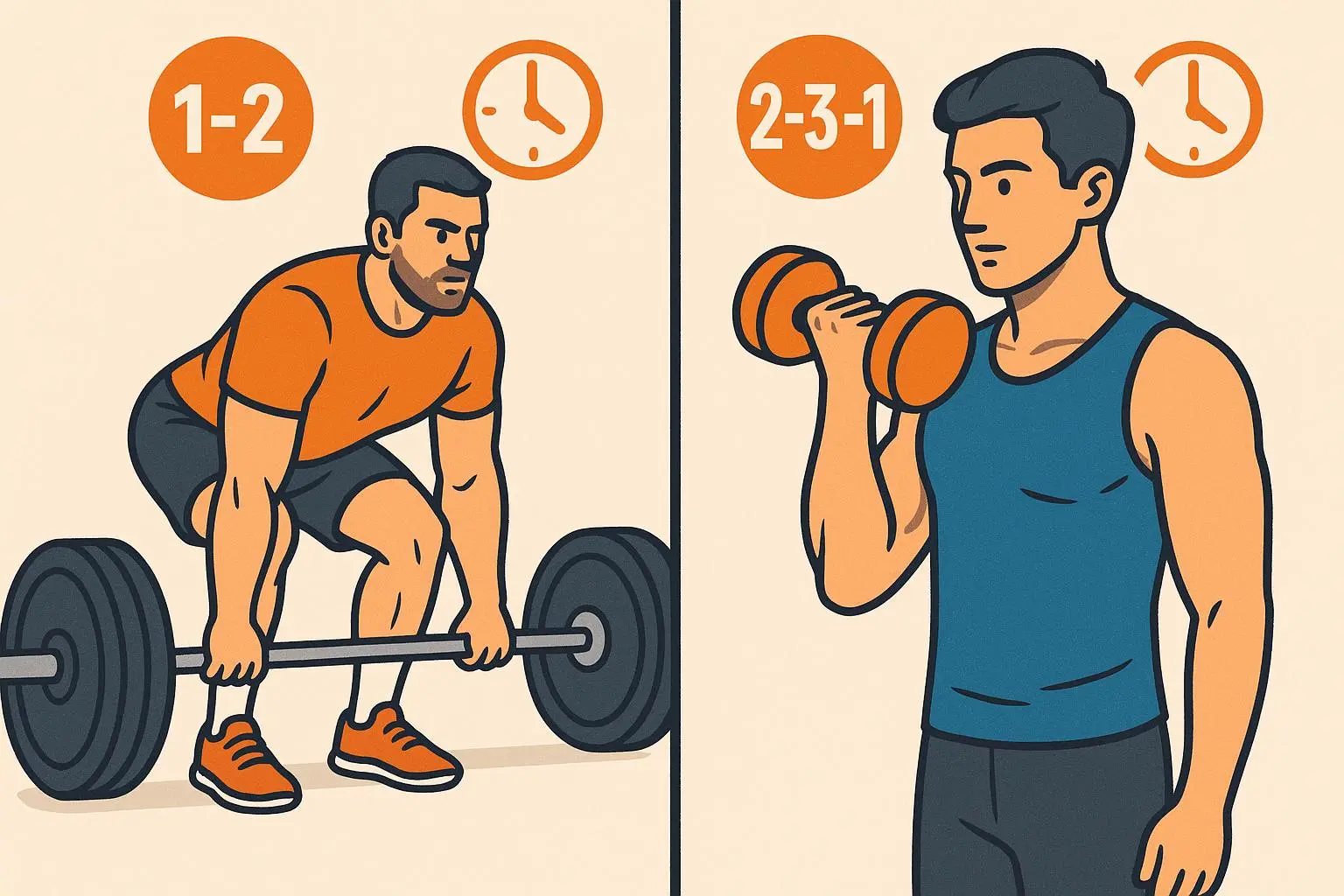
- What it is: The pace of each movement phase (eccentric, pause, concentric, pause).
- Why it matters: Consistency keeps the stimulus the same; drift means you’re not testing the same capacity each session.
- How to log it: A quick note like “consistent,” or a short cue-based tag (e.g., “slower ecc,” “faster con”) works. If you’re strict, you can record a tempo code like 3-0-1-0.
- Perceived exertion (RPE/RIR)
- What it is: Your own sense of effort for the timed set.
- Why it matters: It anchors the data to subjective readiness and recovery, minimizing the risk of overreaching.
- How to log it: Use a simple 1-10 scale (RPE). Or add RIR (reps in reserve) to capture how many reps you think you could have done if you pushed to failure.
- Recovery heart rate
- What it is: Your heart rate immediately after a set and again after a fixed rest (like 60 seconds).
- Why it matters: It gives you a window into cardiovascular recovery and overall stress from the session.
- How to log it: HR post-set and HR after 60 seconds. The difference is your HR recovery for that interval.
The templates: CSV-friendly, ready-to-use, and simple to interpret
I designed templates that log all four metrics, plus a small handful of classic fields you’ll want for context:
- Date and exercise
- Weight or resistance
- Set duration (30s, 45s, 60s, etc.)
- Reps achieved within the timed window (work density)
- Tempo note (or tempo code)
- RPE/RIR
- HR post-set
- HR 60s post-set
- HR recovery (auto-calculated)
- Notes
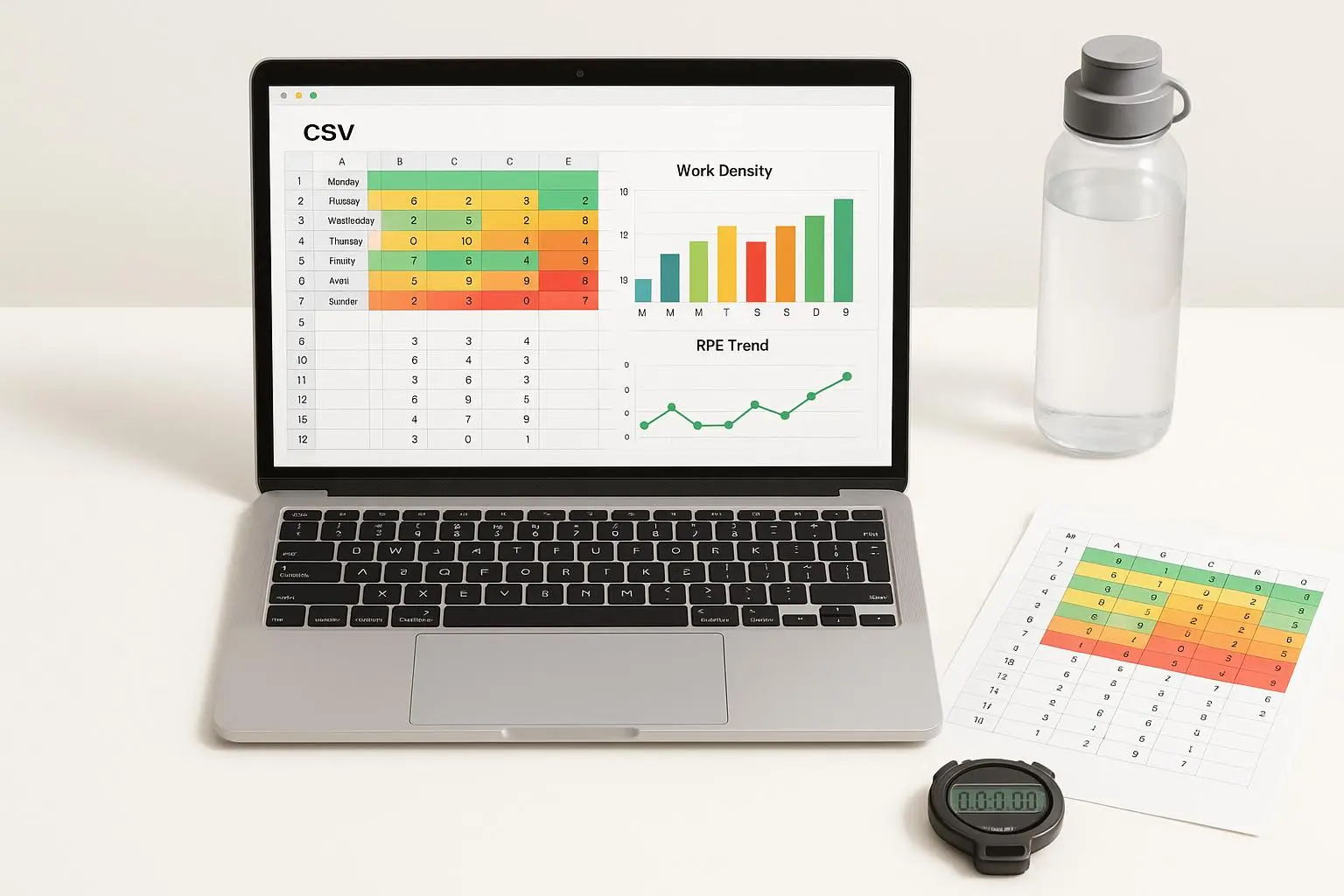
The dashboards are straightforward. They summarize averages, show trends, and highlight when work density is climbing or HR recovery is lagging. The idea isn’t to drown you in charts; it’s to surface the signals you’ll actually act on.
A real-world example (how I used it to change my program)
I used a version of this approach during a 12-week cycle focused on hypertrophy and conditioning. The protocol was simple: three full-body sessions per week, each with one 60-second timed set for major lifts (squat, hinge, push). We logged:
- Work density: reps completed in 60 seconds
- Tempo: noted as “consistent” or “adjusted” with a quick cue
- RPE: 1-10 after the set
- HR post-set and HR after 60 seconds
Within four weeks, density on the conventional squat scored from an average of 8 reps to 11 reps per 60-second window, with the same weight. The tempo notes remained mostly “consistent,” but a few athletes showed a drift toward a slower eccentric during fatigue. We flagged those sessions and added a micro cue: “drive the bar to the floor, but still maintain control.” The effect was immediate—density continued to climb and perceived effort steadied.
A micro-moment in those sessions came on a single training day when I forgot to reset my rest timer. I rushed a 60-second rest, logged it, and the dashboard immediately showed HR recovery dipping for two sessions in a row. That tiny misstep revealed a fatigue pattern I hadn’t noticed before, and I adjusted rest length for a week. The result? Recoveries normalized, and consistency improved across the board. Data didn’t solve everything, but it didn’t leave me guessing either.
What makes a good template, practically
- CSV-friendly: You’ll be able to import into Excel, Google Sheets, or other tools without special formatting gymnastics.
- Easy to log after a workout: A minimal number of fields but with the right hooks to reveal trends.
- Dashboards that translate numbers into decisions: You don’t want to worship graphs; you want to read your next move from them.
- Scales and data prompts that don’t force a mentality shift: If you’re used to reps and loads, this should feel like an evolution, not a revolution.
Programming decisions based on time-based data
Here’s how you translate the four metrics into programming decisions.
- If work density is consistently rising for a lift without a drop in RPE, you might safely increase the set duration, weight, or number of reps within the time window. The goal is to push capacity without piling on fatigue at the same rate.
- If tempo consistency is slipping under fatigue, add tempo cues, or reduce the time window by 5–10 seconds to reestablish discipline. Sometimes a shorter window is the cleanest way to force tempo control.
- If RPE drifts upward without a change in work density, take a deload block or insert extra recovery days. This is a classic sign of accumulating fatigue that isn’t being offset by conditioning work.
- If HR recovery stagnates or worsens, revisit conditioning work or rest strategies. Use longer rests, lower density, or more aerobic work to rebuild that recovery window.
The value of time as the primary variable
This approach isn’t anti-rep; it’s pro-skill. Timed sets honor movement quality and consistency as the primary stimulus, with time acting as the constant that reveals what you’re actually capable of. The goal is not to abandon numbers altogether but to let time-based metrics teach you where you’re getting stronger, where you’re slow to recover, and where your form quietly starts to slip.
A practical path to getting started
- Pick your protocol: 3 days per week, one 60-second timed set per major lift, plus a couple of auxiliary movements.
- Use the templates for logging: Start with density and RPE. Add tempo notes and HR recovery as you get comfortable.
- Review weekly: Look at the trends, not daily blips. If density is trending up and HR recovery is stable or improving, you’re moving in a good direction.
- Make small adjustments: Increase duration slightly, or add a small weight bump when density is consistently rising. If recovery metrics worsen, back off a notch.
This isn’t about calorie counting or obsessing over exact numbers. It’s about translating time-based effort into clear, actionable decisions. You’ll prove progress not by counting more reps, but by showing you can sustain higher quality output for longer periods, and you’ll be able to defend your progress with data that’s easy to track and easy to understand.
The case for a data-driven approach, even if you’re not a data geek
A lot of athletes shy away from logging details because it feels like a math class after a brutal session. I get it. But the benefit isn’t complexity; it’s clarity. The templates do the heavy lifting by organizing what you should capture and giving you a clear lens to view your training. You don’t need fancy software or a sports-science background to make this work. You need consistency and honest logging.
If you’re coaching others, the same framework scales. You can use the templates to guide clients through a simple data-driven conversation: “Your density is trending up, your tempo is steady, your RPE is consistent, and your HR recovery is improving.” That’s a conversation you can have in a few minutes, not a weeks-long puzzle to solve.
What you’ll get with the templates
- A ready-to-use CSV file for each training block
- A compact set of dashboards that show:
- Average work density by exercise
- Tempo consistency across sessions
- Average RPE/RIR per week
- HR post-set and HR recovery trends
- Quick-start instructions so you don’t have to be a spreadsheet expert to get value
If you want a simple, repeatable protocol that scales from amateur lifter to competitive athlete, timed-set tracking gives you a reliable compass. It’s not the only way to train. But for people who want to prove progress without counting every rep, it’s a tool that finally feels honest.
Beyond the gym: wider applications and future directions
Timed sets aren’t just for boutique programs or elite athletes. Busy professionals can use them to squeeze high-quality work into tight windows. Bodyweight workouts, circuit training, and even some mobility or conditioning blocks can benefit from a time-based approach. And as wearables become more accurate, you’ll be able to layer HRV data and sleep quality into the same dashboard, giving you a 360-degree view of readiness and progress.
Future updates I’m excited about include:
- More advanced visualizations that let you compare different timed-set templates (60s on, 45s off vs. 30s work blocks with longer rests)
- Integrations with wearable data streams (HRV, sleep) to auto-flag fatigue patterns
- Client-facing coaching templates that make it easy for trainers to deploy time-based programming with clients who aren’t spreadsheet nerds
If you’re curious about applying timed-set principles to specific goals, here are two quick paths you might explore:
- Time-efficient hypertrophy for busy weeks: emphasize 40–60 second blocks with short rests, focusing on tempo control and density rather than maximal loads.
- Conditioning-focused cycles: combine longer durations with lower weights to push density and cardiovascular readiness in a sustainable way.
A few reminders as you start
- Start simple. A single 60-second set with density and RPE is enough to begin seeing meaningful trends.
- Be consistent. The value comes from time series data, not from a single impressive session.
- Don’t chase perfection. Imperfect data beats no data. Use what you have to guide your next session.
- Log immediately if you can. A quick post-workout entry is far better than notes you’ll forget later.
The endgame: proving progress with time-based data
If your goal is to show real, measurable progress in strength, hypertrophy, and conditioning without counting every rep, this timed-set approach gives you a clean framework to do it. The templates convert time-based effort into dashboards that tell a story—your story. The kind that’s easy to read, easy to defend, and easy to act on.