Teach Kids Tail Sense: A 5-Minute Game to Keep Children and Dogs Safe
Jun 22, 2026 • 7 min
If you’ve ever watched a kid race toward a wagging tail and thought, “Nope, stop,” you’re not alone.
A wag isn’t always a welcome sign. Dogs use tails like a dashboard light—sometimes it’s a friendly blink, sometimes it’s an alarm. The good news: you can teach children to read three simple tail signals and follow four safety rules in about five minutes. No long lectures. No scary diagrams. Just short, repeatable practice that actually sticks.
This is a family-ready lesson plan: printable flashcards, quick role-play scripts, and parent tips so you can practice safely under supervision. It’s designed to reduce bite risk and build empathy—fast.
Why this matters (short version)
Kids aged 5–9 are most frequently bitten by dogs, usually in homes or familiar settings. Often, it’s a misunderstanding: a child misreads a tail or approaches at the wrong moment.[1]
Teaching kids to notice tails is not the whole syllabus on canine behavior. But it’s a high-leverage skill: tails are visible, simple to categorize, and they give reliable clues when combined with other body language. If a child learns “that tail looks scared or tense, I back off,” you’ve prevented a lot of close calls.
The three signals I teach (simple and visual)
I keep this to three categories so a preschooler doesn’t get overwhelmed. Each one gets a clear action.
Tail high and stiff — tense/alert
- Meaning: The dog is aroused, focused, or possibly defensive.
- Action: STOP and FREEZE. Give the dog space.
Tail tucked low — scared/anxious
- Meaning: The dog is uncomfortable and trying to make itself small.
- Action: GIVE SPACE and tell an adult.
Tail mid-level, loose sweep — relaxed/happy
- Meaning: The dog is comfortable and most likely open to calm contact.
- Action: ASK A PARENT before petting.
Say those three out loud with a child and act them out. That’s it.
The four safety rules (the actions that actually matter)
You can teach tail signals, but rules convert knowledge into safe behavior.
- Always ask an adult before petting a dog.
- Never approach a dog that is eating, sleeping, or in its bed.
- Don’t tease, chase, or grab a dog’s body parts (especially tail and head).
- If the dog seems scared or upset, leave it alone and tell an adult.
These are non-negotiable and repeatable. They make sense even if a kid forgets exactly what a particular tail means.
How I actually used this with my niece (real story, 130 words)
Last summer I watched my 3-year-old niece sprint toward our neighbor’s Labrador because—“He’s wagging!” Her dad froze, grabbed her gently, and asked her to “be a tree.” We used flashcards we’d printed that morning: one showed a stiff flag tail, one a tucked tail, one a loose sweep. We did three quick role-plays—30 seconds each. Two days later at the park the dog’s tail was held high and my niece paused on her own. Her dad called it out: “See the stiff tail? Be a tree.” She planted her feet and waited. That pause stopped a potential jump-and-startle. It felt small in the moment, but seeing her do it without being told made me realize five minutes of practice can change a default reaction.
A tiny detail that stuck with me (micro-moment, ~40 words)
One time my niece whispered to the dog, “I’ll wait.” The dog relaxed, tail softened, and wagged more loosely. The exchange was so gentle—an 8-second handshake of trust—and it reminded me that safety and kindness are two sides of the same coin.
Printable flashcards and quick scripts (do this in under 5 minutes)
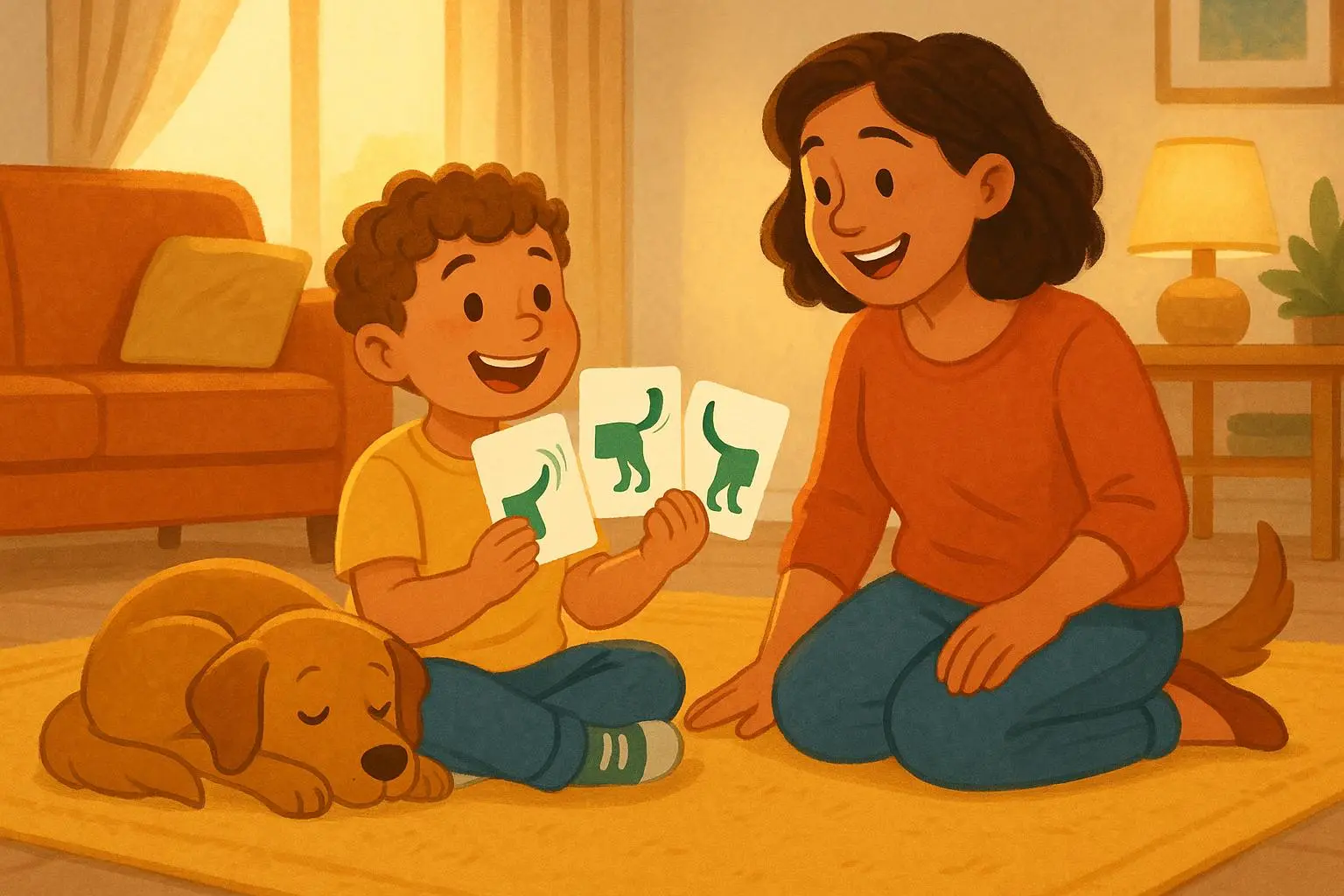
You don’t need fancy printing. Three index cards and markers work fine.
Flashcards:
- Red: Tail high & stiff — STOP and FREEZE
- Yellow: Tail tucked — GIVE SPACE
- Green: Tail loose sweep — ASK A PARENT
Role-play script (3 rounds, 60–90 seconds total):
- Parent: “You see a dog with a red card. What do you do?” Child: “Stop and freeze.” Parent: “Good. Show me tree feet.”
- Parent: “Yellow card.” Child: “I give space and tell an adult.”
- Parent: “Green card.” Child: “I ask a parent and wait to pet.”
Praise the pause. Make it playful, not scary.
How to practice safely (parent tips)
- Supervise every interaction—always. A game isn’t a substitute for adult judgment.[2]
- Start with stuffed animals if you’re nervous, then try the family dog only if you know the dog is calm and comfortable.
- Keep sessions tiny: mornings before breakfast or right after nap, three times a week. Short, consistent practice beats one long lesson.
- Role model the behavior. Kids watch you more than they listen to you. Ask permission before you pet other people’s dogs too.
- Add context later. When a child masters tails, introduce other signals (growling, lip-licking, stiff body) gradually.
What to say when you see the dog is uneasy
Kids often freeze or panic. Give them a script:
- “I see the dog is (stiff/tucked). I will back away quietly.”
- “I need an adult to check first.”
- “I’ll give the dog space.”
Teaching a child these lines gives them an intervention that’s easier than improvising.
Addressing common objections (real talk)
“But a wag is a wag, right?” No. Wagging can mean many things depending on the speed, position, and whole-body context. Explaining that nuance to a toddler is unrealistic. Give them concrete heuristics they can use immediately.
“Isn’t this oversimplifying?” Some parents worry the game is too basic. That’s fair. This is an entry point—an accessible skill that reduces immediate risk. Follow it with deeper lessons about growls, lips, ears, and resource guarding as the child gets older.
“Won’t parents rely on a five-minute game?” Don’t let them. The game is a tool for building habits. It works best when adults commit to repeated short practice and ongoing supervision.
When to bring in professional help
If your family dog shows repeated signs of aggression (lunging, snapping, persistent growling), consult a vetted behaviorist or your veterinarian. Games teach kids how to behave; they don’t fix a dog with serious behavior issues.[3]
How this reduces bite risk (the evidence, briefly)
- Children misread signals and approach during moments of high arousal, which is a frequent precursor to bites.[4]
- Teaching visible cues and rehearsed actions builds reflexive safety behaviors that interrupt risky approaches.
- Combined with adult supervision and basic dog training, these small interventions lower the number of close-call interactions at home.[1][2]
Extra tools and apps (if you want to go deeper)
- Use a simple training app like Dogo to help your dog respond reliably to cues (sit, stay) to control interactions.
- The American Red Cross Pet First Aid app is handy for emergencies.
- The Family Dog online courses offer video resources for integrating dogs into family life.
Wrap-up: five minutes, three cards, one safer kid
You don’t need to transform your child into a canine behaviorist. You need them to notice, pause, and make the safer choice. That’s a five-minute habit, not a semester-long course.
Teach the three tail signals. Practice the four safety rules. Role-play twice a week for 30–60 seconds. Praise the pauses and model the behavior yourself. Do that, and you’ve added a small but powerful layer of protection—and a seed of empathy—into how your child sees animals.
Ready to try it? Print the three cards, set a timer for five minutes, and make the first practice a game. If nothing else, you’ll get a calm moment and a better story to tell at dinner.
References
Footnotes
-
Centers for Disease Control and Prevention. (2023). Dog Bite Prevention. Retrieved from https://www.cdc.gov/injury/features/dog-bite-prevention/index.html ↩ ↩2
-
American Veterinary Medical Association (AVMA). (2022). Dog Bite Prevention: Resources for Pet Owners and Professionals. Retrieved from https://www.avma.org/resources/pet-owners/dog-bite-prevention ↩ ↩2
-
Overall, K. L. (2013). Manual of Clinical Behavioral Medicine for Dogs and Cats. Elsevier Health Sciences. Retrieved from https://books.google.com/books?id=Q_g_AAAAQBAJ ↩
-
Schalke, E., Stichnoth, J., Jones-Engel, L., & Eckert, J. (2007). Analysis of the behavior of children and dogs during interaction. Applied Animal Behaviour Science, 107(1-2), 120-135. Retrieved from https://doi.org/10.1016/j.applanim.2006.09.007 ↩