Troubleshoot TMJ Flare‑Ups at Your Desk: Common Mistakes and Safe Fixes
Jun 6, 2026 • 7 min
The click of your mouse. The hum of a monitor. Forty emails stacked in the inbox.
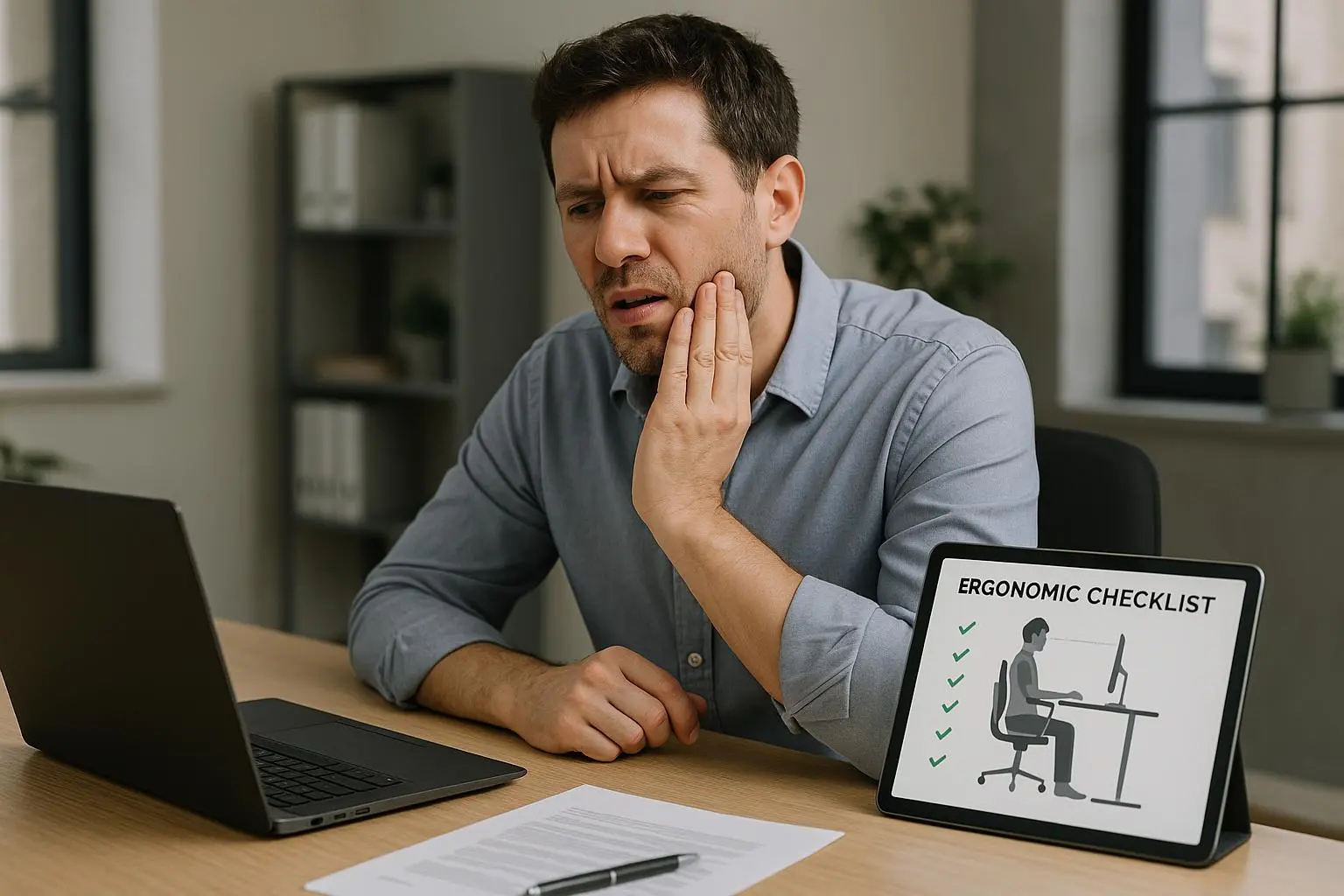
For people with temporomandibular joint disorders (TMD), the office is full of tiny triggers. Over time, those small habits—jaw clenching during a meeting, leaning your chin on your fist, fussing with a heavy headset—add up and turn a quiet ache into a full-blown flare.
I want to give you a practical, no-nonsense desk-side troubleshooting guide: what you’re probably doing wrong, what to do instead (without making things worse), and the red flags that mean it’s time to see a pro.
Why desk habits matter
TMJ problems rarely come from one dramatic moment. They’re cumulative. Static posture, repetitive tension, and small asymmetric loads on the jaw create micro-trauma that the joint and surrounding muscles eventually respond to with pain, clicking, or locking.
Fixing this isn’t about one miracle stretch. It’s about small adjustments you actually stick with during the workday.
The common mistakes I see at desks
Here are the things people keep doing that reliably make TMJ worse.
Mistake: Clench-and-hold focus You clench without knowing it when concentrating—coding, reading, negotiating. Clenching fatigues the masseter and temporalis muscles and keeps them in a protective, painful state.
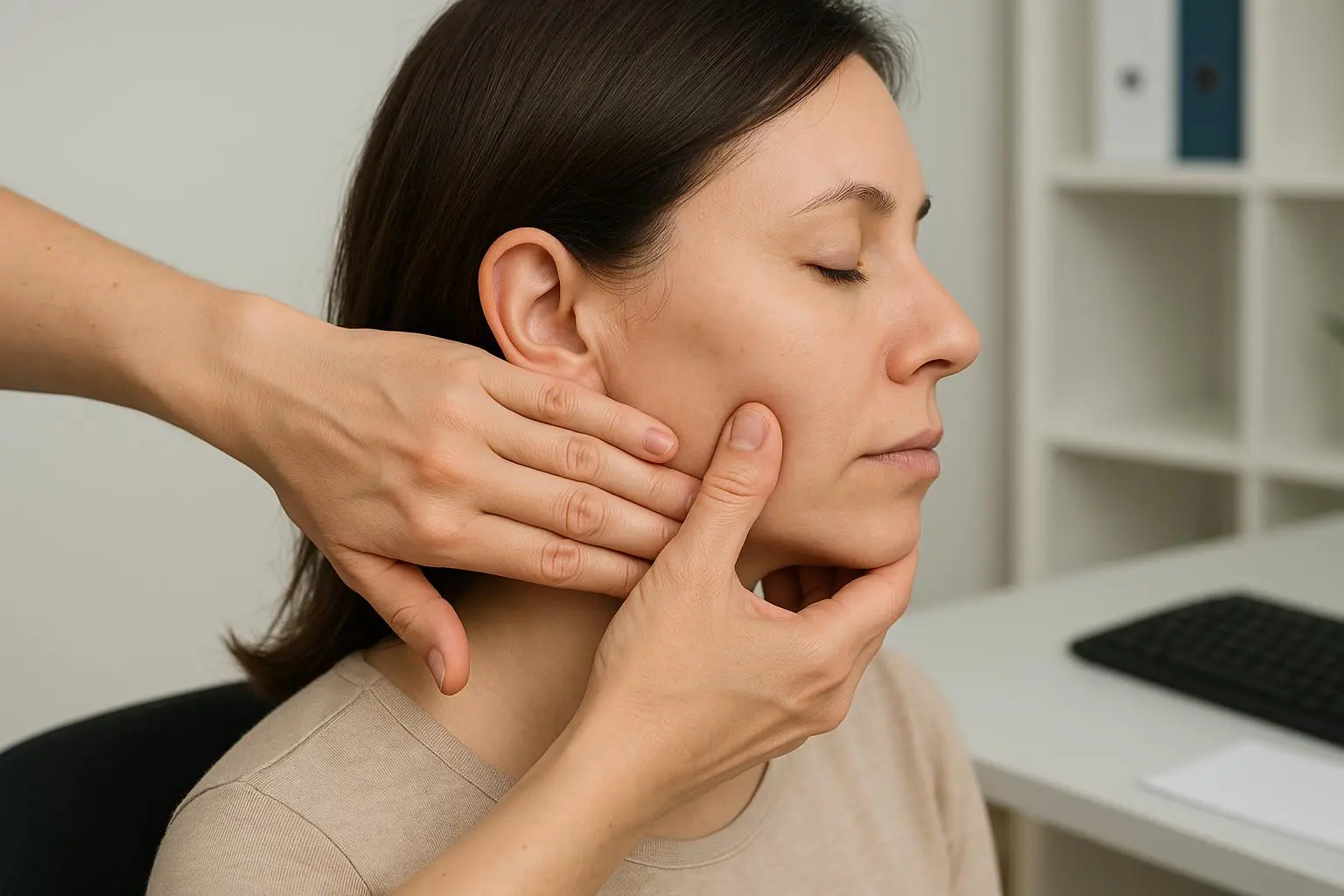
Mistake: Overzealous self-massage or aggressive stretches When pain spikes, the instinct is to press harder. That can inflame the joint and bruise muscles. Gentle is the right word—brute force is not.
Mistake: Heavy or ill-fitting headsets An over-the-ear headset that squeezes the temple or presses the jaw can create persistent, uneven pressure. It’s subtle, so you may not notice until evening pain shows up.
Mistake: Chin propping and asymmetry Resting your head on your hand or leaning your chin to one side for long periods pushes the mandible into a non-neutral position and strains ligaments and the disc.
How I actually made this work (short, real story)
A year ago I hit a patch where my jaw would grind and click by 3 p.m. every day. I tried deep massage, which only made it sore, and switched headsets twice. What finally helped was a simple combo: a lightweight single-ear Bluetooth bud, a posture alarm, and a 30-second "jaw reset" every half hour.
The first week I tracked outcomes—pain level on a 0–10 scale at noon and 5 p.m. By day seven my afternoon pain dropped from a steady 6 to a fluctuating 2–3. The headset change alleviated constant midday pressure, but the real game-changer was the timer reminding me to relax my jaw before tension built up. The lesson: small, consistent cues beat sporadic hero moves.
Micro-moment: I still remember how weirdly satisfying it was to feel that “unlocked” feeling after the first proper reset—like a stubborn window finally sliding open.
Desk fixes that are safe and actually work
These are the things you can do at the desk—no expensive gear, no aggressive therapy.
Practice the "N‑position" (the small awareness trick) The N-position is the natural rest position: teeth slightly apart, lips closed, tongue gently on the roof of the mouth behind the front teeth. Set a gentle timer for every 30–60 minutes. When it rings, check the jaw. If you’re clenched, softly separate the teeth and let your face relax. This reduces muscular hyperactivity and takes seconds.
Gentle, controlled mobilization—not aggressive pulling If you’ll do self-mobilization, make it rhythmic and pain-free. Open and close slowly, tracking for smooth motion. If you self-massage, use two fingers and press as if you were nudging a ripe avocado—firm but gentle. If it hurts, back off. Focus on the muscles around the joint (masseter, temporalis), not pushing deep into the joint capsule.
Do an ergonomic headset audit If you’re on calls a lot, test different options. Lightweight single-ear buds or a boom mic on an arm are often better than heavy over-the-ear cans. Check for asymmetrical pressure (does one side of your jaw feel different?) and move your mic so you don’t lean your head forward. If a new headset reduces afternoon soreness within a week, keep it.
Breaks and movement beats endurance Every hour, stand and move for 60–90 seconds. Do gentle neck rolls and shoulder shrugs—avoid extreme motions. Movement reduces referred tension to the jaw and prevents the sustained postures that lead to guarding.
Fix the chin-propping habit If you read or sign documents at your desk, avoid resting your chin on your hand. Put documents at eye level, or prop them on a document holder. If you catch yourself leaning, correct to neutral alignment.
Practical quick routines (30–90 seconds)
- Jaw reset: inhale, softly part teeth 2–3 mm, exhale and relax. Repeat 3 times.
- Gentle mobilization: open jaw slowly to comfortable limit, hold 1–2 seconds, close smoothly. 6–8 reps.
- Shoulder-neck unwind: shrug up, roll back and down; 5 slow reps to release upper trapezius tension.
Do these during bathroom breaks, after calls, or when your timer goes off. They’re brief, discreet, and prevent escalation.
Red flags: when to stop self-treating and see a professional
Desk fixes help most muscular TMD, but not structural problems. See a dentist who specializes in TMD or an orofacial pain specialist if you have any of these:
- Persistent locking or catching that doesn’t resolve within minutes or recurs often. That can indicate disc displacement and may need hands-on therapy or splints.
- Pain that doesn’t improve after sensible self-care and 3–7 days of rest, heat/ice, and light mobilization.
- Worsening symptoms: increased difficulty chewing, ear pain with dizziness, or progressive limitation of mouth opening.
- New or severe symptoms after trauma (e.g., a blow to the jaw).
Early assessment improves outcomes. Don’t wait until you’ve guarded the muscles for months—muscle guarding makes diagnosis harder and recovery longer.
What to avoid—so you don't make things worse
- Don’t push through sharp pain. If it hurts, it’s too much.
- Skip aggressive foam rolling, deep-tissue cheek pounding, or forceful lateral stretches.
- Don’t assume night-time grinding is the same as daytime clenching. Night bruxism often needs a different approach (splints, sleep assessment).
- Avoid one-size-fits-all advice you find in comment threads—people mean well, but TMJ causes vary.
Tools and small investments that help
- A lightweight headset or boom mic (test for a week to see if soreness drops).
- A posture reminder app set to 30–60 minute intervals.
- A small document holder to avoid chin propping.
- Standing desk converter so you can shift posture during the day.
You don’t need much money to help your jaw—consistency matters more than the gadget.
Expect realistic timelines
If your problem is primarily muscular and caught early, you can see meaningful improvement in days to weeks with good habits and brief home routines. Structural issues (disc displacement, severe inflammation) take longer and require professional care.
If you adopt the N-position checks, micro-breaks, and safer headset choices, expect to notice reduced midday pain within 7–14 days. If nothing changes, escalate.
Final note: treat the jaw like you treat a sore back
You wouldn’t barrel through a bad lower-back day without changing how you sit, stand, and move. Treat your jaw the same way: stop the tiny harms that build up, add small, repeatable resets, and get help early if something’s persistently wrong.
Your jaw is small, but it has outsized effects on your head, ears, and mood. Respect its limits and give it a practical, sustainable routine.