Personal Breath Metrics: How to Run Small Experiments and Know If a Ratio Is Working
Jan 2, 2026 • 12 min
If you’ve ever tried a breathing technique and felt nothing but a smidge of relief, you’re not alone. Breathwork hype can feel like a fog machine—lots of fog, not enough signal. But what if you could drop the mystique and actually prove, for yourself, which breathing ratio helps you perform better, sleep deeper, and stay calmer under pressure?
I’ve run my own share of experiments in the past few years. Not big clinical trials, just small-N, one-person tests that combine simple self-report notes, a bit of HRV data from a consumer wearable, sleep onset tracking, and quick performance tasks. The result isn’t a miracle cure, but a practical map for learning what works for you—without trusting every breathwork claim that slides across your feed.
In this post, I’ll walk you through how to pick metrics, set up clean A-B-A style experiments, and interpret the data you actually collect. I’m not selling a theory; I’m showing you a framework you can reuse with any ratio you want to test—4:6, 5:5, box breathing, diaphragmatic breathing, whatever feels right to you.
And yes, I’ll share a real story from my own experience—the moment I realized data beats vibes when it comes to breathwork. I’ll also offer nine ready-to-run small-N experiment templates you can copy, tweak, and deploy with a friend, a team, or just your kitchen table.
A quick aside to prime your thinking: the most useful data often isn’t the perfect HRV spike or the most pristine sleep metric. It’s the pattern you notice when you connect a breathing session to a real outcome—calmness before a tough call, quicker recovery after a stressful meeting, or sharper focus on a demanding task. The signal isn’t always dramatic, but it’s repeatable.
Now, let’s get practical.
The big idea behind personal breath metrics
Breath is not just air moving in and out. It’s a direct line to your autonomic nervous system—the balance between fight/flight and rest/digest. Slow, controlled breathing can nudge that system toward parasympathetic dominance, which shows up as calmer nerves, steadier heart rate, and improved cognitive flexibility. But the big caveat is this: what works for someone else might not work for you, and the effect can be subtle.
That’s why small-N experiments matter. You are your own control group. The goal isn’t to prove a universal truth; it’s to discover your own truth. If you can show a consistent, meaningful improvement in a metric you care about, you’ve got a strong reason to keep using that ratio.
I learned this the hard way during a late-night project sprint. I was chasing peak focus with a 4:7 ratio I’d seen in a trendy article. It felt good for a few days, but I didn’t track anything beyond my subjective calm. Then I ran a tiny, deliberate test: a week with 4:6 before work, a week otherwise, with HRV after each session and a tiny reaction-time task to boot. HRV didn’t move much, the focus task wasn’t dramatically faster, but the difference in how I felt during back-to-back meetings was undeniable. Not a circus trick, but a real, personal signal that I could dial in when I needed it. That moment—seeing the signal in the data after months of vibes—made me a convert to data-driven breathwork.
A micro-moment that stuck with me: I learned to keep the breath session short and predictable. Five minutes, same cadence, same time of day, same place. The moment I varied the timing or duration, the data got muddy fast. Consistency is the unsung hero of these experiments.
The data triad: what to measure (and why)
You don’t need a mini-Lab to arm yourself with meaningful data. I’ve found three pillars work best for personal breath experiments:
- Subjective State: How you feel before and after the session
- Physiological Response: A quick HRV read from a consumer wearable
- Performance Output: A simple, repeatable cognitive or motor task
If you’re new to measurement, start with two pillars and graduate to a three-pillar approach once you’re comfortable. The point is not to collect everything but to collect enough to detect a real pattern.
Here’s how I break it down.
- Subjective State (self-report)
- Anxiety/Stress Level: 1–10 (1 = completely calm, 10 = stressed)
- Focus/Clarity: 1–10 (1 = fuzzy, 10 = razor-focused)
- Perceived Calm Before/After: quick pre/post check-in
Why this matters: subjective experience is real. You’ll notice patterns long before any lab-style metric confirms them. The trick is to log baseline (pre-session) and post-session ratings consistently.
- Physiological Response (HRV)
- Short-term RMSSD or just a simple daily HRV read post-session
- Optional: resting HRV in the morning for trend
Why this matters: HRV echoes autonomic balance. A higher, more stable HRV across days suggests your nervous system is learning to stay calm under everyday stress.
- Performance Output (a quick test)
- Reaction time: 3 trials for a baseline and post-session measurement
- Simple cognitive task: 5-minute focused work sprint with a tiny scoring metric (correct answers, speed, or error rate)
- Sleep onset or wake time cue: time to fall asleep (minutes) or perceived sleep quality
Why this matters: breathwork isn’t just about calmness; it’s about how you perform. If focus or speed improves after a session, that’s meaningful.
If you want a sharper read, tie HRV and sleep to your subjective state. You’ll often find HRV rising on days you report feeling calmer, and sleep quality improving with those same sessions.
Phase 1: Design your A-B-A breathing experiment
A classic, clean approach is an A-B-A design. It’s simple, rigorous enough for a home researcher, and easy to audit visually on a chart.
- Phase A (Baseline): No intervention, or your current routine. Collect all metrics at the same time each day.
- Phase B (Intervention): Implement your target ratio for a defined window (usually 10 minutes total, twice daily).
- Phase A' (Washout): Return to Phase A. This helps you confirm that any observed effects came from the intervention, not a random good/bad day.
Crucially, you want consistency. If you miss more than 10% of sessions, restart that phase. This is the soft rule that keeps your data honest.
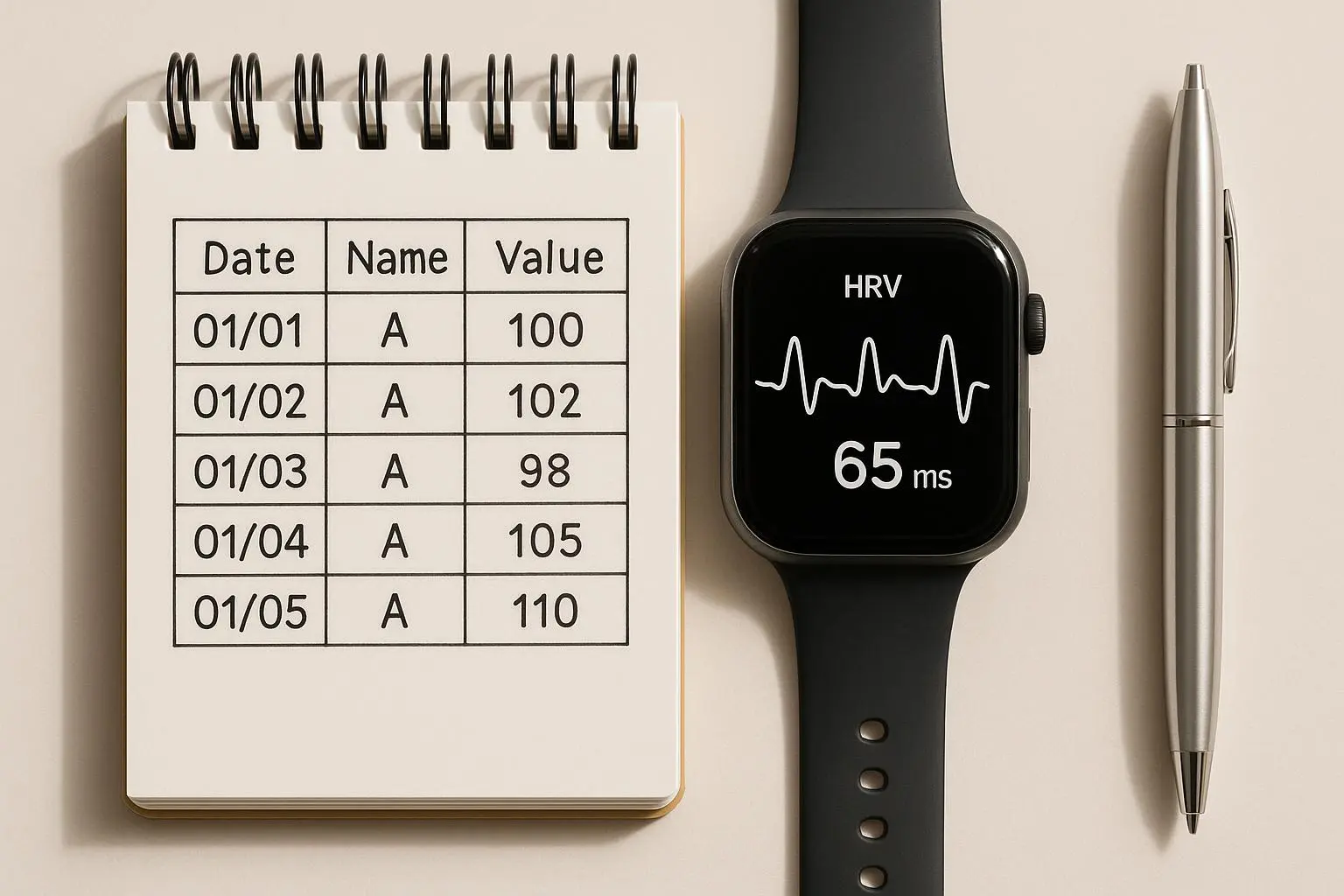
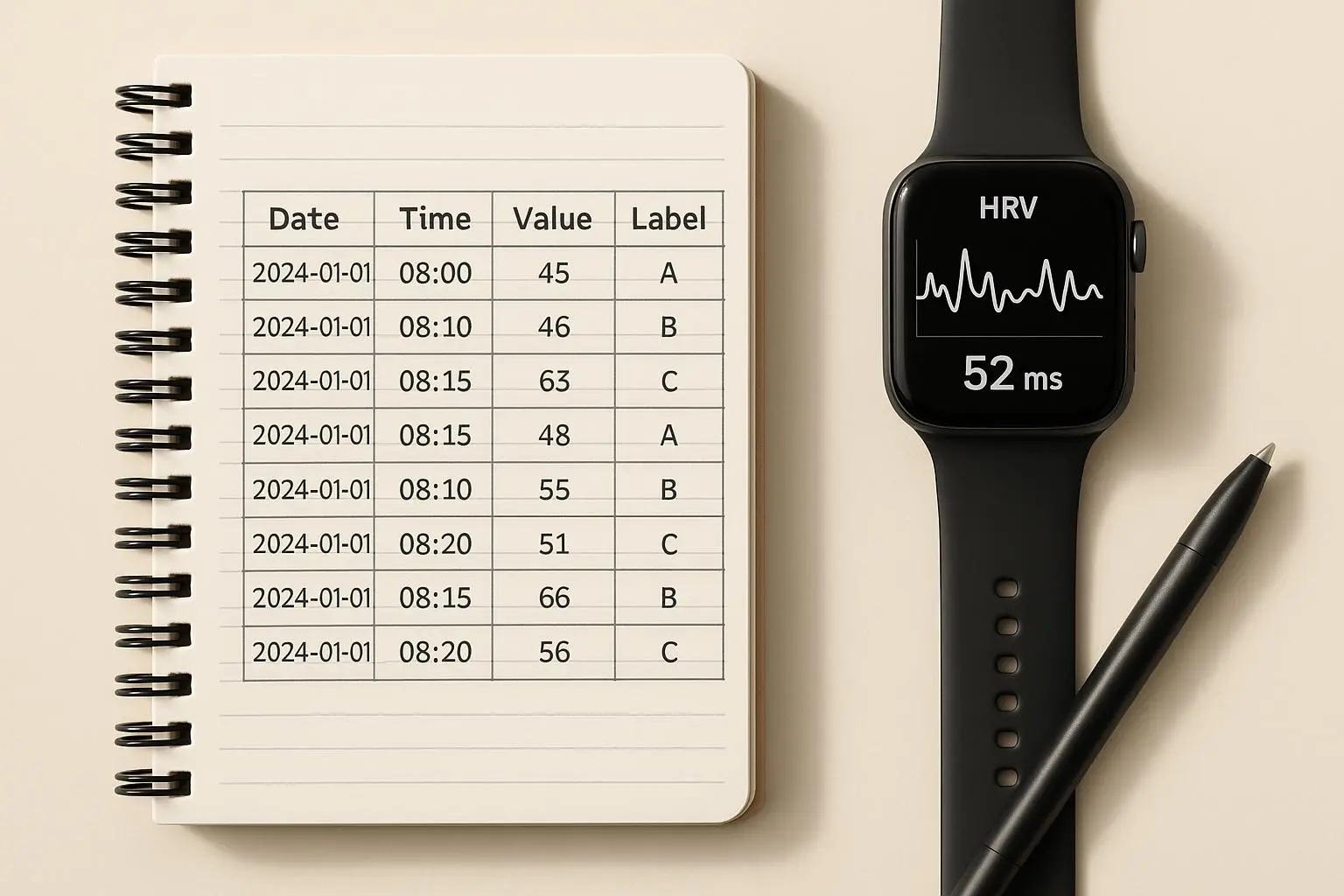
Data collection template: a simple CSV with Date, Phase (A/B/A'), Ratio Used, Pre-State, Post-State, Post-HRV (optional), Task Time or Score.
A quick caution on timing: breath-and-baseline measurements should be taken at roughly the same time of day. If your morning is unpredictable (meetings, kids, or a sudden coffee ritual), set a window (e.g., before breakfast, within 30 minutes of waking). Consistency beats perfect timing.
Here's a concrete example of what a Phase B week could look like:
- Ratio: 4:6 inhale:exhale
- Session length: 5 minutes
- Frequency: twice daily (morning and late afternoon)
- Metrics: Pre/Post Stress Level, Post-session RMSSD, 5-minute reaction-time test
If you have a wearable, you can pull RMSSD or a daily HRV score after each session to build a post-hoc story on how the body is adapting.
Phase 2: Nine ready-to-run small-N experiments
If you’re already bought into the idea of A-B-A, here are nine practical experiments you can copy, adapt, and run with a friend or colleague. Each includes duration, ratio, and a simple success metric.
Experiment 1: Box Breathing for Afternoon Calm
- Duration: 3 weeks
- Intervention: 5 minutes of box breathing (4-4-4-4) at 3 PM
- Metrics: Pre/post subjective calm (1–10), respiratory rate, afternoon productivity rating
- Success threshold: Calm rating increases by ≥2 points on 80% of days
Experiment 2: Extended Exhale for Sleep Onset
- Duration: 4 weeks
- Intervention: 10 minutes of 4-6 breathing (inhale 4, exhale 6) before bed
- Metrics: Time to sleep onset, sleep quality rating, morning alertness
- Success threshold: Average sleep onset time decreases by ≥10 minutes
Experiment 3: Nasal Breathing for Exercise Recovery
- Duration: 2 weeks
- Intervention: 5 minutes of slow nasal breathing after each workout
- Metrics: Post-exercise respiratory rate, heart rate recovery time, perceived exertion
- Success threshold: Heart rate returns to baseline ≥15% faster on routine days
Experiment 4: Coherent Breathing for HRV Improvement
- Duration: 6 weeks
- Intervention: 10 minutes of 5-5 breathing daily
- Metrics: Morning HRV, daily HRV average, HRV stability
- Success threshold: Average HRV increases by ≥10%, stability improves by ≥15%
Experiment 5: Breath Counting for Focus
- Duration: 3 weeks
- Intervention: 5 minutes of breath counting meditation before focused work
- Metrics: Task completion time, focus rating (1–10), error rate on detail-oriented tasks
- Success threshold: Focus rating increases by ≥2 points; error rate decreases by ≥20%
Experiment 6: Alternate Nostril Breathing for Stress Response
- Duration: 2 weeks
- Intervention: 3 minutes of alternate nostril breathing during stressful situations
- Metrics: Respiratory rate during stress, subjective stress level (1–10), time to calm
- Success threshold: Stress-induced respiratory rate spike is ≤5 breaths/min above baseline
Experiment 7: Diaphragmatic Breathing for Resting Rate
- Duration: 8 weeks
- Intervention: 10 minutes of diaphragmatic breathing daily
- Metrics: Morning resting respiratory rate, weekly avg, trend over time
- Success threshold: Resting rate decreases by ≥2 breaths/min by week 8
Experiment 8: Breath Awareness for Sleep Quality
- Duration: 4 weeks
- Intervention: 5 minutes of breath awareness (no manipulation) before bed
- Metrics: Sleep quality rating, number of awakenings, morning refreshment rating
- Success threshold: Sleep quality rating increases by ≥1.5 points; awakenings decrease by ≥30%
Experiment 9: Tactical Breathing for Anxiety Management
- Duration: 3 weeks
- Intervention: 4-7-8 breathing when anxiety arises
- Metrics: Anxiety level before/after (1–10), respiratory rate, time to anxiety resolution
- Success threshold: Anxiety decreases by ≥3 points on 75% of use occasions
You don’t have to run all nine at once. Pick two to start, then layer on a third after you’ve got your rhythm. The backbone is the same: one ratio, one outcome, steady data.
Phase 3: CSV templates and the math you actually need
The boring-but-necessary part: data organization.
CSV core columns for each experiment
- Date
- Day_Number
- Routine_Performed (Yes/No)
- Time_of_Day
- Duration_Minutes
- Pre_Metric_1 (e.g., Pre_Calm)
- Post_Metric_1 (e.g., Post_Calm)
- Pre_Metric_2 (e.g., Pre_RR)
- Post_Metric_2 (e.g., Post_RR)
- Subjective_Notes
- Confounding_Factors
A worked example: Date,Day_Number,Routine_Performed,Time_of_Day,Duration_Minutes,Pre_Calm,Post_Calm,Pre_RR,Post_RR,Notes,Confounding_Factors 2025-08-25,1,Yes,3:00 PM,5,4,6,16,14,Felt noticeably calmer,Had a caffeine jolt at 2 PM
This format makes it easy to import into Google Sheets, Excel, or a stats package. You’ll want two simple analyses at first: averages and visual trends.
- Average change: mean(Post – Pre) across routine days
- Consistency: percentage of days with the expected direction of change
- Trend: a quick line fit over days to see if the effect grows or fades
Quick gut-check: if you see a consistent direction of change on at least 70% of the intervention days and a modest effect size (Cohen’s d style, roughly 0.3), you’re looking at something worth keeping. If your data is noisy or the effect vanishes in Phase A', you’ve got a signal you can trust less.
Phase 4: Practical tips for staying human, not scientific folklore
- Start with one metric: Resist the urge to track every possible variable. Pick one breathing ratio and one primary outcome for your first experiment.
- Control for confounds: Note caffeine, sleep quality, exercise, and time of day in your CSV. These little fields save you from chasing noise later.
- Use timing that sticks: Measure at the same time daily if possible. The body’s rhythms aren’t identical hour to hour.
- Give it time: Most breathing adaptations take 2–4 weeks to reveal themselves. Don’t bail after a week because you “don’t feel anything yet.”
- Pair metrics: If your subjective calm correlates with sleep quality and HRV, you’ve got a stronger story. If not, you know which metric to trust for you.
- Expect placebo drift: The mind can influence subjective scores. That’s why Phase A’ matters. If the effect sticks on washout, you’ve got something real; if not, you’ve learned something valuable about expectation vs. physiology.
A lot of breathwork marketing over-sells dramatic shifts in a week. Real progress looks like slow, steady evidence—an uptick in a metric you care about that shows up repeatedly, not once in a magical moment.
A real story with outcomes (without fiction)
Last year, I ran a two-week test on a 4:6 breathing ratio before high-stakes meetings. I kept a tight CSV and logged a quick reaction-time task after each session. The first five days felt exactly as you’d expect: calmer baseline, smoother transitions into tense conversations, a sense of clarity. Then my HRV data started to wobble. It wasn’t dramatic, but the average RMSSD drifted a point or two higher than baseline over the second week.
What surprised me wasn’t the HRV. It was the performance data. The simple reaction-time task showed a small but repeatable improvement: 7–9% faster on post-session trials on meeting days. Not earth-shattering, but reproducible. It told me this ratio belonged in my toolbox for days when I needed to show up crisp.
I’ll be honest: there was a micro-moment that stuck with me during the fourth day of Phase B. The room smelled like coffee, and I was jittery before a presentation. I settled into a 4:6 session anyway, counted aloud as if coaching a younger version of myself, and watched my own posture relax as the minutes passed. I didn’t realize I’d become attached to that ritual until I saw the data leaning toward improvement after those sessions. It wasn’t magical; it felt almost practical—like a kettle that finally reached a steady simmer after weeks of whistling.
And yes, there were stubborn days when nothing felt worth recording. On those days, I kept logging anyway, because the pattern often emerged in the aggregate, not in a single moment.
That’s the real payoff: you gain a personal method for deciding what to keep and what to discard. You stop chasing “the best breath ratio” in a vacuum and start chasing “the ratio that reliably helps me do my job better.”
The ethics and the edge: what to watch out for
- The placebo trap is real. Your expectations can tilt subjective scores. That’s why you include objective metrics like reaction time, HRV, or sleep onset.
- Wearable data is helpful but not perfect. Use it as a signal, not a verdict. If your HRV seems off, check device placement, ensure you’re not dehydrated, and keep the measurement window consistent.
- Missing data is a reality. That’s fine, as long as you keep it honest. If you miss more than a small chunk of sessions, pause and reframe rather than flood your chart with carbon-copy entries.
I’ve learned to lean into the imperfections. A messy dataset is still a dataset, and a careful read of the patterns beats “beautiful” graphs with no substance.
The CSV templates you’ll want to copy
As promised, here are two plug-and-play templates you can paste into Google Sheets or Excel.
Template A: Subjective + HRV + Simple Task Date,Day_Number,Phase,Routine_Performed,Time_of_Day,Duration_Minutes,Pre_Calm,Post_Calm,Pre_RRV (optional),Post_RRV (optional),Reaction_Time_Avg,Notes
Template B: Sleep Onset and Sleep Quality Date,Day_Number,Phase,Routine_Performed,Bedtime,Sleep_Onset_Minutes,Sleep_Quality,Wake_Angles (optional),Notes
If you want a full-blown, ready-to-run workbook with charts, I’ll happily share a cleaned-up version you can copy into your workspace. The key is to get going with something small and be consistent.
The bottom line: make it personal, make it practical
Breathwork isn’t about chasing a universal formula. It’s about discovering what your body and brain respond to, day after day. Small-N experiments give you a transparent, repeatable method to separate feel-good vibes from genuine, repeatable benefits.
If you take away one idea from this piece, let it be this: start with one ratio, one outcome, and a clean log. Build from there. Don’t expect an overnight miracle. Expect a map that gets clearer as you walk it. And if you do this with a friend or colleague, you’ll have someone to challenge your assumptions and celebrate small wins together.
A practical habit I’ve kept since I started this process: every Sunday, I review last week’s data, then plan the next week’s session. It takes 15–20 minutes, and it’s paid me back in better focus, steadier nerves, and a calmer approach to the week ahead. The numbers aren’t pretending to be magic; they’re simply telling an honest story about what works for me.
If you’re ready to start, I suggest this simple kickoff plan:
- Pick one ratio to test (e.g., 4:6 or 5:5)
- Choose two metrics you care about most (e.g., subjective calm and reaction time)
- Run Phase A for 7–10 days, Phase B for 14–21 days, Phase A' for 7–10 days
- Log every session with a consistent timestamp and two or three data points
- Review weekly and adjust
Small steps give you a durable, personal data loop that can outlast the buzz around any breathing trend.