Troubleshooting Common Mistakes in Transit Breathing
Jan 23, 2026 • 7 min
If you've ever tried a breathing exercise and come away feeling worse, frustrated, or like it didn't work—you're not broken. You probably hit one of the common mistakes that turns helpful breathwork into a headache.
Transit breathing is simply using your breath to move from anxious or activated to calmer and more centered. Done right, it nudges your autonomic nervous system into "rest and digest." Done poorly, it can mimic anxiety: lightheadedness, chest tension, or that awful sense of failing at something that should be simple.
Here's how to spot what’s going wrong, quick fixes that actually help, and when to change tactics altogether.
The two-sentence science bit (without the jargon)
Slow, deep breathing increases vagal tone and encourages parasympathetic activity—basically it helps your body say, “Okay, we can relax now”[1][2]. But that only happens when the breath is diaphragmatic and unforced. Shallow, fast, or clenched breathing does the opposite.
Mistake 1: Rushing the counts
You read a pattern—4-7-8, box breathing, whatever—and your anxious brain says, “Hurry up.” So you rush the inhale, skip the middle, and trample the exhale.
Why that backfires: speeding means you don’t engage the diaphragm; you risk hyperventilating and feeling lightheaded or panicky—the exact opposite of your goal.
Quick fix: slow down the sensation, not the number. If 4-7-8 feels impossible, try 3-3-3 or 4-4-4. Count silently, but let your breath lead. A slow inhale that feels comfortable will do more than a perfectly timed inhale that feels forced[3].
Practical cue: imagine filling a glass from the bottom up—your belly first, then your chest. Slow enough that you could sing two words on the exhale.
Mistake 2: Holding the breath like a secret
Some people tighten and hold at the top of an inhale, especially if they’re anxious. I used to do this without noticing—tiny, tense pauses like little knots in the chest.
Why that backfires: breath-holding can spike CO2 or create tension in the neck and shoulders, which feeds the panic loop.
Quick fix: bias toward the exhale. Make the out-breath longer and softer than the in-breath. Pursed-lip breathing helps: inhale gently through the nose, exhale slowly through pursed lips as if fogging a mirror. That tiny resistance keeps the breath flowing and prevents the unconscious pause[4].
Short practice: inhale for 3, exhale for 5. Repeat five times and notice shoulders drop.
Mistake 3: Ignoring the obvious signs that it’s not working
If your shoulders ride up, your chest heaves, or your heart’s still pounding after a few cycles—listen to that. Many people soldier on, thinking effort equals progress. It doesn’t.
Why that backfires: ignoring feedback keeps you in shallow chest breathing. You’re working harder but getting less parasympathetic benefit.
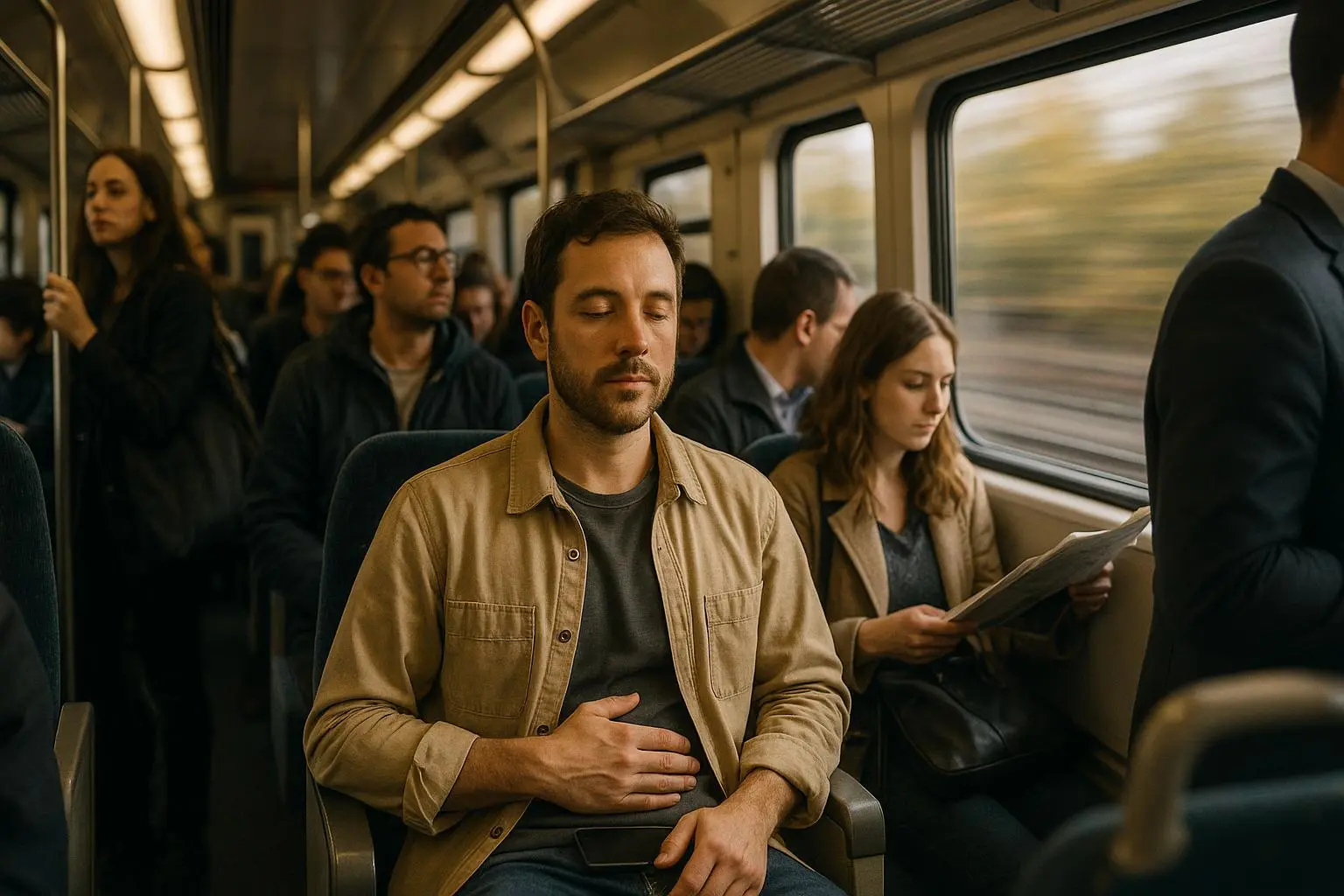
Quick fix: do a quick body scan. Put one hand on your chest and one on your belly. On the inhale the belly hand should rise more than the chest hand. If it doesn’t, switch to lying down for a few minutes so gravity helps your diaphragm move. Use a mirror or a guided app to check your form until it feels natural[2].
Micro-moment: I keep a sticky note on my bathroom mirror that says “belly first.” For some reason, that visual nudge works better than mental reminders.
Mistake 4: Over-analyzing during a panic episode
When panic hits, your brain is not in tutorial mode. Throwing a complicated (to you) breathing recipe at yourself—4-7-8, box breathing, patterned pranayama—can overload your thinking and make the panic worse.
Why that backfires: cognitive load + physiological arousal = spiral. Trying to do it perfectly feels like failing, which feeds the anxiety.
Quick fix: simplify. Abandon counts. Do one simple thing: a long, slow exhale. Or try a sigh—deep inhale, audible sigh out. The sound of the exhale and the physical release are grounding. Once the initial wave fades, you can reintroduce structure.
Practical anchor: silently say “out” during the exhale. No counting. Just one word, repeated until the chest eases.
When a pattern consistently fails, switch
Not every pattern fits every person or every situation. Box breathing might be calming between meetings, but during a full-blown panic it can feel impossible. Conversely, a free-form exhale may help panic but feel sloppy during focused relaxation.
How to decide:
- If a pattern makes you dizzy or more anxious, stop.
- If it’s consistently frustrating, try another rhythm for two weeks before judging.
- Match intensity to need: structured patterns for mild stress, exhale-focused for acute panic.
- If you can, use guided apps to remove the pressure of self-monitoring—visual or audible cues are huge for learning proper rhythm[5].
User stories in the wild back this up: some swear by 4-7-8, others say box breathing saved them, and some needed an app’s visual guide to actually feel the diaphragm move.
A short true story: the breathing exercise that didn't—at first
A few years ago I decided to learn diaphragmatic breathing properly after a bad panic episode on a cross-country flight. I read articles and tried to follow apps, but every attempt on the plane left me lightheaded. I’d rush, hold my breath, and feel worse.
So I stopped aiming for textbook form and started small. At home, lying on my back, I put a soft book on my belly and tried to keep it rising while my chest stayed quiet. For two weeks I did three minutes every morning—no counts, just watching the book. The book made the belly movement obvious. After ten days, during my next flight, I tried the same simple exhale-focused breath and felt my shoulders drop within a minute. The panic didn’t vanish instantly, but it defused, enough that I could sleep. Outcome: small, consistent practice beat one-off, stressed attempts.
What I learned: make it obvious. Use a prop (book, hand, app), simplify under stress, and practice when you’re calm.
Quick checklist you can actually use
- If you feel dizzy: stop and breathe normally. Try shorter counts (3-3-3).
- Shoulders up? Put a hand on your chest and belly and aim for belly-first.
- Holding breath? Extend the exhale or use pursed lips.
- Panic spike? Drop the pattern. Do long, audible exhales or sighs.
- Still stuck after trying fixes for a week? Try a guided app or talk to a clinician[6].
Tools that help (not an ad, just practical)
- Guided apps with visual cues: Breathwrk, Calm, Headspace. They take the counting out of your head and put it into your ears or on screen.
- Simple web timers/visuals: online box breathing guides—good for training rhythm without thinking.
- A small prop for practice: a soft book on your belly when lying down. Cheap and effective.
When to get professional help
If breathing exercises repeatedly make your anxiety worse, or panic attacks are frequent and debilitating, see a clinician. A therapist can help you integrate breathing into a broader coping plan (CBT, exposure, medication if needed). Breathing is a tool—not a full treatment for everything[6].
Final note: progress, not perfection
Breathwork isn’t magic and it isn’t a test. Most people who stick with it see benefits after a few weeks; many notice big changes after a few months of short, regular practice[2][3]. The trick is to be curious about what your body tells you and to switch tactics when something feels wrong.
So, next time a breathing pattern trips you up: pause, check the simple signs (shoulders, belly, pauses), choose the smallest fix, and try again. Your breath is your simplest tool—treat it like one.
References
Footnotes
-
Porges, S. W. (2007). The polyvagal perspective. Annals of the New York Academy of Sciences, 1104(1), 67-83. Retrieved from https://nyaspubs.onlinelibrary.wiley.com/doi/abs/10.1196/annals.1391.007 ↩
-
Ma, X., Yue, Z.-H., Gong, Z.-Q., Zhang, H.-M., Li, L.-N., Shi, Y.-Y., Feng, Y.-Y., & Ma, Y.-Y. (2017). The Effect of Diaphragmatic Breathing on Attention, Negative Affect and Stress in Healthy Adults. Frontiers in Psychology, 8, 874. Retrieved from https://www.frontiersin.org/articles/10.3389/fpsyg.2017.00874/full ↩ ↩2 ↩3
-
Brown, R. P., & Gerbarg, P. L. (2012). Sudarshan Kriya Yogic Breathing in the Treatment of Stress, Anxiety, and Depression: Part I—Neurophysiologic Model. Journal of Clinical Psychiatry, 73(11), e1437-e1443. Retrieved from https://link.springer.com/article/10.1007/s12671-012-0164-1 ↩ ↩2
-
American Lung Association. (2023). Breathing Exercises. Retrieved from https://www.lung.org/lung-health-diseases/wellness/breathing-exercises ↩
-
National Institutes of Health. (2021). The Benefits of Guided Breathing Apps for Stress Reduction. Retrieved from https://www.nih.gov/news-events/nih-research-matters/guided-breathing-apps-stress ↩
-
American Psychological Association. (2020). Anxiety. Retrieved from https://www.apa.org/topics/anxiety ↩ ↩2