Get Started: Use a Fleet Fuel Savings Calculator to Lower Costs Quickly
Feb 13, 2026 • 8 min
If you run a small fleet, fuel is the thing that keeps you awake at 3 a.m. It’s unpredictable, it’s visible in every invoice, and it eats margin faster than anything else.
But here’s the part most owners miss: you don’t need a $2,000/month telematics subscription to start cutting fuel costs. You need a simple calculator, a few reliable inputs, and the discipline to act on what the numbers tell you.
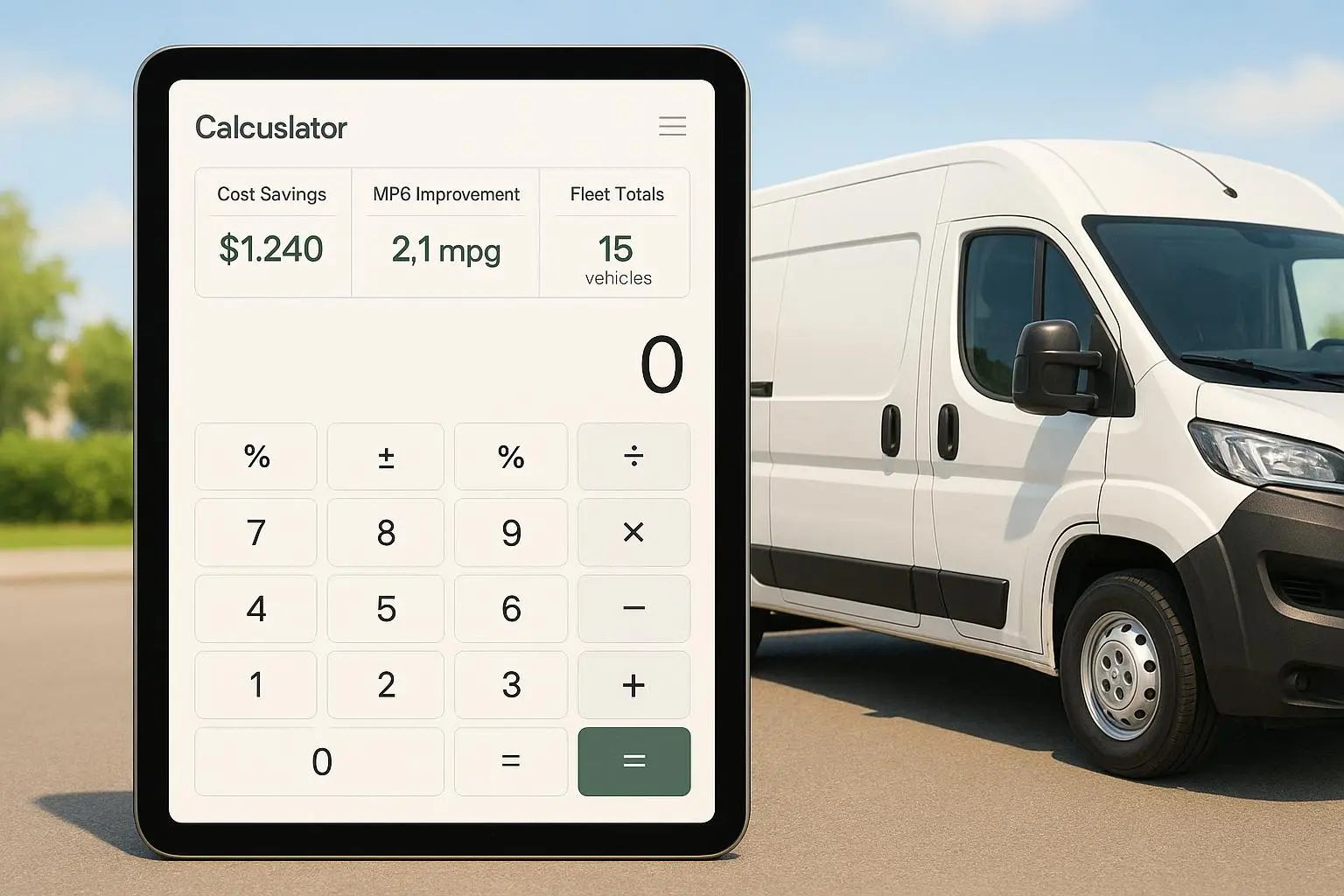
This post walks through three practical levers—tire PSI, route choices, and load management—and how a tiny, server-less fuel savings calculator helps you turn those levers into dollars saved. No jargon. No corporate-speak. Just what works for fleets of five to twenty vehicles.
Why a calculator beats guesswork
When someone says “we lost MPG last month,” what they usually mean is “we don’t know why.” A calculator forces you to translate vague feelings into cash: how many gallons, at what price, over how many miles.
Good calculators are offline, mobile-friendly, and require only a few inputs: vehicle count, baseline MPG, average mileage, and the change you expect (PSI improvement, route miles shifted, or percent of load optimized). Plug those in and you get an instant annualized ROI. That concrete number is what helps you get buy-in from drivers, owners, or customers.
And yes, the accuracy depends on your baseline data. But even a conservative estimate is better than no estimate.
The low-hanging fruit: tire pressure
Tire pressure is boring, visible, and incredibly effective. Underinflated tires increase rolling resistance. That means more engine work and less MPG.
Government testing shows that keeping tires properly inflated can improve fuel economy by up to about 3% in light vehicles; for heavy trucks, the impact can be similar or larger depending on loads and tire types [1]. Three percent doesn’t sound huge—until you run the numbers for a fleet.
Example: one truck averaging 8 MPG, burning 30,000 miles a year, at $4/gallon uses 3,750 gallons and spends $15,000 on fuel. A 3% improvement is 113 gallons and $452 saved on that truck alone. Multiply by five trucks and you’re talking $2,260 saved annually. That pays for a good set of tires or a basic digital gauge and then some.
A calculator takes your baseline MPG, the modeled MPG after correct PSI, mileage, and fuel price and shows you the exact annual savings. That visualization is how you turn a maintenance note into a budget line item.
Quick story: making PSI checks stick
I ran a small 7-truck local delivery fleet for three years. Drivers were busy, and tire checks were “whenever.” Fuel costs were drifting up, and no one could point to a cause.
I built a one-page calculator in a spreadsheet and ran the baseline numbers using the lowest two weeks of tank-to-tank MPG from each truck. Then I ran a scenario: weekly PSI checks that lifted average pressure by 5 PSI. The spreadsheet showed a combined annual saving of $3,400.
What changed was not the math—it was the proof. I posted the spreadsheet in the dispatch office and handed each driver a printout showing their truck’s personal savings. Monday morning checks became a habit because drivers could see their name next to a dollar amount. Within six months, the fleet’s average MPG improved by 0.9 MPG—real savings, not guesses.
That little behavioral nudge cost me a $60 digital gauge and one printed page. It paid back in eight weeks.
Micro-moment: I still remember one driver walking into my office, gripping the gauge like it was his new favorite tool. He said, “Now I know why you bug me.” That five-second exchange was worth a hundred memos.
Route optimization: not always the shortest road
GPS units show the shortest or fastest route, but neither is necessarily the most fuel-efficient. Hills, stop frequency, traffic congestion, and speed cadence are the things that actually eat diesel.
NREL’s work on routing shows dynamic routing that factors topography and traffic can yield fuel savings between 4% and 10% depending on terrain and stops [2]. That’s huge if you have hilly runs or heavy stop-start city routes.
A simple calculator helps you compare two routes side-by-side: baseline route miles and average speed profile versus an alternative route with fewer stops or gentler grades. It doesn’t need real-time traffic. Even conservative, average-speed inputs expose obvious wins.
Imagine swapping one daily run from a route with six steep grades and many signals to a slightly longer route with steady speed and fewer stops. The calculator might show you add five minutes but save $300 per month in fuel. That’s an operational decision, not a guess.
Load management: weight matters more than you think
Every extra pound reduces MPG. Rule of thumb from DOT studies: fuel economy drops roughly 1% for every additional 1,000 pounds of payload in many commercial scenarios [3]. For high-mileage vehicles, that adds up.
Two common problems show up in small fleets:
- Partial loads because of scheduling pressure (you run at 60-75% capacity rather than waiting a day for a full run).
- Poorly balanced backhauls that leave trucks heavy one direction and empty the other.
A calculator models these trade-offs. You can compare the fuel cost of running a 75% load now versus waiting a day to run full. You can model consolidating two half-loads into one full run and seeing the annual savings.
One operator I worked with used the calculator to renegotiate return-trip rates with a broker: the math showed that accepting a small fee to pick up a backhaul at 90% capacity saved enough fuel to justify lowering their empty-run rate. Negotiation backed by numbers beats instinct every time.
Why offline, server-less tools win for small fleets
Big fleets can afford telematics, sensors, and analysts. Small fleets can’t. Here’s why a local, no-cloud calculator is a better starting point:
- No subscription overhead. One-time cost or free.
- No hardware installers, no OBD dongles, no monthly data bills.
- Faster decisions. You get ROI in minutes, not weeks.
- Privacy. You don’t have to stream location data to a vendor.
- Focused outputs. It answers one question: will this change pay off?
That doesn’t mean telematics are useless. It means start small. Use a calculator to pick the top one or two investments, validate them, and then, if the ROI is large, consider more expensive tools.
How to use the calculator (the simple way)
Open the tool. Enter:
- Number of vehicles
- Baseline MPG per vehicle (use the worst recorded MPG for conservative estimates)
- Average annual mileage per vehicle
- Fuel price ($/gallon)
- The expected change (PSI improvement, route miles shifted, or percent load optimization)
Hit calculate and read the results: gallons saved, dollars saved, and payback period on any investment (tires, gauges, training).
A quick rule: always run a conservative and an aggressive scenario. The conservative scenario uses the lowest real MPG, conservative fuel price, and modest MPG uplift. The aggressive uses average MPG and optimistic uplift. If both show a positive payback within reasonable time, you’ve got a winner.
Common mistakes to avoid
Don’t use optimistic baselines. If your truck sometimes does 8 MPG and sometimes 6.5, use 6.5. People inflate baselines because they want projects to look good. That backfires when projects underperform.
Don’t treat the calculator as a crystal ball. It’s a decision amplifier. Use it to prioritize actions, not to guarantee outcomes.
Don’t forget implementation costs: training, spare parts, slight driver time increases. The calculator should include one-time investments so your payback calculation is honest.
Implementation checklist that actually gets used
You don’t need a policy manual the size of a filing cabinet. Do this:
- Pick one lever (PSI, route, or load) and one measurable change.
- Use historical low-MPG data to set a baseline.
- Run conservative and aggressive calculator scenarios.
- Implement for two weeks, measure MPG tank-to-tank, and compare to baseline.
- If the numbers match or beat conservative scenario, scale across the fleet.
- Repeat quarterly.
The two-week trial is key. It’s small enough to be low-risk and long enough to remove daily noise.
When to graduate to telematics
If your calculator-backed projects save more than the cost of a telematics pilot in 6–12 months, consider a pilot. Telematics should be used to get granular: driver behavior, idle time, and real-time routing.
But don’t buy telematics to find the one low-cost improvement you can already see with a calculator. Use simple tools to build the case first.
Final thought: numbers change behavior
Numbers have a way of changing minds. A driver will roll their eyes at “fuel efficiency training,” but put a $ amount next to their name and they pay attention. A dispatcher will tolerate a longer route for a customer if you can show the fleet-wide fuel savings. Small fleets win by making decisions, measuring outcomes, and repeating what works.
Start with a simple fuel savings calculator. Use real, conservative data. Make small changes, measure fast, and scale what proves out. I’ve seen a $60 gauge and a printed spreadsheet change a fleet’s culture. That’s the power of turning MPG into dollars.
References
Footnotes
-
U.S. Department of Energy. (2023). Fuel Economy Tips: Tires. Retrieved from https://www.fueleconomy.gov/feg/maintenance.shtml ↩
-
National Renewable Energy Laboratory. (2021). Impact of Routing Strategies on Commercial Vehicle Fuel Consumption. Retrieved from https://www.nrel.gov/docs/fy21osti/79871.pdf ↩
-
U.S. DOT FMCSA. (2022). Driver Safety and Vehicle Maintenance. Retrieved from https://www.fmcsa.dot.gov/safety/driver-safety/vehicle-maintenance ↩